[{"id":"para_1","index":0,"start":0,"offset":368,"words":9,"paraNum":"","lastModified":1601628725000,"semanticType":"title-book-title","voicework":"no_audio","blockId":"deliverance_from_error_islam_ocean_en-bl2s","language":"en","wordsRange":{"start":100000000,"end":110000000},"paragraphVersion":56,"direction":"ltr","paragraph":"<h1 class=\"ilm-title\" id=\"para_1\" semantictype=\"title-book-title\" data-ilmid=\"deliverance_from_error_islam_ocean_en-bl2s\" data-chapter=\"para_1\" data-words-count=\"9\" data-before=\"0\" data-ww=\"\"><span class=\"block-pb\"> <span class=\"block-pb is-animated\"></span> </span><span class=\"itm-wrap\">Abu Hamid al-Ghazali: Munkidh min al-Dalal (Deliverance from Error)</span></h1>","hasContent":true,"isFirst":true,"isLast":false},{"id":"para_2","index":1,"start":368,"offset":165,"words":0,"paraNum":"","lastModified":1600144131000,"semanticType":"line","blockId":"deliverance_from_error_islam_ocean_en-bl8p","language":"en","wordsRange":{"start":210000000,"end":310000000},"paragraphVersion":44,"direction":"ltr","paragraph":"<hr class=\"ilm-hr ilm-small\" id=\"para_2\" semantictype=\"line\" data-ilmid=\"deliverance_from_error_islam_ocean_en-bl8p\" data-words-count=\"0\" data-before=\"9\" data-ww=\"\">","hasContent":true,"isFirst":false,"isLast":false},{"id":"para_3","index":2,"start":533,"offset":326,"words":1,"paraNum":"","lastModified":1600142846000,"semanticType":"header-chapter-header","voicework":"no_audio","blockId":"deliverance_from_error_islam_ocean_en-bl2w","language":"en","wordsRange":{"start":410000000,"end":412000000},"paragraphVersion":56,"direction":"ltr","paragraph":"<h2 class=\"ilm-header ilm-h2\" id=\"para_3\" semantictype=\"header-chapter-header\" data-ilmid=\"deliverance_from_error_islam_ocean_en-bl2w\" data-chapter=\"para_3\" data-words-count=\"1\" data-before=\"9\" data-ww=\"\"><span class=\"block-pb\"> <span class=\"block-pb is-animated\"></span> </span><span class=\"itm-wrap\">Introduction</span></h2>","hasContent":true,"isFirst":false,"isLast":false},{"id":"para_4","index":3,"start":859,"offset":2519,"words":172,"paraNum":"I.1","lastModified":1601473751000,"semanticType":"par","voicework":"no_audio","blockId":"deliverance_from_error_islam_ocean_en-bl2x","language":"en","wordsRange":{"start":512000000,"end":685000000},"paragraphVersion":67,"direction":"ltr","paragraph":"<p id=\"para_4\" semantictype=\"par\" data-ilmid=\"deliverance_from_error_islam_ocean_en-bl2x\" data-words-count=\"172\" data-before=\"10\" data-ww=\"\"><span class=\"block-num\" data-id=\"I.1\"></span><span class=\"block-pb\"> <span class=\"block-pb is-animated\"></span> </span><span class=\"itm-wrap\"><i>Abu </i><i>Hamid </i><i>Ibn </i><i>Muhammad </i><i>Ibn </i><i>Muhammad </i><i>al-Tusi </i><i>al-Shafi’i </i><b>al-Ghazali </b>(<i>Ghazali </i><i>in </i><i>Persian, </i><i>Al-Ghazali </i><i>in </i><i>Arabic) </i><i>was </i><i>born </i><i>in </i><i>450/41 </i><i>AH/1058 </i><i>A.</i><i>D. </i><i>in </i><i>Tus </i><i>in </i><i>Khorasan, (</i><i>a </i><i>region </i><i>of </i><i>Iran). </i><i>His </i><i>father </i><i>died </i><i>while </i><i>he </i><i>was </i><i>still </i><i>very </i><i>young </i><i>but </i><i>he </i><i>had </i><i>the </i><i>opportunity </i><i>of </i><i>getting </i><i>education </i><i>in </i><i>the </i><i>prevalent </i><i>curriculum </i><i>at </i><i>Nishapur </i><i>and </i><i>Baghdad. </i><i>Soon </i><i>he </i><i>acquired </i><i>a </i><i>high </i><i>standard </i><i>of </i><i>scholarship </i><i>in </i><i>religion </i><i>and </i><i>philosophy </i><i>and </i><i>was </i><i>honoured </i><i>by </i><i>his </i><i>appointment </i><i>as </i><i>a </i><i>Professor </i><i>at </i><i>the </i><i>Nizamiyah </i><i>University </i><i>of </i><i>Baghdad, </i><i>which </i><i>was </i><i>recognised </i><i>as </i><i>one </i><i>of </i><i>the </i><i>most </i><i>reputed </i><i>institutions </i><i>of </i><i>learning </i><i>in </i><i>the </i><i>golden </i><i>era </i><i>of </i><i>Muslim </i><i>history. </i><i>After </i><i>a </i><i>few </i><i>years, </i><i>however, </i><i>he </i><i>gave </i><i>up </i><i>his </i><i>academic </i><i>pursuits </i><i>and </i><i>worldly </i><i>interests </i><i>and </i><i>became </i><i>a </i><i>wandering </i><i>ascetic. </i><i>This </i><i>was </i><i>a </i><i>process </i><i>(period) </i><i>of </i><i>personal </i><i>mystical </i><i>transformation. </i><i>Later, </i><i>he </i><i>resumed </i><i>his </i><i>teaching </i><i>duties, </i><i>but </i><i>again </i><i>left </i><i>these. </i><i>An </i><i>era </i><i>of </i><i>solitary </i><i>life, </i><i>devoted </i><i>to </i><i>contemplation </i><i>and </i><i>writing </i><i>then </i><i>ensued, </i><i>which </i><i>led </i><i>to </i><i>the </i><i>author-ship </i><i>of </i><i>a </i><i>number </i><i>of </i><i>everlasting </i><i>books. </i><i>He </i><i>died </i><i>in </i><i>505 </i><i>AH/11 </i><i>11 </i><i>A.</i><i>D. </i><i>at </i><i>Tus.</i></span></p>","hasContent":true,"isFirst":false,"isLast":false},{"id":"para_5","index":4,"start":3378,"offset":1429,"words":81,"paraNum":"I.2","lastModified":1600142923000,"semanticType":"par","voicework":"no_audio","blockId":"deliverance_from_error_islam_ocean_en-bl2y","language":"en","wordsRange":{"start":785000000,"end":867000000},"paragraphVersion":55,"direction":"ltr","paragraph":"<p id=\"para_5\" semantictype=\"par\" data-ilmid=\"deliverance_from_error_islam_ocean_en-bl2y\" data-words-count=\"81\" data-before=\"182\" data-ww=\"\"><span class=\"block-num\" data-id=\"I.2\"></span><span class=\"block-pb\"> <span class=\"block-pb is-animated\"></span> </span><span class=\"itm-wrap\"><i>Al-Ghazali’s </i><i>major </i><i>contribution </i><i>lies </i><i>in </i><i>religion, </i><i>philosophy </i><i>and </i><i>Sufism. </i><i>A </i><i>number </i><i>of </i><i>Muslim </i><i>philosophers </i><i>had </i><i>been </i><i>following </i><i>and </i><i>developing </i><i>several </i><i>viewpoints </i><i>of </i><i>Greek </i><i>philosophy, </i><i>including </i><i>the </i><i>Neoplatonic </i><i>philosophy, </i><i>and </i><i>had </i><i>lead </i><i>to </i><i>conflict </i><i>with </i><i>several </i><i>Islamic </i><i>teachings. </i><i>On </i><i>the </i><i>other </i><i>hand, </i><i>the </i><i>movement </i><i>of </i><i>sufism </i><i>was </i><i>assuming </i><i>such </i><i>excessive </i><i>proportions </i><i>as </i><i>to </i><i>avoid </i><i>observance </i><i>of </i><i>obligatory </i><i>prayers </i><i>and </i><i>duties </i><i>of </i><i>Islam. </i><i>Based </i><i>on </i><i>his </i><i>unquestionable </i><i>scholarship </i><i>and </i><i>personal </i><i>mystical </i><i>experience, </i><i>Ghazali </i><i>sought </i><i>to </i><i>rectify </i><i>these </i><i>trends, </i><i>both </i><i>in </i><i>philosophy </i><i>and </i><i>sufism.</i></span></p>","hasContent":true,"isFirst":false,"isLast":false},{"id":"para_6","index":5,"start":4807,"offset":1950,"words":123,"paraNum":"I.3","lastModified":1600143166000,"semanticType":"par","voicework":"no_audio","blockId":"deliverance_from_error_islam_ocean_en-bl2z","language":"en","wordsRange":{"start":967000000,"end":1091000000},"paragraphVersion":58,"direction":"ltr","paragraph":"<p id=\"para_6\" semantictype=\"par\" data-ilmid=\"deliverance_from_error_islam_ocean_en-bl2z\" data-words-count=\"123\" data-before=\"263\" data-ww=\"\"><span class=\"block-num\" data-id=\"I.3\"></span><span class=\"block-pb\"> <span class=\"block-pb is-animated\"></span> </span><span class=\"itm-wrap\"><i>In </i><i>philosophy, </i><i>Ghazali </i><i>upheld </i><i>the </i><i>approach </i><i>of </i><i>mathematics </i><i>and </i><i>exact </i><i>sciences </i><i>as </i><i>essentially </i><i>correct. </i><i>However, </i><i>he </i><i>adopted </i><i>the </i><i>techniques </i><i>of </i><i>Aristotelian </i><i>logic </i><i>and </i><i>the </i><i>Neoplatonic </i><i>procedures </i><i>and </i><i>employed </i><i>these </i><i>very </i><i>tools </i><i>to </i><i>lay </i><i>bare </i><i>the </i><i>flaws </i><i>and </i><i>lacunas </i><i>of </i><i>the </i><i>then </i><i>prevalent </i><i>Neoplatonic </i><i>philosophy </i><i>and </i><i>to </i><i>diminish </i><i>the </i><i>negative </i><i>influences </i><i>of </i><i>Aristotelianism </i><i>and </i><i>excessive </i><i>rationalism. </i><i>In </i><i>contrast </i><i>to </i><i>some </i><i>of </i><i>the </i><i>Muslim </i><i>philosophers, </i><i>e.</i><i>g., </i><i>al-Farabi, </i><i>he </i><i>portrayed </i><i>the </i><i>inability </i><i>of </i><i>reason </i><i>to </i><i>comprehend </i><i>the </i><i>absolute </i><i>and </i><i>the </i><i>infinite. </i><i>Reason </i><i>could </i><i>not </i><i>transcend </i><i>the </i><i>finite </i><i>and </i><i>was </i><i>limited </i><i>to </i><i>the </i><i>observation </i><i>of </i><i>the </i><i>relative. </i><i>Also, </i><i>several </i><i>Muslim </i><i>philosophers </i><i>had </i><i>held </i><i>that </i><i>the </i><i>universe </i><i>was </i><i>finite </i><i>in </i><i>space </i><i>but </i><i>infinite </i><i>in </i><i>time. </i><i>Ghazali </i><i>argued </i><i>that </i><i>an </i><i>infinite </i><i>time </i><i>was </i><i>related </i><i>to </i><i>an </i><i>infinite </i><i>space.</i></span></p>","hasContent":true,"isFirst":false,"isLast":false},{"id":"para_7","index":6,"start":6757,"offset":867,"words":43,"paraNum":"I.4","lastModified":1600143192000,"semanticType":"par","voicework":"no_audio","blockId":"deliverance_from_error_islam_ocean_en-bl31","language":"en","wordsRange":{"start":1191000000,"end":1235000000},"paragraphVersion":58,"direction":"ltr","paragraph":"<p id=\"para_7\" semantictype=\"par\" data-ilmid=\"deliverance_from_error_islam_ocean_en-bl31\" data-words-count=\"43\" data-before=\"386\" data-ww=\"\"><span class=\"block-num\" data-id=\"I.4\"></span><span class=\"block-pb\"> <span class=\"block-pb is-animated\"></span> </span><span class=\"itm-wrap\"><i>In </i><i>religion, </i><i>particularly </i><i>mysticism, </i><i>he </i><i>cleansed </i><i>the </i><i>approach </i><i>of </i><i>sufism </i><i>of </i><i>its </i><i>excesses </i><i>and </i><i>reestablished </i><i>the </i><i>authority </i><i>of </i><i>the </i><i>orthodox </i><i>(i.</i><i>e. </i><i>Sunni) </i><i>religion. </i><i>Yet, </i><i>he </i><i>stressed </i><i>the </i><i>importance </i><i>of </i><i>genuine </i><i>sufism, </i><i>which </i><i>he </i><i>maintained </i><i>was </i><i>the </i><i>path </i><i>to </i><i>attain </i><i>the </i><i>absolute </i><i>truth.</i></span></p>","hasContent":true,"isFirst":false,"isLast":false},{"id":"para_8","index":7,"start":7624,"offset":1189,"words":71,"paraNum":"I.5","lastModified":1601456299000,"semanticType":"par","voicework":"no_audio","blockId":"deliverance_from_error_islam_ocean_en-bl32","language":"en","wordsRange":{"start":1335000000,"end":1404000000},"paragraphVersion":65,"direction":"ltr","paragraph":"<p id=\"para_8\" semantictype=\"par\" data-ilmid=\"deliverance_from_error_islam_ocean_en-bl32\" data-words-count=\"71\" data-before=\"429\" data-ww=\"\"><span class=\"block-num\" data-id=\"I.5\"></span><span class=\"block-pb\"> <span class=\"block-pb is-animated\"></span> </span><span class=\"itm-wrap\"><i>He </i><i>was </i><i>a </i><i>prolific </i><i>writer. </i><i>His </i><i>books </i><i>include </i>Tahafut al-Falasifa<i> </i><i>(The </i><i>Incoherence </i><i>of </i><i>the </i><i>Philosophers), </i>Ihya al-'Ulum al-Islamia<i> </i><i>(The </i><i>Revival </i><i>of </i><i>the </i><i>Religious </i><i>Sciences), </i><i>\"The </i><i>Beginning </i><i>of </i><i>Guidance </i><i>and </i><i>his </i><i>Autobiography\", </i><i>\"Deliverance </i><i>from </i><i>Error\". </i><i>Some </i><i>of </i><i>his </i><i>works </i><i>were </i><i>translated </i><i>into </i><i>Latin </i><i>in </i><i>the </i><i>Middle </i><i>Ages, </i><i>where </i><i>he </i><i>was </i><i>known </i><i>as </i><i>Algazel </i><i>and </i><i>via </i><i>the </i><i>translation </i><i>of </i><i>a </i><i>truncated </i><i>work, </i><i>the </i>Maqasid al-Falasifa<i> </i><i>[The </i><i>Intentions </i><i>of </i><i>the </i><i>Philosophers.]</i></span></p>","hasContent":true,"isFirst":false,"isLast":false},{"id":"para_9","index":8,"start":8813,"offset":1002,"words":52,"paraNum":"I.6","lastModified":1600143662000,"semanticType":"par","voicework":"no_audio","blockId":"deliverance_from_error_islam_ocean_en-bl33","language":"en","wordsRange":{"start":1504000000,"end":1557000000},"paragraphVersion":59,"direction":"ltr","paragraph":"<p id=\"para_9\" semantictype=\"par\" data-ilmid=\"deliverance_from_error_islam_ocean_en-bl33\" data-words-count=\"52\" data-before=\"500\" data-ww=\"\"><span class=\"block-num\" data-id=\"I.6\"></span><span class=\"block-pb\"> <span class=\"block-pb is-animated\"></span> </span><span class=\"itm-wrap\"><i>Al-Ghazali's </i><i>influence </i><i>was </i><i>deep </i><i>and </i><i>everlasting. </i><i>He </i><i>is </i><i>one </i><i>of </i><i>the </i><i>greatest </i><i>theologians </i><i>of </i><i>Islam </i><i>and </i><i>his </i><i>influence </i><i>penetrated </i><i>Europe, </i><i>influenced </i><i>Jewish </i><i>and </i><i>Christian </i><i>Scholasticism, </i><i>and </i><i>several </i><i>of </i><i>his </i><i>arguments </i><i>seem </i><i>to </i><i>have </i><i>been </i><i>adopted </i><i>by </i><i>Thomas </i><i>Aquinas </i><i>in </i><i>order </i><i>to </i><i>similarly </i><i>reestablish </i><i>the </i><i>authority </i><i>of </i><i>orthodox </i><i>Christian </i><i>religion </i><i>in </i><i>the </i><i>West.</i></span></p>","hasContent":true,"isFirst":false,"isLast":false},{"id":"para_10","index":9,"start":9815,"offset":344,"words":4,"paraNum":"","lastModified":1601628949000,"semanticType":"header-chapter-header","voicework":"no_audio","blockId":"deliverance_from_error_islam_ocean_en-bl34","language":"en","wordsRange":{"start":1657000000,"end":1662000000},"paragraphVersion":93,"direction":"ltr","paragraph":"<h2 class=\"ilm-header ilm-h2\" id=\"para_10\" semantictype=\"header-chapter-header\" data-ilmid=\"deliverance_from_error_islam_ocean_en-bl34\" data-chapter=\"para_10\" data-words-count=\"4\" data-before=\"552\" data-ww=\"\"><span class=\"block-pb\"> <span class=\"block-pb is-animated\"></span> </span><span class=\"itm-wrap\">The Deliverance from Error</span></h2>","hasContent":true,"isFirst":false,"isLast":false},{"id":"para_11","index":10,"start":10159,"offset":618,"words":32,"paraNum":"","lastModified":1600144425000,"semanticType":"par","voicework":"no_audio","blockId":"deliverance_from_error_islam_ocean_en-bl35","language":"en","wordsRange":{"start":1762000000,"end":1795000000},"paragraphVersion":65,"direction":"ltr","paragraph":"<p id=\"para_11\" semantictype=\"par\" data-ilmid=\"deliverance_from_error_islam_ocean_en-bl35\" data-words-count=\"32\" data-before=\"556\" data-ww=\"\"><span class=\"block-pb\"> <span class=\"block-pb is-animated\"></span> </span><span class=\"itm-wrap\"><i>The</i> Munkidh min al-Dalal (<i>Deliverance </i><i>from </i><i>Error), </i><i>is </i><i>a </i><i>sort </i><i>of </i><i>intellectual </i><i>autobiography. </i><i>A </i><i>more </i><i>modern </i><i>translation </i><i>can </i><i>be </i><i>found </i><i>in </i><i>W. </i><i>Montgomery </i><i>Watt, </i>The Faith and Practice of Al-Ghazali, (<i>London: </i><i>1951).</i></span></p>","hasContent":true,"isFirst":false,"isLast":false},{"id":"para_12","index":11,"start":10777,"offset":491,"words":19,"paraNum":"","lastModified":1600144427000,"semanticType":"par","voicework":"no_audio","blockId":"deliverance_from_error_islam_ocean_en-bl36","language":"en","wordsRange":{"start":1895000000,"end":1915000000},"paragraphVersion":69,"direction":"ltr","paragraph":"<p id=\"para_12\" semantictype=\"par\" data-ilmid=\"deliverance_from_error_islam_ocean_en-bl36\" data-words-count=\"19\" data-before=\"588\" data-ww=\"\"><span class=\"block-pb\"> <span class=\"block-pb is-animated\"></span> </span><span class=\"itm-wrap\"><i>The </i><i>following, </i><i>an </i><i>excerpt </i><i>from </i><i>the</i> Encyclopedia of Philosophy (<i>New </i><i>York: </i><i>Macmillan, </i><i>1967), </i><i>explains </i><i>the </i><i>significance </i><i>of </i><i>the </i><i>work:</i></span></p>","hasContent":true,"isFirst":false,"isLast":false},{"id":"para_13","index":12,"start":11268,"offset":3152,"words":213,"paraNum":"","lastModified":1749716899000,"semanticType":"par","voicework":"no_audio","blockId":"deliverance_from_error_islam_ocean_en-bl37","language":"en","wordsRange":{"start":2015000000,"end":2229000000},"paragraphVersion":109,"direction":"ltr","paragraph":"<p class=\"ilm-blockquote ilm-small\" id=\"para_13\" semantictype=\"par\" data-ilmid=\"deliverance_from_error_islam_ocean_en-bl37\" data-words-count=\"213\" data-before=\"607\" data-ww=\"\"><span class=\"block-pb\"> <span class=\"block-pb is-animated\"></span> </span><span class=\"itm-wrap\"><i>At </i><i>the </i><i>age </i><i>of </i><i>36, </i><i>Ghazali </i><i>experienced </i><i>a </i><i>profound </i><i>crisis, </i><i>provoked </i><i>by </i><i>the </i><i>problem </i><i>of </i><i>intellectual </i><i>certitude. </i><i>He </i><i>abandoned </i><i>his </i><i>professorship </i><i>and </i><i>his </i><i>position </i><i>as </i><i>rector </i><i>of </i><i>Nizamiya </i><i>University </i><i>of </i><i>Baghdad. </i><i>During </i><i>a </i><i>period </i><i>of </i><i>ten </i><i>years, </i><i>clothed </i><i>in </i><i>the </i><i>characteristic </i><i>wool </i><i>garment </i><i>of </i><i>the </i><i>Sufis </i><i>and </i><i>completely </i><i>absorbed </i><i>in </i><i>spiritual </i><i>practices, </i><i>he </i><i>made </i><i>solitary </i><i>pilgrimages </i><i>throughout </i><i>the </i><i>Muslim </i><i>world, </i><i>to </i><i>Syria, </i><i>Egypt, </i><i>Mecca, </i><i>and </i><i>Medina. </i><i>What </i><i>he </i><i>conveyed </i><i>in </i><i>his </i><i>doctrines </i><i>cannot </i><i>be </i><i>separated </i><i>from </i><i>this </i><i>pathetic </i><i>experience. </i><i>He </i><i>solved </i><i>the </i><i>problem </i><i>of </i><i>knowledge </i><i>and </i><i>certitude </i><i>by </i><i>affirming </i><i>a </i><i>degree </i><i>of </i><i>comprehension </i><i>that </i><i>left </i><i>the </i><i>heart </i><i>no </i><i>room </i><i>for </i><i>doubt, </i><i>a </i><i>comprehension </i><i>that </i><i>is </i><i>the </i><i>essential </i><i>apprehension </i><i>of </i><i>things. </i><i>The </i><i>thinking </i><i>soul </i><i>becomes </i><i>the </i><i>focus </i><i>of </i><i>the </i><i>universal </i><i>Soul's </i><i>irradiations, </i><i>the </i><i>mirror </i><i>of </i><i>intelligible </i><i>forms </i><i>received </i><i>from </i><i>the </i><i>universal </i><i>Soul. </i><i>This </i><i>theme </i><i>dominates </i><i>certain </i><i>characteristic </i><i>short </i><i>treatises </i><i>(the </i><i>Monqidh </i><i>or </i><i>\"Preservative </i><i>From </i><i>Error,</i><i>\" [this </i><i>text], </i><i>the </i><i>Risalat </i><i>alLadoniya, </i><i>etc.) </i><i>as </i><i>well </i><i>as </i><i>the </i><i>great </i><i>synthesis </i><i>entitled </i><i>Ilya </i><i>Ulum </i><i>ad-Din </i><i>(\"Revival </i><i>of </i><i>the </i><i>Religious </i><i>Sciences\"). </i><i>But </i><i>this </i><i>theme </i><i>had </i><i>already </i><i>been </i><i>treated, </i><i>undoubtedly </i><i>without </i><i>his </i><i>knowledge, </i><i>by </i><i>the </i><i>Imams </i><i>of </i><i>Shi'ism, </i><i>and </i><i>it </i><i>does </i><i>not </i><i>differ </i><i>essentially </i><i>from </i><i>the </i><i>Ishraq </i><i>of </i><i>Sohrawardi. </i><i>This </i><i>very </i><i>theme </i><i>led </i><i>Sohrawardi </i><i>to </i><i>advance </i><i>philosophy </i><i>on </i><i>a </i><i>new </i><i>basis </i><i>rather </i><i>than </i><i>destroy </i><i>the </i><i>efforts </i><i>of </i><i>philosophers </i><i>as </i><i>such.</i></span></p>","hasContent":true,"isFirst":false,"isLast":false},{"id":"para_14","index":13,"start":14420,"offset":3110,"words":212,"paraNum":"","lastModified":1601462343000,"semanticType":"par","voicework":"no_audio","blockId":"deliverance_from_error_islam_ocean_en-bl38","language":"en","wordsRange":{"start":2329000000,"end":2540000000},"paragraphVersion":89,"direction":"ltr","paragraph":"<p class=\"ilm-small ilm-blockquote\" id=\"para_14\" semantictype=\"par\" data-ilmid=\"deliverance_from_error_islam_ocean_en-bl38\" data-words-count=\"212\" data-before=\"820\" data-ww=\"\"><span class=\"block-pb\"> <span class=\"block-pb is-animated\"></span> </span><span class=\"itm-wrap\"><i>It </i><i>is </i><i>principally </i><i>this </i><i>aspect </i><i>of </i><i>Ghazali's </i><i>work, </i><i>developed </i><i>in </i><i>his </i>Tahafut al-Falasifa<i> </i><i>(\"Autodestruction </i><i>of </i><i>the </i><i>Philosophers\") </i><i>that </i><i>Westerners </i><i>have </i><i>been </i><i>inclined </i><i>to </i><i>emphasize. </i><i>An </i><i>attempt </i><i>has </i><i>even </i><i>been </i><i>made </i><i>to </i><i>read </i><i>into </i><i>it </i><i>a </i><i>more </i><i>incisive </i><i>and </i><i>decisive </i><i>critique </i><i>or </i><i>metaphysics </i><i>than </i><i>that </i><i>of </i><i>Kant. </i><i>In </i><i>fact, </i><i>Ghazali </i><i>strove </i><i>vehemently </i><i>to </i><i>destroy </i><i>the </i><i>demonstrative </i><i>range </i><i>that </i><i>philosophers, </i><i>Avicennians </i><i>as </i><i>well </i><i>as </i><i>others, </i><i>accorded </i><i>to </i><i>their </i><i>arguments </i><i>regarding </i><i>the </i><i>eternity </i><i>of </i><i>the </i><i>world, </i><i>the </i><i>procession </i><i>of </i><i>the </i><i>Intelligences, </i><i>the </i><i>existence </i><i>of </i><i>purely </i><i>spiritual </i><i>substances, </i><i>and </i><i>the </i><i>idea </i><i>of </i><i>spiritual </i><i>resurrection. </i><i>In </i><i>general </i><i>Ghazali </i><i>strove </i><i>to </i><i>refute </i><i>the </i><i>idea </i><i>of </i><i>any </i><i>causality, </i><i>of </i><i>any </i><i>necessary </i><i>connection. </i><i>According </i><i>to </i><i>him </i><i>all </i><i>that </i><i>can </i><i>be </i><i>experimentally </i><i>affirmed </i><i>is, </i><i>for </i><i>example, </i><i>that </i><i>combustion </i><i>of </i><i>cotton </i><i>occurs </i><i>at </i><i>the </i><i>moment </i><i>of </i><i>contact </i><i>with </i><i>fire; </i><i>it </i><i>cannot </i><i>be </i><i>shown </i><i>that </i><i>combustion </i><i>takes </i><i>place </i><i>because </i><i>of </i><i>the </i><i>contact </i><i>between </i><i>cotton </i><i>and </i><i>fire. </i><i>Nor </i><i>can </i><i>it </i><i>be </i><i>shown </i><i>that </i><i>there </i><i>is </i><i>any </i><i>cause </i><i>whatsoever. </i><i>From </i><i>this </i><i>bursts </i><i>forth </i><i>the </i><i>paradox </i><i>of </i><i>a </i><i>thinker </i><i>who </i><i>professes </i><i>the </i><i>inability </i><i>of </i><i>reason </i><i>to </i><i>attain </i><i>certitude </i><i>while </i><i>maintaining </i><i>the </i><i>certitude </i><i>of </i><i>destroying, </i><i>with </i><i>massive </i><i>doses </i><i>of </i><i>rational </i><i>dialectic, </i><i>the </i><i>certitudes </i><i>of </i><i>the </i><i>philosophers. </i><i>Averroe </i><i>s </i><i>clearly </i><i>discerned </i><i>this </i><i>self-contradiction </i><i>and </i><i>replied </i><i>to </i><i>it </i><i>with </i><i>his </i><i>celebrated </i>Tahafut al-Tahafut<i> </i><i>(\"Autodestruction </i><i>of </i><i>the </i><i>Autodestruction\").</i></span></p>","hasContent":true,"isFirst":false,"isLast":false},{"id":"para_15","index":14,"start":17530,"offset":169,"words":0,"paraNum":"","lastModified":1600144157000,"semanticType":"line","blockId":"deliverance_from_error_islam_ocean_en-bl8q","language":"en","wordsRange":{"start":2640000000,"end":2740000000},"paragraphVersion":41,"direction":"ltr","paragraph":"<hr class=\"ilm-hr ilm-small\" id=\"para_15\" semantictype=\"line\" data-ilmid=\"deliverance_from_error_islam_ocean_en-bl8q\" data-words-count=\"0\" data-before=\"1032\" data-ww=\"\">","hasContent":true,"isFirst":false,"isLast":false},{"id":"para_16","index":15,"start":17699,"offset":370,"words":4,"paraNum":"","lastModified":1600144472000,"semanticType":"header-chapter-header","voicework":"no_audio","blockId":"deliverance_from_error_islam_ocean_en-bl39","language":"en","wordsRange":{"start":2840000000,"end":2845000000},"paragraphVersion":83,"direction":"ltr","paragraph":"<h2 class=\"ilm-header ilm-h2\" id=\"para_16\" semantictype=\"header-chapter-header\" data-ilmid=\"deliverance_from_error_islam_ocean_en-bl39\" data-chapter=\"para_16\" data-words-count=\"4\" data-before=\"1032\" data-ww=\"\"><span class=\"block-pb\"> <span class=\"block-pb is-animated\"></span> </span><span class=\"itm-wrap\"><i>Quoth </i><i>the </i><i>Imam </i><i>Ghazali:</i></span></h2>","hasContent":true,"isFirst":false,"isLast":false},{"id":"para_17","index":16,"start":18069,"offset":510,"words":37,"paraNum":"1.1","lastModified":1600144469000,"semanticType":"par","voicework":"no_audio","blockId":"deliverance_from_error_islam_ocean_en-bl3a","language":"en","wordsRange":{"start":2945000000,"end":2983000000},"paragraphVersion":79,"direction":"ltr","paragraph":"<p id=\"para_17\" semantictype=\"par\" data-ilmid=\"deliverance_from_error_islam_ocean_en-bl3a\" data-words-count=\"37\" data-before=\"1036\" data-ww=\"\"><span class=\"block-num\" data-id=\"1.1\"></span><span class=\"block-pb\"> <span class=\"block-pb is-animated\"></span> </span><span class=\"itm-wrap\">Glory be to God, whose praise should precede every writing and every speech! May the blessings of God rest on Mohammed, his Prophet and his Apostle, on his family and companions, by whose guidance error is escaped!</span></p>","hasContent":true,"isFirst":false,"isLast":false},{"id":"para_18","index":17,"start":18579,"offset":1367,"words":187,"paraNum":"1.2","lastModified":1600144469000,"semanticType":"par","voicework":"no_audio","blockId":"deliverance_from_error_islam_ocean_en-bl3b","language":"en","wordsRange":{"start":3083000000,"end":3271000000},"paragraphVersion":79,"direction":"ltr","paragraph":"<p id=\"para_18\" semantictype=\"par\" data-ilmid=\"deliverance_from_error_islam_ocean_en-bl3b\" data-words-count=\"187\" data-before=\"1073\" data-ww=\"\"><span class=\"block-num\" data-id=\"1.2\"></span><span class=\"block-pb\"> <span class=\"block-pb is-animated\"></span> </span><span class=\"itm-wrap\">You have asked me, O brother in the faith, to expound the aim and the mysteries of religious sciences, the boundaries and depths of theological doctrines. You wish to know my experiences while disentangling truth lost in the medley of sects and divergencies of thought, and how I have dared to climb from the low levels of traditional belief to the topmost summit of assurance. You desire to learn what I have borrowed, first of all from scholastic theology; and secondly from the method of the Ta'limites, who, in seeking truth, rest upon the authority of a leader; and why, thirdly, I have been led to reject philosophic systems; and finally, what I have accepted of the doctrine of the Sufis, and the sum total of truth which I have gathered in studying every variety of opinion. You ask me why, after resigning at Baghdad a teaching post which attracted a number of hearers, I have, long afterward, accepted a similar one at Nishapur. Convinced as I am of the sincerity which prompts your inquiries, I proceed to answer them, invoking the help and protection of God.</span></p>","hasContent":true,"isFirst":false,"isLast":false},{"id":"para_19","index":18,"start":19946,"offset":933,"words":114,"paraNum":"1.3","lastModified":1600144469000,"semanticType":"par","voicework":"no_audio","blockId":"deliverance_from_error_islam_ocean_en-bl3c","language":"en","wordsRange":{"start":3371000000,"end":3486000000},"paragraphVersion":79,"direction":"ltr","paragraph":"<p id=\"para_19\" semantictype=\"par\" data-ilmid=\"deliverance_from_error_islam_ocean_en-bl3c\" data-words-count=\"114\" data-before=\"1260\" data-ww=\"\"><span class=\"block-num\" data-id=\"1.3\"></span><span class=\"block-pb\"> <span class=\"block-pb is-animated\"></span> </span><span class=\"itm-wrap\">Know then, my brothers (may God direct you in the right way), that the diversity in beliefs and religions, and the variety of doctrines and sects which divide men, are like a deep ocean strewn with shipwrecks, from which very few escape safe and sound. Each sect, it is true, believes itself in possession of the truth and of salvation, \"each party,\" as the Qur'an saith, \"rejoices in its own creed\"; but as the chief of the apostles, whose word is always truthful, has told us, \"My people will be divided into more than seventy sects, of whom only one will be saved.\" This prediction, like all others of the Prophet, must be fulfilled.</span></p>","hasContent":true,"isFirst":false,"isLast":false},{"id":"para_20","index":19,"start":20879,"offset":1103,"words":137,"paraNum":"1.4","lastModified":1600144469000,"semanticType":"par","voicework":"no_audio","blockId":"deliverance_from_error_islam_ocean_en-bl3d","language":"en","wordsRange":{"start":3586000000,"end":3724000000},"paragraphVersion":79,"direction":"ltr","paragraph":"<p id=\"para_20\" semantictype=\"par\" data-ilmid=\"deliverance_from_error_islam_ocean_en-bl3d\" data-words-count=\"137\" data-before=\"1374\" data-ww=\"\"><span class=\"block-num\" data-id=\"1.4\"></span><span class=\"block-pb\"> <span class=\"block-pb is-animated\"></span> </span><span class=\"itm-wrap\">From the period of adolescence, that is to say, previous to reaching my twentieth year to the present time when I have passed my fiftieth, I have ventured into this vast ocean; I have fearlessly sounded its depths, and like a resolute diver, I have penetrated its darkness and dared its dangers and abysses. I have interrogated the beliefs of each sect and scrutinized the mysteries of each doctrine, in order to disentangle truth from error and orthodoxy from heresy. I have never met one who maintained the hidden meaning of the Qur'an without investigating the nature of his belief. nor a partisan of its exterior sense without inquiring into the results of his doctrine. There is no philosopher whose system I have not fathomed, nor theologian the intricacies of whose doctrine I have not followed out.</span></p>","hasContent":true,"isFirst":false,"isLast":false},{"id":"para_21","index":20,"start":21982,"offset":773,"words":89,"paraNum":"1.5","lastModified":1600144469000,"semanticType":"par","voicework":"no_audio","blockId":"deliverance_from_error_islam_ocean_en-bl3e","language":"en","wordsRange":{"start":3824000000,"end":3914000000},"paragraphVersion":79,"direction":"ltr","paragraph":"<p id=\"para_21\" semantictype=\"par\" data-ilmid=\"deliverance_from_error_islam_ocean_en-bl3e\" data-words-count=\"89\" data-before=\"1511\" data-ww=\"\"><span class=\"block-num\" data-id=\"1.5\"></span><span class=\"block-pb\"> <span class=\"block-pb is-animated\"></span> </span><span class=\"itm-wrap\">Sufism has no secrets into which I have not penetrated; the devout adorer of Deity has revealed to me the aim of his austerities; the atheist has not been able to conceal from me the real reason of his unbelief. The thirst for knowledge was innate in me from an early age; it was like a second nature implanted by God, without any will on my part. No sooner had I emerged from boyhood than I had already broken the fetters of tradition and freed myself from hereditary beliefs.</span></p>","hasContent":true,"isFirst":false,"isLast":false},{"id":"para_22","index":21,"start":22755,"offset":850,"words":91,"paraNum":"1.6","lastModified":1600144469000,"semanticType":"par","voicework":"no_audio","blockId":"deliverance_from_error_islam_ocean_en-bl3f","language":"en","wordsRange":{"start":4014000000,"end":4106000000},"paragraphVersion":79,"direction":"ltr","paragraph":"<p id=\"para_22\" semantictype=\"par\" data-ilmid=\"deliverance_from_error_islam_ocean_en-bl3f\" data-words-count=\"91\" data-before=\"1600\" data-ww=\"\"><span class=\"block-num\" data-id=\"1.6\"></span><span class=\"block-pb\"> <span class=\"block-pb is-animated\"></span> </span><span class=\"itm-wrap\">Having noticed how easily the children of Christians become Christians, and the children of Muslims embrace Islam, and remembering also the traditional saying ascribed to the Prophet, \"Every child has in him the germ of Islam, then his parents make him Jew, Christian, or Zarathustrian,\" I was moved by a keen desire to learn what was this innate disposition in the child, the nature of the accidental beliefs imposed on him by the authority of his parents and his masters, and finally the unreasoned convictions which he derives from their instructions.</span></p>","hasContent":true,"isFirst":false,"isLast":false},{"id":"para_23","index":22,"start":23605,"offset":1608,"words":234,"paraNum":"1.7","lastModified":1600144635000,"semanticType":"par","voicework":"no_audio","blockId":"deliverance_from_error_islam_ocean_en-bl3g","language":"en","wordsRange":{"start":4206000000,"end":4441000000},"paragraphVersion":79,"direction":"ltr","paragraph":"<p id=\"para_23\" semantictype=\"par\" data-ilmid=\"deliverance_from_error_islam_ocean_en-bl3g\" data-words-count=\"234\" data-before=\"1691\" data-ww=\"\"><span class=\"block-num\" data-id=\"1.7\"></span><span class=\"block-pb\"> <span class=\"block-pb is-animated\"></span> </span><span class=\"itm-wrap\">Struck with the contradictions which I encountered in endeavoring to disentangle the truth and falsehood of these opinions, I was led to make the following reflection: \"The search after truth being the aim which I propose to myself, I ought in the first place to ascertain what are the bases of certitude.\" In the next place I recognized that certitude is the clear and complete knowledge of things, such knowledge as leaves no room for doubt nor possibility of error and conjecture, so that there remains no room in the mind for error to find an entrance. In such a case it is necessary that the mind, fortified against all possibility of going astray, should embrace such a strong conviction that, if, for example, any one possessing the power of changing a stone into gold, or a stick into a serpent, should seek to shake the bases of this certitude, it would remain firm and immovable. Suppose, for instance, a man should come and say to me, who am firmly convinced that ten is more than three, \"No; on the contrary, three is more than ten, and, to prove it, I change this rod into a serpent,\" and supposing that he actually did so, I should remain none the less convinced of the falsity of his assertion, and although his miracle might arouse my astonishment, it would not instill any doubt into my belief.</span></p>","hasContent":true,"isFirst":false,"isLast":false},{"id":"para_24","index":23,"start":25213,"offset":555,"words":43,"paraNum":"1.8","lastModified":1600145033000,"semanticType":"par","voicework":"no_audio","blockId":"deliverance_from_error_islam_ocean_en-bl3h","language":"en","wordsRange":{"start":4541000000,"end":4585000000},"paragraphVersion":80,"direction":"ltr","paragraph":"<p id=\"para_24\" semantictype=\"par\" data-ilmid=\"deliverance_from_error_islam_ocean_en-bl3h\" data-words-count=\"43\" data-before=\"1925\" data-ww=\"\"><span class=\"block-num\" data-id=\"1.8\"></span><span class=\"block-pb\"> <span class=\"block-pb is-animated\"></span> </span><span class=\"itm-wrap\">I then understood that all forms of knowledge which do not unite these conditions (imperviousness to doubt, etc.) do not deserve any confidence, because they are not beyond the reach of doubt, and what is not impregnable to doubt can not constitute certitude.</span></p>","hasContent":true,"isFirst":false,"isLast":false},{"id":"para_25","index":24,"start":25768,"offset":169,"words":0,"paraNum":"","lastModified":1600145051000,"semanticType":"line","blockId":"deliverance_from_error_islam_ocean_en-bl8o","language":"en","wordsRange":{"start":4685000000,"end":4785000000},"paragraphVersion":40,"direction":"ltr","paragraph":"<hr class=\"ilm-hr ilm-small\" id=\"para_25\" semantictype=\"line\" data-ilmid=\"deliverance_from_error_islam_ocean_en-bl8o\" data-words-count=\"0\" data-before=\"1968\" data-ww=\"\">","hasContent":true,"isFirst":false,"isLast":false},{"id":"para_26","index":25,"start":25937,"offset":385,"words":5,"paraNum":"","lastModified":1600145673000,"semanticType":"header-chapter-header","voicework":"no_audio","blockId":"deliverance_from_error_islam_ocean_en-bl3i","language":"en","wordsRange":{"start":4885000000,"end":4891000000},"paragraphVersion":98,"direction":"ltr","paragraph":"<h2 class=\"ilm-header ilm-h2\" id=\"para_26\" semantictype=\"header-chapter-header\" data-ilmid=\"deliverance_from_error_islam_ocean_en-bl3i\" data-chapter=\"para_26\" data-words-count=\"5\" data-before=\"1968\" data-ww=\"\"><span class=\"block-pb\"> <span class=\"block-pb is-animated\"></span> </span><span class=\"itm-wrap\"><i>The </i><i>Subterfuges </i><i>of </i><i>the </i><i>Sophists</i></span></h2>","hasContent":true,"isFirst":false,"isLast":false},{"id":"para_27","index":26,"start":26322,"offset":698,"words":65,"paraNum":"2.1","lastModified":1601462354000,"semanticType":"par","voicework":"no_audio","blockId":"deliverance_from_error_islam_ocean_en-bl3j","language":"en","wordsRange":{"start":4991000000,"end":5057000000},"paragraphVersion":92,"direction":"ltr","paragraph":"<p id=\"para_27\" semantictype=\"par\" data-ilmid=\"deliverance_from_error_islam_ocean_en-bl3j\" data-words-count=\"65\" data-before=\"1973\" data-ww=\"\"><span class=\"block-num\" data-id=\"2.1\"></span><span class=\"block-pb\"> <span class=\"block-pb is-animated\"></span> </span><span class=\"itm-wrap\">I then examined what knowledge I possessed, and discovered that in none of it, with the exception of sense-perceptions and necessary principles, did I enjoy that degree of certitude which I have just described. I then sadly reflected as follows: \"We can not hope to find truth except in matters which carry their evidence in themselves — that is to say, in sense-perceptions and necessary principles;</span></p>","hasContent":true,"isFirst":false,"isLast":false},{"id":"para_28","index":27,"start":27020,"offset":693,"words":64,"paraNum":"2.2","lastModified":1600145135000,"semanticType":"par","voicework":"no_audio","blockId":"deliverance_from_error_islam_ocean_en-bl3k","language":"en","wordsRange":{"start":5157000000,"end":5222000000},"paragraphVersion":85,"direction":"ltr","paragraph":"<p id=\"para_28\" semantictype=\"par\" data-ilmid=\"deliverance_from_error_islam_ocean_en-bl3k\" data-words-count=\"64\" data-before=\"2038\" data-ww=\"\"><span class=\"block-num\" data-id=\"2.2\"></span><span class=\"block-pb\"> <span class=\"block-pb is-animated\"></span> </span><span class=\"itm-wrap\">we must therefore establish these on a firm basis. Is my absolute confidence in sense-perceptions and on the infallibility of necessary principles analogous to the confidence which I formerly possessed in matters believed on the authority of others? Is it only analogous to the reliance most people place on their organs of vision, or is it rigorously true without admixture of illusion or doubt?\"</span></p>","hasContent":true,"isFirst":false,"isLast":false},{"id":"para_29","index":28,"start":27713,"offset":869,"words":96,"paraNum":"2.3","lastModified":1600145152000,"semanticType":"par","voicework":"no_audio","blockId":"deliverance_from_error_islam_ocean_en-bl3l","language":"en","wordsRange":{"start":5322000000,"end":5419000000},"paragraphVersion":85,"direction":"ltr","paragraph":"<p id=\"para_29\" semantictype=\"par\" data-ilmid=\"deliverance_from_error_islam_ocean_en-bl3l\" data-words-count=\"96\" data-before=\"2102\" data-ww=\"\"><span class=\"block-num\" data-id=\"2.3\"></span><span class=\"block-pb\"> <span class=\"block-pb is-animated\"></span> </span><span class=\"itm-wrap\">I then set myself earnestly to examine the notions we derive from the evidence of the senses and from sight in order to see if they could be called in question. The result of a careful examination was that my confidence in them was shaken. Our sight, for instance, perhaps the best practiced of all our senses, observes a shadow, and finding it apparently stationary pronounces it devoid of movement. Observation and experience, however, show subsequently that a shadow moves not suddenly, it is true, but gradually and imperceptibly, so that it is never really motionless.</span></p>","hasContent":true,"isFirst":false,"isLast":false},{"id":"para_30","index":29,"start":28582,"offset":623,"words":56,"paraNum":"2.4","lastModified":1600145165000,"semanticType":"par","voicework":"no_audio","blockId":"deliverance_from_error_islam_ocean_en-bl3m","language":"en","wordsRange":{"start":5519000000,"end":5576000000},"paragraphVersion":85,"direction":"ltr","paragraph":"<p id=\"para_30\" semantictype=\"par\" data-ilmid=\"deliverance_from_error_islam_ocean_en-bl3m\" data-words-count=\"56\" data-before=\"2198\" data-ww=\"\"><span class=\"block-num\" data-id=\"2.4\"></span><span class=\"block-pb\"> <span class=\"block-pb is-animated\"></span> </span><span class=\"itm-wrap\">Again, the eye sees a star and believes it as large as a piece of gold, but mathematical calculations prove, on the contrary, that it is larger than the earth. These notions, and all others which the senses declare true, are subsequently contradicted and convicted of falsity in an irrefragable manner by the verdict of reason.</span></p>","hasContent":true,"isFirst":false,"isLast":false},{"id":"para_31","index":30,"start":29205,"offset":1249,"words":165,"paraNum":"2.5","lastModified":1600145184000,"semanticType":"par","voicework":"no_audio","blockId":"deliverance_from_error_islam_ocean_en-bl3n","language":"en","wordsRange":{"start":5676000000,"end":5842000000},"paragraphVersion":85,"direction":"ltr","paragraph":"<p id=\"para_31\" semantictype=\"par\" data-ilmid=\"deliverance_from_error_islam_ocean_en-bl3n\" data-words-count=\"165\" data-before=\"2254\" data-ww=\"\"><span class=\"block-num\" data-id=\"2.5\"></span><span class=\"block-pb\"> <span class=\"block-pb is-animated\"></span> </span><span class=\"itm-wrap\">Then I reflected in myself: \"Since I can not trust to the evidence of my senses, I must rely only on intellectual notions based on fundamental principles, such as the following axioms: 'Ten is more than three. Affirmation and negation can not coexist together. A thing can not both be created and also existent from eternity, living and annihilated simultaneously, at once necessary and impossible.'\" To this the notions I derived from my senses made the following objections: \"Who can guarantee you that you can trust to the evidence of reason more than to that of the senses? You believed in our testimony till it was contradicted by the verdict of reason, otherwise you would have continued to believe it to this day. Well, perhaps, there is above reason another judge who, if he appeared, would convict reason of falsehood, just as reason has confuted us. And if such a third arbiter is not yet apparent, it does not follow that he does not exist.\"</span></p>","hasContent":true,"isFirst":false,"isLast":false},{"id":"para_32","index":31,"start":30454,"offset":1016,"words":126,"paraNum":"2.6","lastModified":1600145293000,"semanticType":"par","voicework":"no_audio","blockId":"deliverance_from_error_islam_ocean_en-bl3o","language":"en","wordsRange":{"start":5942000000,"end":6069000000},"paragraphVersion":85,"direction":"ltr","paragraph":"<p id=\"para_32\" semantictype=\"par\" data-ilmid=\"deliverance_from_error_islam_ocean_en-bl3o\" data-words-count=\"126\" data-before=\"2419\" data-ww=\"\"><span class=\"block-num\" data-id=\"2.6\"></span><span class=\"block-pb\"> <span class=\"block-pb is-animated\"></span> </span><span class=\"itm-wrap\">To this argument I remained some time without reply; a reflection drawn from the phenomena of sleep deepened my doubt. \"Do you not see,\" I reflected, \"that while asleep you assume your dreams to be indisputably real? Once awake, you recognize them for what they are — baseless chimeras. Who can assure you, then, of the reliability of notions which, when awake, you derive from the senses and from reason? In relation to your present state they may be real; but it is possible also that you may enter upon another state of being which will bear the same relation to your present state as this does to your condition when asleep. In that new sphere you will recognize that the conclusions of reason are only chimeras.\"</span></p>","hasContent":true,"isFirst":false,"isLast":false},{"id":"para_33","index":32,"start":31470,"offset":958,"words":115,"paraNum":"2.7","lastModified":1600145348000,"semanticType":"par","voicework":"no_audio","blockId":"deliverance_from_error_islam_ocean_en-bl3p","language":"en","wordsRange":{"start":6169000000,"end":6285000000},"paragraphVersion":85,"direction":"ltr","paragraph":"<p id=\"para_33\" semantictype=\"par\" data-ilmid=\"deliverance_from_error_islam_ocean_en-bl3p\" data-words-count=\"115\" data-before=\"2545\" data-ww=\"\"><span class=\"block-num\" data-id=\"2.7\"></span><span class=\"block-pb\"> <span class=\"block-pb is-animated\"></span> </span><span class=\"itm-wrap\">This possible condition is perhaps, that which the Sufis call \"ecstasy\" (<i>hal), </i>that is to say, according to them, a state in which, absorbed in themselves and in the suspension of sense-perceptions, they have visions beyond the reach of intellect. Perhaps also Death is that state, according to that saying of the prince of prophets: \"Men are asleep; when they die, they wake.\" Our present life in relation to the future is perhaps only a dream, and man, once dead, will see things in direct opposition to those now before his eyes; he will then understand that word of the Qur'an, \"To-day we have removed the veil from thine eyes and thy sight is keen.\"</span></p>","hasContent":true,"isFirst":false,"isLast":false},{"id":"para_34","index":33,"start":32428,"offset":743,"words":79,"paraNum":"2.8","lastModified":1600145362000,"semanticType":"par","voicework":"no_audio","blockId":"deliverance_from_error_islam_ocean_en-bl3q","language":"en","wordsRange":{"start":6385000000,"end":6465000000},"paragraphVersion":85,"direction":"ltr","paragraph":"<p id=\"para_34\" semantictype=\"par\" data-ilmid=\"deliverance_from_error_islam_ocean_en-bl3q\" data-words-count=\"79\" data-before=\"2660\" data-ww=\"\"><span class=\"block-num\" data-id=\"2.8\"></span><span class=\"block-pb\"> <span class=\"block-pb is-animated\"></span> </span><span class=\"itm-wrap\">Such thoughts as these threatened to shake my reason, and I sought to find an escape from them. But how? In order to disentangle the knot of this difficulty, a proof was necessary. Now a proof must be based on primary assumptions, and it was precisely these of which I was in doubt. This unhappy state lasted about two months, during which I was, not, it is true, explicitly or by profession, but morally and essentially, a thorough-going skeptic.</span></p>","hasContent":true,"isFirst":false,"isLast":false},{"id":"para_35","index":34,"start":33171,"offset":1179,"words":154,"paraNum":"2.9","lastModified":1600145388000,"semanticType":"par","voicework":"no_audio","blockId":"deliverance_from_error_islam_ocean_en-bl3r","language":"en","wordsRange":{"start":6565000000,"end":6720000000},"paragraphVersion":87,"direction":"ltr","paragraph":"<p id=\"para_35\" semantictype=\"par\" data-ilmid=\"deliverance_from_error_islam_ocean_en-bl3r\" data-words-count=\"154\" data-before=\"2739\" data-ww=\"\"><span class=\"block-num\" data-id=\"2.9\"></span><span class=\"block-pb\"> <span class=\"block-pb is-animated\"></span> </span><span class=\"itm-wrap\">God at last deigned to heal me of this mental malady; my mind recovered sanity and equilibrium, the primary assumptions of reason recovered with me all their stringency and force. I owed my deliverance, not to a concatenation of proofs and arguments, but to the light which God caused to penetrate into my heart — the light which illuminates the threshold of all knowledge. To suppose that certitude can be only based upon formal arguments is to limit the boundless mercy of God. Some one asked the Prophet the explanation of this passage in the Divine Book: \"God opens to Islam the heart of him whom he chooses to direct.\" \"That is spoken,\" replied the Prophet, \"of the light which God sheds in the heart.\" \"And how can man recognize that light?\" he was asked. \"By his detachment from this world of illusion and by a secret drawing toward the eternal world,\" the Prophet replied.</span></p>","hasContent":true,"isFirst":false,"isLast":false},{"id":"para_36","index":35,"start":34350,"offset":743,"words":84,"paraNum":"2.10","lastModified":1600145404000,"semanticType":"par","voicework":"no_audio","blockId":"deliverance_from_error_islam_ocean_en-bl3s","language":"en","wordsRange":{"start":6820000000,"end":6905000000},"paragraphVersion":85,"direction":"ltr","paragraph":"<p id=\"para_36\" semantictype=\"par\" data-ilmid=\"deliverance_from_error_islam_ocean_en-bl3s\" data-words-count=\"84\" data-before=\"2893\" data-ww=\"\"><span class=\"block-num\" data-id=\"2.10\"></span><span class=\"block-pb\"> <span class=\"block-pb is-animated\"></span> </span><span class=\"itm-wrap\">On another occasion he said: \"God has created his creatures in darkness, and then has shed upon them his light.\" It is by the help of this light that the search for truth must be carried on. As by his mercy this light descends from time to time among men, we must ceaselessly be on the watch for it. This is also corroborated by another saying of the Apostle: \"God sends upon you, at certain times, breathings of his grace; be prepared for them.\"</span></p>","hasContent":true,"isFirst":false,"isLast":false},{"id":"para_37","index":36,"start":35093,"offset":766,"words":82,"paraNum":"2.11","lastModified":1600145444000,"semanticType":"par","voicework":"no_audio","blockId":"deliverance_from_error_islam_ocean_en-bl3t","language":"en","wordsRange":{"start":7005000000,"end":7088000000},"paragraphVersion":87,"direction":"ltr","paragraph":"<p id=\"para_37\" semantictype=\"par\" data-ilmid=\"deliverance_from_error_islam_ocean_en-bl3t\" data-words-count=\"82\" data-before=\"2977\" data-ww=\"\"><span class=\"block-num\" data-id=\"2.11\"></span><span class=\"block-pb\"> <span class=\"block-pb is-animated\"></span> </span><span class=\"itm-wrap\">My object in this account is to make others understand with what earnestness we should search for truth, since it leads to results we never dreamed of. Primary assumptions have not got to be sought for, since they are always present to our minds; if we engage in such a search, we only find them persistently elude our grasp. But those who push their investigation beyond ordinary limits are safe from the suspicion of negligence in pursuing what is within their reach.</span></p>","hasContent":true,"isFirst":false,"isLast":false},{"id":"para_38","index":37,"start":35859,"offset":169,"words":0,"paraNum":"","lastModified":1600147769000,"semanticType":"line","blockId":"deliverance_from_error_islam_ocean_en-bl8t","language":"en","wordsRange":{"start":7188000000,"end":7288000000},"paragraphVersion":38,"direction":"ltr","paragraph":"<hr class=\"ilm-hr ilm-small\" id=\"para_38\" semantictype=\"line\" data-ilmid=\"deliverance_from_error_islam_ocean_en-bl8t\" data-words-count=\"0\" data-before=\"3059\" data-ww=\"\">","hasContent":true,"isFirst":false,"isLast":false},{"id":"para_39","index":38,"start":36028,"offset":410,"words":7,"paraNum":"","lastModified":1600145665000,"semanticType":"header-chapter-header","voicework":"no_audio","blockId":"deliverance_from_error_islam_ocean_en-bl3u","language":"en","wordsRange":{"start":7388000000,"end":7396000000},"paragraphVersion":105,"direction":"ltr","paragraph":"<h2 class=\"ilm-header ilm-h2\" id=\"para_39\" semantictype=\"header-chapter-header\" data-ilmid=\"deliverance_from_error_islam_ocean_en-bl3u\" data-chapter=\"para_39\" data-words-count=\"7\" data-before=\"3059\" data-ww=\"\"><span class=\"block-pb\"> <span class=\"block-pb is-animated\"></span> </span><span class=\"itm-wrap\"><i>The </i><i>Different </i><i>Kinds </i><i>of </i><i>Seekers </i><i>After </i><i>Truth</i></span></h2>","hasContent":true,"isFirst":false,"isLast":false},{"id":"para_40","index":39,"start":36438,"offset":463,"words":32,"paraNum":"3.1","lastModified":1600145521000,"semanticType":"par","voicework":"no_audio","blockId":"deliverance_from_error_islam_ocean_en-bl3v","language":"en","wordsRange":{"start":7496000000,"end":7529000000},"paragraphVersion":91,"direction":"ltr","paragraph":"<p id=\"para_40\" semantictype=\"par\" data-ilmid=\"deliverance_from_error_islam_ocean_en-bl3v\" data-words-count=\"32\" data-before=\"3066\" data-ww=\"\"><span class=\"block-num\" data-id=\"3.1\"></span><span class=\"block-pb\"> <span class=\"block-pb is-animated\"></span> </span><span class=\"itm-wrap\">When God in the abundance of his mercy had healed me of this malady, I ascertained that those who are engaged in the search for truth may be divided into three groups:</span></p>","hasContent":true,"isFirst":false,"isLast":false},{"id":"para_41","index":40,"start":36901,"offset":346,"words":10,"paraNum":"","lastModified":1600145543000,"semanticType":"par","voicework":"no_audio","blockId":"deliverance_from_error_islam_ocean_en-bl3w","language":"en","wordsRange":{"start":7629000000,"end":7640000000},"paragraphVersion":95,"direction":"ltr","paragraph":"<p class=\"ilm-blockquote\" id=\"para_41\" semantictype=\"par\" data-ilmid=\"deliverance_from_error_islam_ocean_en-bl3w\" data-words-count=\"10\" data-before=\"3098\" data-ww=\"\"><span class=\"block-pb\"> <span class=\"block-pb is-animated\"></span> </span><span class=\"itm-wrap\">I. Scholastic theologians, who profess to follow theory and speculation.</span></p>","hasContent":true,"isFirst":false,"isLast":false},{"id":"para_42","index":41,"start":37247,"offset":334,"words":10,"paraNum":"","lastModified":1600145582000,"semanticType":"par","voicework":"no_audio","blockId":"deliverance_from_error_islam_ocean_en-bl3x","language":"en","wordsRange":{"start":7740000000,"end":7751000000},"paragraphVersion":99,"direction":"ltr","paragraph":"<p class=\"ilm-blockquote\" id=\"para_42\" semantictype=\"par\" data-ilmid=\"deliverance_from_error_islam_ocean_en-bl3x\" data-words-count=\"10\" data-before=\"3108\" data-ww=\"\"><span class=\"block-pb\"> <span class=\"block-pb is-animated\"></span> </span><span class=\"itm-wrap\">II. The philosophers, who profess to rely upon formal logic.</span></p>","hasContent":true,"isFirst":false,"isLast":false},{"id":"para_43","index":42,"start":37581,"offset":402,"words":23,"paraNum":"","lastModified":1600145588000,"semanticType":"par","voicework":"no_audio","blockId":"deliverance_from_error_islam_ocean_en-bl3y","language":"en","wordsRange":{"start":7851000000,"end":7875000000},"paragraphVersion":99,"direction":"ltr","paragraph":"<p class=\"ilm-blockquote\" id=\"para_43\" semantictype=\"par\" data-ilmid=\"deliverance_from_error_islam_ocean_en-bl3y\" data-words-count=\"23\" data-before=\"3118\" data-ww=\"\"><span class=\"block-pb\"> <span class=\"block-pb is-animated\"></span> </span><span class=\"itm-wrap\">III. The Sufis, who call themselves the elect of God and possessors of intuition and knowledge of the truth by means of ecstasy.</span></p>","hasContent":true,"isFirst":false,"isLast":false},{"id":"para_44","index":43,"start":37983,"offset":993,"words":119,"paraNum":"3.2","lastModified":1600145622000,"semanticType":"par","voicework":"no_audio","blockId":"deliverance_from_error_islam_ocean_en-bl3z","language":"en","wordsRange":{"start":7975000000,"end":8095000000},"paragraphVersion":101,"direction":"ltr","paragraph":"<p id=\"para_44\" semantictype=\"par\" data-ilmid=\"deliverance_from_error_islam_ocean_en-bl3z\" data-words-count=\"119\" data-before=\"3141\" data-ww=\"\"><span class=\"block-num\" data-id=\"3.2\"></span><span class=\"block-pb\"> <span class=\"block-pb is-animated\"></span> </span><span class=\"itm-wrap\">\"The truth,\" I said to myself, \"must be found among these three classes of men who devote themselves to the search for it. If it escapes them, one must give up all hope of attaining it. Having once surrendered blind belief, it is impossible to return to it, for the essence of such belief is to be unconscious of itself. As soon as this unconsciousness ceases it is shattered like a glass whose fragments can not be again reunited except by being cast again into the furnace and refashioned.\" Determined to follow these paths and to search out these systems to the bottom, I proceeded with my investigations in the following order: Scholastic theology; philosophical systems; and, finally Sufism.</span></p>","hasContent":true,"isFirst":false,"isLast":false},{"id":"para_45","index":44,"start":38976,"offset":169,"words":0,"paraNum":"","lastModified":1600145631000,"semanticType":"line","blockId":"deliverance_from_error_islam_ocean_en-bl40","language":"en","wordsRange":{"start":8195000000,"end":8295000000},"paragraphVersion":104,"direction":"ltr","paragraph":"<hr class=\"ilm-hr ilm-small\" id=\"para_45\" semantictype=\"line\" data-ilmid=\"deliverance_from_error_islam_ocean_en-bl40\" data-words-count=\"0\" data-before=\"3260\" data-ww=\"\">","hasContent":true,"isFirst":false,"isLast":false},{"id":"para_46","index":45,"start":39145,"offset":421,"words":8,"paraNum":"","lastModified":1600145653000,"semanticType":"header-chapter-header","voicework":"no_audio","blockId":"deliverance_from_error_islam_ocean_en-bl41","language":"en","wordsRange":{"start":8395000000,"end":8404000000},"paragraphVersion":114,"direction":"ltr","paragraph":"<h2 class=\"ilm-header ilm-h2\" id=\"para_46\" semantictype=\"header-chapter-header\" data-ilmid=\"deliverance_from_error_islam_ocean_en-bl41\" data-chapter=\"para_46\" data-words-count=\"8\" data-before=\"3260\" data-ww=\"\"><span class=\"block-pb\"> <span class=\"block-pb is-animated\"></span> </span><span class=\"itm-wrap\"><i>The </i><i>Aim </i><i>of </i><i>Scholastic </i><i>Theology </i><i>and </i><i>Its </i><i>Results</i></span></h2>","hasContent":true,"isFirst":false,"isLast":false},{"id":"para_47","index":46,"start":39566,"offset":1330,"words":171,"paraNum":"4.1","lastModified":1600145709000,"semanticType":"par","voicework":"no_audio","blockId":"deliverance_from_error_islam_ocean_en-bl42","language":"en","wordsRange":{"start":8504000000,"end":8676000000},"paragraphVersion":105,"direction":"ltr","paragraph":"<p id=\"para_47\" semantictype=\"par\" data-ilmid=\"deliverance_from_error_islam_ocean_en-bl42\" data-words-count=\"171\" data-before=\"3268\" data-ww=\"\"><span class=\"block-num\" data-id=\"4.1\"></span><span class=\"block-pb\"> <span class=\"block-pb is-animated\"></span> </span><span class=\"itm-wrap\">Commencing with theological science, I carefully studied and meditated upon it. I read the writings of the authorities in this department and myself composed several treatises. I recognized that this science, while sufficing its own requirements, could not assist me in arriving at the desired goal. In short, its object is to preserve the purity of orthodox beliefs from all heretical innovation. God, by means of his apostle, has revealed to his creatures a belief which is true as regards their temporal and eternal interests; the chief articles of it are laid down in the Qur'an and in the traditions. Subsequently, Satan suggested to innovators principles contrary to those of orthodoxy; they listened greedily to his suggestions, and the purity of the faith was menaced. God then raised up a school of theologians and inspired them with the desire to defend orthodoxy by means of a system of proofs adapted to unveil the devices of the heretics and to foil the attacks which they made on the doctrines established by tradition.</span></p>","hasContent":true,"isFirst":false,"isLast":false},{"id":"para_48","index":47,"start":40896,"offset":1100,"words":132,"paraNum":"4.2","lastModified":1600145717000,"semanticType":"par","voicework":"no_audio","blockId":"deliverance_from_error_islam_ocean_en-bl43","language":"en","wordsRange":{"start":8776000000,"end":8909000000},"paragraphVersion":105,"direction":"ltr","paragraph":"<p id=\"para_48\" semantictype=\"par\" data-ilmid=\"deliverance_from_error_islam_ocean_en-bl43\" data-words-count=\"132\" data-before=\"3439\" data-ww=\"\"><span class=\"block-num\" data-id=\"4.2\"></span><span class=\"block-pb\"> <span class=\"block-pb is-animated\"></span> </span><span class=\"itm-wrap\">Such is the origin of scholastic theology. Many of its adepts, worthy of their high calling, valiantly defended the orthodox faith by proving the reality of prophecy and the falsity of heretical innovations. But, in order to do so, they had to rely upon a certain number of premises, which they accepted in common with their adversaries, and which authority and universal consent or simply the Qur'an and the traditions obliged them to accept. Their principal effort was to expose the self-contradictions of their opponents and to confute them by means of the premises which they had professed to accept. Now a method of argumentation like this has little value for one who only admits self-evident truths. Scholastic theology could not consequently satisfy me nor heal the malady from which I suffered.</span></p>","hasContent":true,"isFirst":false,"isLast":false},{"id":"para_49","index":48,"start":41996,"offset":685,"words":63,"paraNum":"4.3","lastModified":1600145738000,"semanticType":"par","voicework":"no_audio","blockId":"deliverance_from_error_islam_ocean_en-bl44","language":"en","wordsRange":{"start":9009000000,"end":9073000000},"paragraphVersion":105,"direction":"ltr","paragraph":"<p id=\"para_49\" semantictype=\"par\" data-ilmid=\"deliverance_from_error_islam_ocean_en-bl44\" data-words-count=\"63\" data-before=\"3571\" data-ww=\"\"><span class=\"block-num\" data-id=\"4.3\"></span><span class=\"block-pb\"> <span class=\"block-pb is-animated\"></span> </span><span class=\"itm-wrap\">It is true that in its later development theology was not content to defend dogma; it betook itself to the study of first principles, of substances, accidents and the laws which govern them; but through want of a thoroughly scientific basis, it could not advance far in its researches, nor succeed in dispelling entirely the over-hanging obscurity which springs from diversities of belief.</span></p>","hasContent":true,"isFirst":false,"isLast":false},{"id":"para_50","index":49,"start":42681,"offset":727,"words":76,"paraNum":"4.4","lastModified":1600145750000,"semanticType":"par","voicework":"no_audio","blockId":"deliverance_from_error_islam_ocean_en-bl45","language":"en","wordsRange":{"start":9173000000,"end":9250000000},"paragraphVersion":105,"direction":"ltr","paragraph":"<p id=\"para_50\" semantictype=\"par\" data-ilmid=\"deliverance_from_error_islam_ocean_en-bl45\" data-words-count=\"76\" data-before=\"3634\" data-ww=\"\"><span class=\"block-num\" data-id=\"4.4\"></span><span class=\"block-pb\"> <span class=\"block-pb is-animated\"></span> </span><span class=\"itm-wrap\">I do not, however, deny that it has had a more satisfactory result for others; on the contrary, I admit that it has; but it is by introducing the principle of authority in matters which are not self-evident. Moreover, my object is to explain my own mental attitude and not to dispute with those who have found healing for themselves. Remedies vary according to the nature of the disease; those which benefit some may injure others.</span></p>","hasContent":true,"isFirst":false,"isLast":false},{"id":"para_51","index":50,"start":43408,"offset":700,"words":63,"paraNum":"4.5","lastModified":1600145794000,"semanticType":"par","voicework":"no_audio","blockId":"deliverance_from_error_islam_ocean_en-bl46","language":"en","wordsRange":{"start":9350000000,"end":9414000000},"paragraphVersion":105,"direction":"ltr","paragraph":"<p id=\"para_51\" semantictype=\"par\" data-ilmid=\"deliverance_from_error_islam_ocean_en-bl46\" data-words-count=\"63\" data-before=\"3710\" data-ww=\"\"><span class=\"block-num\" data-id=\"4.5\"></span><span class=\"block-pb\"> <span class=\"block-pb is-animated\"></span> </span><span class=\"itm-wrap\"><i>Philosophy. — </i>How far it is open to censure or not — On what points its adherents may be considered believers or unbelievers, orthodox or heretical — What they have borrowed from the true doctrine to render their chimerical theories acceptable — Why the minds of men swerve from the truth — What criteria are available wherewith to separate the pure gold from the alloy in their systems.</span></p>","hasContent":true,"isFirst":false,"isLast":false},{"id":"para_52","index":51,"start":44108,"offset":1893,"words":284,"paraNum":"4.6","lastModified":1600145901000,"semanticType":"par","voicework":"no_audio","blockId":"deliverance_from_error_islam_ocean_en-bl47","language":"en","wordsRange":{"start":9514000000,"end":9799000000},"paragraphVersion":105,"direction":"ltr","paragraph":"<p id=\"para_52\" semantictype=\"par\" data-ilmid=\"deliverance_from_error_islam_ocean_en-bl47\" data-words-count=\"284\" data-before=\"3773\" data-ww=\"\"><span class=\"block-num\" data-id=\"4.6\"></span><span class=\"block-pb\"> <span class=\"block-pb is-animated\"></span> </span><span class=\"itm-wrap\">I proceeded from the study of scholastic theology to that of philosophy. It was plain to me that, in order to discover where the professors of any branch of knowledge have erred, one must make a profound study of that science; must equal, nay surpass, those who know most of it, so as to penetrate into secrets of it unknown to them. Only by this method can they be completely answered, and of this method I can find no trace in the theologians of Islam. In theological writings devoted to the refutation of philosophy I have only found a tangled mass of phrases full of contradictions and mistakes, and incapable of deceiving, I will not say a critical mind, but even the common crowd. Convinced that to dream of refuting a doctrine before having thoroughly comprehended it was like shooting at an object in the dark, I devoted myself zealously to the study of philosophy; but in books only and without the aid of a teacher. I gave up to this work all the leisure remaining from teaching and from composing works on law. There were then attending my lectures three hundred of the students of Baghdad. With the help of God, these studies, carried on in secret, so to speak, put me in a condition to thoroughly comprehend philosophical systems within a space of two years. I then spent about a year in meditating on these systems after having thoroughly understood them. I turned them over and over in my mind 'till they were thoroughly clear of all obscurity. In this manner I acquired a complete knowledge of all their subterfuges and subtleties, of what was truth and what was illusion in them.</span></p>","hasContent":true,"isFirst":false,"isLast":false},{"id":"para_53","index":52,"start":46001,"offset":777,"words":79,"paraNum":"4.7","lastModified":1600146048000,"semanticType":"par","voicework":"no_audio","blockId":"deliverance_from_error_islam_ocean_en-bl48","language":"en","wordsRange":{"start":9899000000,"end":9979000000},"paragraphVersion":106,"direction":"ltr","paragraph":"<p id=\"para_53\" semantictype=\"par\" data-ilmid=\"deliverance_from_error_islam_ocean_en-bl48\" data-words-count=\"79\" data-before=\"4057\" data-ww=\"\"><span class=\"block-num\" data-id=\"4.7\"></span><span class=\"block-pb\"> <span class=\"block-pb is-animated\"></span> </span><span class=\"itm-wrap\">I now proceed to give a résumé of these doctrines. I ascertained that they were divided into different varieties, and that their adherents might be ranged under diverse heads. All, in spite of their diversity, are marked with the stamp of infidelity and irreligion, although there is a considerable difference between the ancient and modern, between the first and last of these philosophers, according as they have missed or approximated to the truth in a greater or less degree.</span></p>","hasContent":true,"isFirst":false,"isLast":false},{"id":"para_54","index":53,"start":46778,"offset":169,"words":0,"paraNum":"","lastModified":1600146065000,"semanticType":"line","blockId":"deliverance_from_error_islam_ocean_en-bl8s","language":"en","wordsRange":{"start":10079000000,"end":10179000000},"paragraphVersion":38,"direction":"ltr","paragraph":"<hr class=\"ilm-hr ilm-small\" id=\"para_54\" semantictype=\"line\" data-ilmid=\"deliverance_from_error_islam_ocean_en-bl8s\" data-words-count=\"0\" data-before=\"4136\" data-ww=\"\">","hasContent":true,"isFirst":false,"isLast":false},{"id":"para_55","index":54,"start":46947,"offset":508,"words":14,"paraNum":"","lastModified":1600146087000,"semanticType":"header-chapter-header","voicework":"no_audio","blockId":"deliverance_from_error_islam_ocean_en-bl49","language":"en","wordsRange":{"start":10279000000,"end":10294000000},"paragraphVersion":121,"direction":"ltr","paragraph":"<h2 class=\"ilm-header ilm-h2\" id=\"para_55\" semantictype=\"header-chapter-header\" data-ilmid=\"deliverance_from_error_islam_ocean_en-bl49\" data-chapter=\"para_55\" data-words-count=\"14\" data-before=\"4136\" data-ww=\"\"><span class=\"block-pb\"> <span class=\"block-pb is-animated\"></span> </span><span class=\"itm-wrap\"><i>Concerning </i><i>the </i><i>Philosophical </i><i>Sects </i><i>and </i><i>the </i><i>Stigma </i><i>of </i><i>Infidelity </i><i>Which </i><i>Attaches </i><i>to </i><i>Them </i><i>All</i></span></h2>","hasContent":true,"isFirst":false,"isLast":false},{"id":"para_56","index":55,"start":47455,"offset":445,"words":24,"paraNum":"5.1","lastModified":1600146109000,"semanticType":"par","voicework":"no_audio","blockId":"deliverance_from_error_islam_ocean_en-bl4a","language":"en","wordsRange":{"start":10394000000,"end":10419000000},"paragraphVersion":111,"direction":"ltr","paragraph":"<p id=\"para_56\" semantictype=\"par\" data-ilmid=\"deliverance_from_error_islam_ocean_en-bl4a\" data-words-count=\"24\" data-before=\"4150\" data-ww=\"\"><span class=\"block-num\" data-id=\"5.1\"></span><span class=\"block-pb\"> <span class=\"block-pb is-animated\"></span> </span><span class=\"itm-wrap\">The philosophical systems, in spite of their number and variety, may be reduced to three: (1) the Materialists; (2) the Naturalists; (3) the Theists.</span></p>","hasContent":true,"isFirst":false,"isLast":false},{"id":"para_57","index":56,"start":47900,"offset":601,"words":54,"paraNum":"","lastModified":1600146799000,"semanticType":"par","voicework":"no_audio","blockId":"deliverance_from_error_islam_ocean_en-bl4b","language":"en","wordsRange":{"start":10519000000,"end":10574000000},"paragraphVersion":122,"direction":"ltr","paragraph":"<p class=\"ilm-blockquote\" id=\"para_57\" semantictype=\"par\" data-ilmid=\"deliverance_from_error_islam_ocean_en-bl4b\" data-words-count=\"54\" data-before=\"4174\" data-ww=\"\"><span class=\"block-pb\"> <span class=\"block-pb is-animated\"></span> </span><span class=\"itm-wrap\">(1) <i>The </i><i>Materialists. </i>They reject an intelligent and omnipotent Creator and disposer of the universe. In their view the world exists from all eternity and had no author. The animal comes from semen and semen from the animal; so it had always been and will always be; those who maintain this doctrine are atheists.</span></p>","hasContent":true,"isFirst":false,"isLast":false},{"id":"para_58","index":57,"start":48501,"offset":1747,"words":246,"paraNum":"","lastModified":1600146946000,"semanticType":"par","voicework":"no_audio","blockId":"deliverance_from_error_islam_ocean_en-bl4c","language":"en","wordsRange":{"start":10674000000,"end":10921000000},"paragraphVersion":125,"direction":"ltr","paragraph":"<p class=\"ilm-blockquote\" id=\"para_58\" semantictype=\"par\" data-ilmid=\"deliverance_from_error_islam_ocean_en-bl4c\" data-words-count=\"246\" data-before=\"4228\" data-ww=\"\"><span class=\"block-pb\"> <span class=\"block-pb is-animated\"></span> </span><span class=\"itm-wrap\">(2) <i>The </i><i>Naturalists. </i>These devote themselves to the study of nature and of the marvelous phenomena of the animal and vegetable world. Having carefully analyzed animal organs with the help of anatomy, struck with the wonders of God's work and with the wisdom therein revealed, they are forced to admit the existence of a wise Creator who knows the end and purpose of everything. And certainly no one can study anatomy and the wonderful mechanism of living things without being obliged to confess the profound wisdom of him who has framed the bodies of animals and especially of man. But carried away by their natural researches they believed that the existence of a being absolutely depended upon the proper equilibrium of its organism. According to them, as the latter perishes and is destroyed, so is the thinking faculty which is bound up with it; and as they assert that the restoration of a thing once destroyed to existence is unthinkable, they deny the immortality of the soul. Consequently they deny heaven, hell, resurrection, and judgment. Acknowledging neither a recompense for good deeds nor a punishment for evil ones, they fling off all authority and plunge into sensual pleasures with the avidity of brutes. These also ought to be called atheists, for the true faith depends not only on the acknowledgment of God, but of his Apostle and of the day of judgment. And although they acknowledge God and his attributes, they deny a judgment to come.</span></p>","hasContent":true,"isFirst":false,"isLast":false},{"id":"para_59","index":58,"start":50248,"offset":826,"words":89,"paraNum":"","lastModified":1600146954000,"semanticType":"par","voicework":"no_audio","blockId":"deliverance_from_error_islam_ocean_en-bl4d","language":"en","wordsRange":{"start":11021000000,"end":11111000000},"paragraphVersion":127,"direction":"ltr","paragraph":"<p class=\"ilm-blockquote\" id=\"para_59\" semantictype=\"par\" data-ilmid=\"deliverance_from_error_islam_ocean_en-bl4d\" data-words-count=\"89\" data-before=\"4474\" data-ww=\"\"><span class=\"block-pb\"> <span class=\"block-pb is-animated\"></span> </span><span class=\"itm-wrap\">(3) <i>The </i><i>Theists. </i>Among them should be reckoned Socrates, who was the teacher of Plato as Plato was of Aristotle. This latter drew up for his disciples the rules of logic, organized the sciences, elucidated what was formerly obscure, and expounded what had not been understood. This school refuted the systems of the two others, i.e., the Materialists and Naturalists; but in exposing their mistaken and perverse beliefs, they made use of arguments which they should not. \"God suffices to protect the faithful in war\" (Qur'an, xxxiii. 25).</span></p>","hasContent":true,"isFirst":false,"isLast":false},{"id":"para_60","index":59,"start":51074,"offset":760,"words":73,"paraNum":"5.2","lastModified":1600147169000,"semanticType":"par","voicework":"no_audio","blockId":"deliverance_from_error_islam_ocean_en-bl4e","language":"en","wordsRange":{"start":11211000000,"end":11285000000},"paragraphVersion":125,"direction":"ltr","paragraph":"<p id=\"para_60\" semantictype=\"par\" data-ilmid=\"deliverance_from_error_islam_ocean_en-bl4e\" data-words-count=\"73\" data-before=\"4563\" data-ww=\"\"><span class=\"block-num\" data-id=\"5.2\"></span><span class=\"block-pb\"> <span class=\"block-pb is-animated\"></span> </span><span class=\"itm-wrap\">Aristotle also contended with success against the theories of Plato, Socrates, and the theists who had preceded him, and separated himself entirely from them; but he could not eliminate from his doctrine the stains of infidelity and heresy which disfigure the teaching of his predecessors. We should therefore consider them all as unbelievers, as well as the so-called Muslim philosophers, such as Ibn Sina [Avicenna] and Al Farabi, who have adopted their systems.</span></p>","hasContent":true,"isFirst":false,"isLast":false}]
Introduction
Abu Hamid Ibn Muhammad Ibn Muhammad al-Tusi al-Shafi’i al-Ghazali (Ghazali in Persian, Al-Ghazali in Arabic) was born in 450/41 AH/1058 A.D. in Tus in Khorasan, (a region of Iran). His father died while he was still very young but he had the opportunity of getting education in the prevalent curriculum at Nishapur and Baghdad. Soon he acquired a high standard of scholarship in religion and philosophy and was honoured by his appointment as a Professor at the Nizamiyah University of Baghdad, which was recognised as one of the most reputed institutions of learning in the golden era of Muslim history. After a few years, however, he gave up his academic pursuits and worldly interests and became a wandering ascetic. This was a process (period) of personal mystical transformation. Later, he resumed his teaching duties, but again left these. An era of solitary life, devoted to contemplation and writing then ensued, which led to the author-ship of a number of everlasting books. He died in 505 AH/11 11 A.D. at Tus.
Al-Ghazali’s major contribution lies in religion, philosophy and Sufism. A number of Muslim philosophers had been following and developing several viewpoints of Greek philosophy, including the Neoplatonic philosophy, and had lead to conflict with several Islamic teachings. On the other hand, the movement of sufism was assuming such excessive proportions as to avoid observance of obligatory prayers and duties of Islam. Based on his unquestionable scholarship and personal mystical experience, Ghazali sought to rectify these trends, both in philosophy and sufism.
In philosophy, Ghazali upheld the approach of mathematics and exact sciences as essentially correct. However, he adopted the techniques of Aristotelian logic and the Neoplatonic procedures and employed these very tools to lay bare the flaws and lacunas of the then prevalent Neoplatonic philosophy and to diminish the negative influences of Aristotelianism and excessive rationalism. In contrast to some of the Muslim philosophers, e.g., al-Farabi, he portrayed the inability of reason to comprehend the absolute and the infinite. Reason could not transcend the finite and was limited to the observation of the relative. Also, several Muslim philosophers had held that the universe was finite in space but infinite in time. Ghazali argued that an infinite time was related to an infinite space.
In religion, particularly mysticism, he cleansed the approach of sufism of its excesses and reestablished the authority of the orthodox (i.e. Sunni) religion. Yet, he stressed the importance of genuine sufism, which he maintained was the path to attain the absolute truth.
He was a prolific writer. His books include Tahafut al-Falasifa (The Incoherence of the Philosophers), Ihya al-'Ulum al-Islamia (The Revival of the Religious Sciences), "The Beginning of Guidance and his Autobiography", "Deliverance from Error". Some of his works were translated into Latin in the Middle Ages, where he was known as Algazel and via the translation of a truncated work, the Maqasid al-Falasifa [The Intentions of the Philosophers.]
Al-Ghazali's influence was deep and everlasting. He is one of the greatest theologians of Islam and his influence penetrated Europe, influenced Jewish and Christian Scholasticism, and several of his arguments seem to have been adopted by Thomas Aquinas in order to similarly reestablish the authority of orthodox Christian religion in the West.
The Deliverance from Error
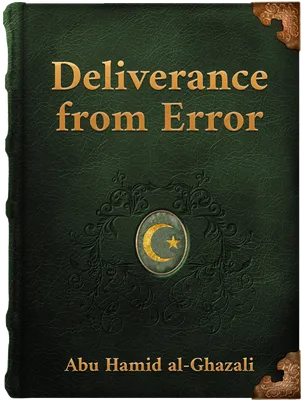
The Munkidh min al-Dalal (Deliverance from Error), is a sort of intellectual autobiography. A more modern translation can be found in W. Montgomery Watt, The Faith and Practice of Al-Ghazali, (London: 1951).
The following, an excerpt from the Encyclopedia of Philosophy (New York: Macmillan, 1967), explains the significance of the work:
At the age of 36, Ghazali experienced a profound crisis, provoked by the problem of intellectual certitude. He abandoned his professorship and his position as rector of Nizamiya University of Baghdad. During a period of ten years, clothed in the characteristic wool garment of the Sufis and completely absorbed in spiritual practices, he made solitary pilgrimages throughout the Muslim world, to Syria, Egypt, Mecca, and Medina. What he conveyed in his doctrines cannot be separated from this pathetic experience. He solved the problem of knowledge and certitude by affirming a degree of comprehension that left the heart no room for doubt, a comprehension that is the essential apprehension of things. The thinking soul becomes the focus of the universal Soul's irradiations, the mirror of intelligible forms received from the universal Soul. This theme dominates certain characteristic short treatises (the Monqidh or "Preservative From Error," [this text], the Risalat alLadoniya, etc.) as well as the great synthesis entitled Ilya Ulum ad-Din ("Revival of the Religious Sciences"). But this theme had already been treated, undoubtedly without his knowledge, by the Imams of Shi'ism, and it does not differ essentially from the Ishraq of Sohrawardi. This very theme led Sohrawardi to advance philosophy on a new basis rather than destroy the efforts of philosophers as such.
It is principally this aspect of Ghazali's work, developed in his Tahafut al-Falasifa ("Autodestruction of the Philosophers") that Westerners have been inclined to emphasize. An attempt has even been made to read into it a more incisive and decisive critique or metaphysics than that of Kant. In fact, Ghazali strove vehemently to destroy the demonstrative range that philosophers, Avicennians as well as others, accorded to their arguments regarding the eternity of the world, the procession of the Intelligences, the existence of purely spiritual substances, and the idea of spiritual resurrection. In general Ghazali strove to refute the idea of any causality, of any necessary connection. According to him all that can be experimentally affirmed is, for example, that combustion of cotton occurs at the moment of contact with fire; it cannot be shown that combustion takes place because of the contact between cotton and fire. Nor can it be shown that there is any cause whatsoever. From this bursts forth the paradox of a thinker who professes the inability of reason to attain certitude while maintaining the certitude of destroying, with massive doses of rational dialectic, the certitudes of the philosophers. Averroe s clearly discerned this self-contradiction and replied to it with his celebrated Tahafut al-Tahafut ("Autodestruction of the Autodestruction").
Quoth the Imam Ghazali:
Glory be to God, whose praise should precede every writing and every speech! May the blessings of God rest on Mohammed, his Prophet and his Apostle, on his family and companions, by whose guidance error is escaped!
You have asked me, O brother in the faith, to expound the aim and the mysteries of religious sciences, the boundaries and depths of theological doctrines. You wish to know my experiences while disentangling truth lost in the medley of sects and divergencies of thought, and how I have dared to climb from the low levels of traditional belief to the topmost summit of assurance. You desire to learn what I have borrowed, first of all from scholastic theology; and secondly from the method of the Ta'limites, who, in seeking truth, rest upon the authority of a leader; and why, thirdly, I have been led to reject philosophic systems; and finally, what I have accepted of the doctrine of the Sufis, and the sum total of truth which I have gathered in studying every variety of opinion. You ask me why, after resigning at Baghdad a teaching post which attracted a number of hearers, I have, long afterward, accepted a similar one at Nishapur. Convinced as I am of the sincerity which prompts your inquiries, I proceed to answer them, invoking the help and protection of God.
Know then, my brothers (may God direct you in the right way), that the diversity in beliefs and religions, and the variety of doctrines and sects which divide men, are like a deep ocean strewn with shipwrecks, from which very few escape safe and sound. Each sect, it is true, believes itself in possession of the truth and of salvation, "each party," as the Qur'an saith, "rejoices in its own creed"; but as the chief of the apostles, whose word is always truthful, has told us, "My people will be divided into more than seventy sects, of whom only one will be saved." This prediction, like all others of the Prophet, must be fulfilled.
From the period of adolescence, that is to say, previous to reaching my twentieth year to the present time when I have passed my fiftieth, I have ventured into this vast ocean; I have fearlessly sounded its depths, and like a resolute diver, I have penetrated its darkness and dared its dangers and abysses. I have interrogated the beliefs of each sect and scrutinized the mysteries of each doctrine, in order to disentangle truth from error and orthodoxy from heresy. I have never met one who maintained the hidden meaning of the Qur'an without investigating the nature of his belief. nor a partisan of its exterior sense without inquiring into the results of his doctrine. There is no philosopher whose system I have not fathomed, nor theologian the intricacies of whose doctrine I have not followed out.
Sufism has no secrets into which I have not penetrated; the devout adorer of Deity has revealed to me the aim of his austerities; the atheist has not been able to conceal from me the real reason of his unbelief. The thirst for knowledge was innate in me from an early age; it was like a second nature implanted by God, without any will on my part. No sooner had I emerged from boyhood than I had already broken the fetters of tradition and freed myself from hereditary beliefs.
Having noticed how easily the children of Christians become Christians, and the children of Muslims embrace Islam, and remembering also the traditional saying ascribed to the Prophet, "Every child has in him the germ of Islam, then his parents make him Jew, Christian, or Zarathustrian," I was moved by a keen desire to learn what was this innate disposition in the child, the nature of the accidental beliefs imposed on him by the authority of his parents and his masters, and finally the unreasoned convictions which he derives from their instructions.
Struck with the contradictions which I encountered in endeavoring to disentangle the truth and falsehood of these opinions, I was led to make the following reflection: "The search after truth being the aim which I propose to myself, I ought in the first place to ascertain what are the bases of certitude." In the next place I recognized that certitude is the clear and complete knowledge of things, such knowledge as leaves no room for doubt nor possibility of error and conjecture, so that there remains no room in the mind for error to find an entrance. In such a case it is necessary that the mind, fortified against all possibility of going astray, should embrace such a strong conviction that, if, for example, any one possessing the power of changing a stone into gold, or a stick into a serpent, should seek to shake the bases of this certitude, it would remain firm and immovable. Suppose, for instance, a man should come and say to me, who am firmly convinced that ten is more than three, "No; on the contrary, three is more than ten, and, to prove it, I change this rod into a serpent," and supposing that he actually did so, I should remain none the less convinced of the falsity of his assertion, and although his miracle might arouse my astonishment, it would not instill any doubt into my belief.
I then understood that all forms of knowledge which do not unite these conditions (imperviousness to doubt, etc.) do not deserve any confidence, because they are not beyond the reach of doubt, and what is not impregnable to doubt can not constitute certitude.
The Subterfuges of the Sophists
I then examined what knowledge I possessed, and discovered that in none of it, with the exception of sense-perceptions and necessary principles, did I enjoy that degree of certitude which I have just described. I then sadly reflected as follows: "We can not hope to find truth except in matters which carry their evidence in themselves — that is to say, in sense-perceptions and necessary principles;
we must therefore establish these on a firm basis. Is my absolute confidence in sense-perceptions and on the infallibility of necessary principles analogous to the confidence which I formerly possessed in matters believed on the authority of others? Is it only analogous to the reliance most people place on their organs of vision, or is it rigorously true without admixture of illusion or doubt?"
I then set myself earnestly to examine the notions we derive from the evidence of the senses and from sight in order to see if they could be called in question. The result of a careful examination was that my confidence in them was shaken. Our sight, for instance, perhaps the best practiced of all our senses, observes a shadow, and finding it apparently stationary pronounces it devoid of movement. Observation and experience, however, show subsequently that a shadow moves not suddenly, it is true, but gradually and imperceptibly, so that it is never really motionless.
Again, the eye sees a star and believes it as large as a piece of gold, but mathematical calculations prove, on the contrary, that it is larger than the earth. These notions, and all others which the senses declare true, are subsequently contradicted and convicted of falsity in an irrefragable manner by the verdict of reason.
Then I reflected in myself: "Since I can not trust to the evidence of my senses, I must rely only on intellectual notions based on fundamental principles, such as the following axioms: 'Ten is more than three. Affirmation and negation can not coexist together. A thing can not both be created and also existent from eternity, living and annihilated simultaneously, at once necessary and impossible.'" To this the notions I derived from my senses made the following objections: "Who can guarantee you that you can trust to the evidence of reason more than to that of the senses? You believed in our testimony till it was contradicted by the verdict of reason, otherwise you would have continued to believe it to this day. Well, perhaps, there is above reason another judge who, if he appeared, would convict reason of falsehood, just as reason has confuted us. And if such a third arbiter is not yet apparent, it does not follow that he does not exist."
To this argument I remained some time without reply; a reflection drawn from the phenomena of sleep deepened my doubt. "Do you not see," I reflected, "that while asleep you assume your dreams to be indisputably real? Once awake, you recognize them for what they are — baseless chimeras. Who can assure you, then, of the reliability of notions which, when awake, you derive from the senses and from reason? In relation to your present state they may be real; but it is possible also that you may enter upon another state of being which will bear the same relation to your present state as this does to your condition when asleep. In that new sphere you will recognize that the conclusions of reason are only chimeras."
This possible condition is perhaps, that which the Sufis call "ecstasy" (hal), that is to say, according to them, a state in which, absorbed in themselves and in the suspension of sense-perceptions, they have visions beyond the reach of intellect. Perhaps also Death is that state, according to that saying of the prince of prophets: "Men are asleep; when they die, they wake." Our present life in relation to the future is perhaps only a dream, and man, once dead, will see things in direct opposition to those now before his eyes; he will then understand that word of the Qur'an, "To-day we have removed the veil from thine eyes and thy sight is keen."
Such thoughts as these threatened to shake my reason, and I sought to find an escape from them. But how? In order to disentangle the knot of this difficulty, a proof was necessary. Now a proof must be based on primary assumptions, and it was precisely these of which I was in doubt. This unhappy state lasted about two months, during which I was, not, it is true, explicitly or by profession, but morally and essentially, a thorough-going skeptic.
God at last deigned to heal me of this mental malady; my mind recovered sanity and equilibrium, the primary assumptions of reason recovered with me all their stringency and force. I owed my deliverance, not to a concatenation of proofs and arguments, but to the light which God caused to penetrate into my heart — the light which illuminates the threshold of all knowledge. To suppose that certitude can be only based upon formal arguments is to limit the boundless mercy of God. Some one asked the Prophet the explanation of this passage in the Divine Book: "God opens to Islam the heart of him whom he chooses to direct." "That is spoken," replied the Prophet, "of the light which God sheds in the heart." "And how can man recognize that light?" he was asked. "By his detachment from this world of illusion and by a secret drawing toward the eternal world," the Prophet replied.
On another occasion he said: "God has created his creatures in darkness, and then has shed upon them his light." It is by the help of this light that the search for truth must be carried on. As by his mercy this light descends from time to time among men, we must ceaselessly be on the watch for it. This is also corroborated by another saying of the Apostle: "God sends upon you, at certain times, breathings of his grace; be prepared for them."
My object in this account is to make others understand with what earnestness we should search for truth, since it leads to results we never dreamed of. Primary assumptions have not got to be sought for, since they are always present to our minds; if we engage in such a search, we only find them persistently elude our grasp. But those who push their investigation beyond ordinary limits are safe from the suspicion of negligence in pursuing what is within their reach.
The Different Kinds of Seekers After Truth
When God in the abundance of his mercy had healed me of this malady, I ascertained that those who are engaged in the search for truth may be divided into three groups:
I. Scholastic theologians, who profess to follow theory and speculation.
II. The philosophers, who profess to rely upon formal logic.
III. The Sufis, who call themselves the elect of God and possessors of intuition and knowledge of the truth by means of ecstasy.
"The truth," I said to myself, "must be found among these three classes of men who devote themselves to the search for it. If it escapes them, one must give up all hope of attaining it. Having once surrendered blind belief, it is impossible to return to it, for the essence of such belief is to be unconscious of itself. As soon as this unconsciousness ceases it is shattered like a glass whose fragments can not be again reunited except by being cast again into the furnace and refashioned." Determined to follow these paths and to search out these systems to the bottom, I proceeded with my investigations in the following order: Scholastic theology; philosophical systems; and, finally Sufism.
The Aim of Scholastic Theology and Its Results
Commencing with theological science, I carefully studied and meditated upon it. I read the writings of the authorities in this department and myself composed several treatises. I recognized that this science, while sufficing its own requirements, could not assist me in arriving at the desired goal. In short, its object is to preserve the purity of orthodox beliefs from all heretical innovation. God, by means of his apostle, has revealed to his creatures a belief which is true as regards their temporal and eternal interests; the chief articles of it are laid down in the Qur'an and in the traditions. Subsequently, Satan suggested to innovators principles contrary to those of orthodoxy; they listened greedily to his suggestions, and the purity of the faith was menaced. God then raised up a school of theologians and inspired them with the desire to defend orthodoxy by means of a system of proofs adapted to unveil the devices of the heretics and to foil the attacks which they made on the doctrines established by tradition.
Such is the origin of scholastic theology. Many of its adepts, worthy of their high calling, valiantly defended the orthodox faith by proving the reality of prophecy and the falsity of heretical innovations. But, in order to do so, they had to rely upon a certain number of premises, which they accepted in common with their adversaries, and which authority and universal consent or simply the Qur'an and the traditions obliged them to accept. Their principal effort was to expose the self-contradictions of their opponents and to confute them by means of the premises which they had professed to accept. Now a method of argumentation like this has little value for one who only admits self-evident truths. Scholastic theology could not consequently satisfy me nor heal the malady from which I suffered.
It is true that in its later development theology was not content to defend dogma; it betook itself to the study of first principles, of substances, accidents and the laws which govern them; but through want of a thoroughly scientific basis, it could not advance far in its researches, nor succeed in dispelling entirely the over-hanging obscurity which springs from diversities of belief.
I do not, however, deny that it has had a more satisfactory result for others; on the contrary, I admit that it has; but it is by introducing the principle of authority in matters which are not self-evident. Moreover, my object is to explain my own mental attitude and not to dispute with those who have found healing for themselves. Remedies vary according to the nature of the disease; those which benefit some may injure others.
Philosophy. — How far it is open to censure or not — On what points its adherents may be considered believers or unbelievers, orthodox or heretical — What they have borrowed from the true doctrine to render their chimerical theories acceptable — Why the minds of men swerve from the truth — What criteria are available wherewith to separate the pure gold from the alloy in their systems.
I proceeded from the study of scholastic theology to that of philosophy. It was plain to me that, in order to discover where the professors of any branch of knowledge have erred, one must make a profound study of that science; must equal, nay surpass, those who know most of it, so as to penetrate into secrets of it unknown to them. Only by this method can they be completely answered, and of this method I can find no trace in the theologians of Islam. In theological writings devoted to the refutation of philosophy I have only found a tangled mass of phrases full of contradictions and mistakes, and incapable of deceiving, I will not say a critical mind, but even the common crowd. Convinced that to dream of refuting a doctrine before having thoroughly comprehended it was like shooting at an object in the dark, I devoted myself zealously to the study of philosophy; but in books only and without the aid of a teacher. I gave up to this work all the leisure remaining from teaching and from composing works on law. There were then attending my lectures three hundred of the students of Baghdad. With the help of God, these studies, carried on in secret, so to speak, put me in a condition to thoroughly comprehend philosophical systems within a space of two years. I then spent about a year in meditating on these systems after having thoroughly understood them. I turned them over and over in my mind 'till they were thoroughly clear of all obscurity. In this manner I acquired a complete knowledge of all their subterfuges and subtleties, of what was truth and what was illusion in them.
I now proceed to give a résumé of these doctrines. I ascertained that they were divided into different varieties, and that their adherents might be ranged under diverse heads. All, in spite of their diversity, are marked with the stamp of infidelity and irreligion, although there is a considerable difference between the ancient and modern, between the first and last of these philosophers, according as they have missed or approximated to the truth in a greater or less degree.
Concerning the Philosophical Sects and the Stigma of Infidelity Which Attaches to Them All
The philosophical systems, in spite of their number and variety, may be reduced to three: (1) the Materialists; (2) the Naturalists; (3) the Theists.
(1) The Materialists. They reject an intelligent and omnipotent Creator and disposer of the universe. In their view the world exists from all eternity and had no author. The animal comes from semen and semen from the animal; so it had always been and will always be; those who maintain this doctrine are atheists.
(2) The Naturalists. These devote themselves to the study of nature and of the marvelous phenomena of the animal and vegetable world. Having carefully analyzed animal organs with the help of anatomy, struck with the wonders of God's work and with the wisdom therein revealed, they are forced to admit the existence of a wise Creator who knows the end and purpose of everything. And certainly no one can study anatomy and the wonderful mechanism of living things without being obliged to confess the profound wisdom of him who has framed the bodies of animals and especially of man. But carried away by their natural researches they believed that the existence of a being absolutely depended upon the proper equilibrium of its organism. According to them, as the latter perishes and is destroyed, so is the thinking faculty which is bound up with it; and as they assert that the restoration of a thing once destroyed to existence is unthinkable, they deny the immortality of the soul. Consequently they deny heaven, hell, resurrection, and judgment. Acknowledging neither a recompense for good deeds nor a punishment for evil ones, they fling off all authority and plunge into sensual pleasures with the avidity of brutes. These also ought to be called atheists, for the true faith depends not only on the acknowledgment of God, but of his Apostle and of the day of judgment. And although they acknowledge God and his attributes, they deny a judgment to come.
(3) The Theists. Among them should be reckoned Socrates, who was the teacher of Plato as Plato was of Aristotle. This latter drew up for his disciples the rules of logic, organized the sciences, elucidated what was formerly obscure, and expounded what had not been understood. This school refuted the systems of the two others, i.e., the Materialists and Naturalists; but in exposing their mistaken and perverse beliefs, they made use of arguments which they should not. "God suffices to protect the faithful in war" (Qur'an, xxxiii. 25).
Aristotle also contended with success against the theories of Plato, Socrates, and the theists who had preceded him, and separated himself entirely from them; but he could not eliminate from his doctrine the stains of infidelity and heresy which disfigure the teaching of his predecessors. We should therefore consider them all as unbelievers, as well as the so-called Muslim philosophers, such as Ibn Sina [Avicenna] and Al Farabi, who have adopted their systems.