Guru Granth Sahib: The Living Guru of Sikhism Explained
Discover why Sikhs revere a book as their eternal Guru. Explore the Guru Granth Sahib's revolutionary teachings on equality, divine wisdom, and spiritual lib...
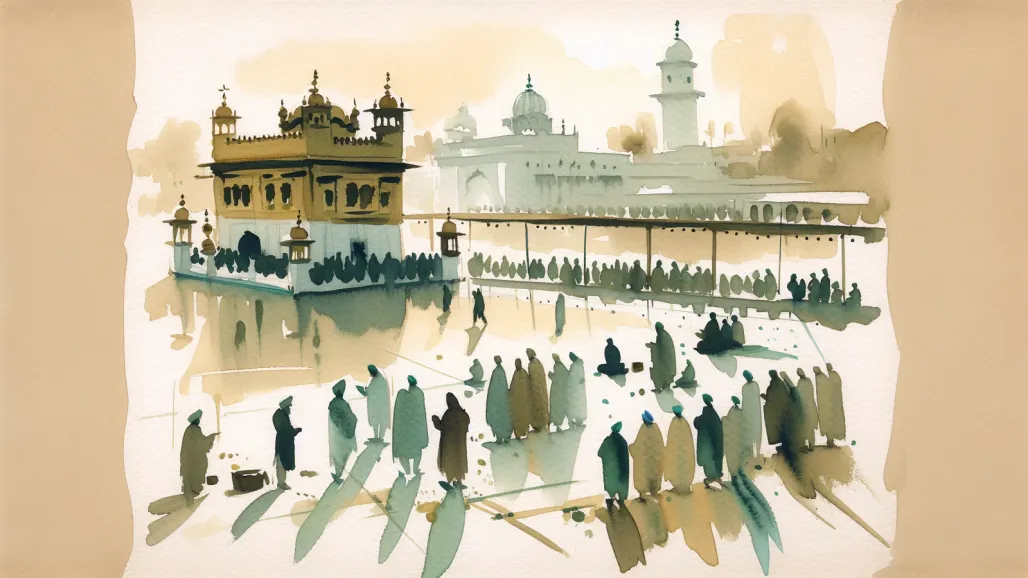
Before dawn in Amritsar, the Golden Temple shimmers on its sacred pool like a vision from another world. Inside, something extraordinary unfolds. A hushed congregation watches as five turbaned devotees approach the inner sanctum with measured steps. They bear no idol, crown no prophet. Instead, they carry a book—but to call it merely a book is to misunderstand everything. Wrapped in silks that cost more than most earn in a year, fanned with yak-tail whisks as if it were royalty, the Guru Granth Sahib processes through the marble halls. Men and women from every continent bow as it passes. Some weep. All understand: their Guru has arrived.
This scene repeats daily in thousands of gurdwaras worldwide, from rural Punjab to Manhattan skyscrapers. For Sikhs don't just read their scripture—they live with it, speak to it, seek its counsel as they would a beloved teacher. The Guru Granth Sahib breathes, guides, and transforms. It is, in the deepest sense, alive.
To understand this phenomenon, we must grasp a revolutionary concept: in Sikhism, the eternal wisdom of the Gurus transcended their physical forms to dwell permanently within sacred verse. The Guru Granth Sahib contains not just teachings but presence—1,430 pages of mystic poetry that pulse with the same transformative power that once flowed through ten human Gurus.
This radical departure from personality-centered spirituality emerged from profound theological insight. If divine wisdom is eternal, why should it be confined to mortal flesh? If truth is universal, why shouldn't Hindu bhagats and Muslim saints sing alongside Sikh Gurus in the same sacred symphony? The Guru Granth Sahib embodies these revolutionary answers, creating a scripture that doesn't just teach about the divine—it manifests divine presence in the world.
The Revolutionary Birth of a Scripture Without Borders

In 15th-century Punjab, where Hindu caste hierarchies met Islamic conquest, where saints and warriors crossed paths at dusty crossroads, Guru Nanak emerged with a message that shattered every boundary. “There is no Hindu, there is no Muslim,” he declared after a mystical experience. “There is only humanity seeking the One.”
This wasn't mere philosophy—it was revolution. In a land where your birth determined your worth, where women were property and lower castes untouchable, Guru Nanak proclaimed radical equality. He sang of a God beyond religion, accessible to all through love, service, and remembrance. Kings and paupers sat together as he taught. Muslims and Hindus shared his table. The social order trembled (Kaur, 2003).
This universal vision of oneness is captured in the opening verse of the Guru Granth Sahib, known as the Mūl Mantar:
“Ik Onkar, Sat Naam, Karta Purakh, Nirbhau, Nirvair, Akaal Moorat, Ajooni, Saibhang, Gur Prasad.” — Guru Granth Sahib, Ang 1
(There is One Universal Creator God, whose Name is Truth. The Creator, without fear and without hate, timeless, beyond birth and death, self-existent, realized by the Guru's grace.)
Over two and a half centuries, nine more Gurus carried this flame forward. Each added their voice to a growing symphony of sacred verse while facing persecution, martyrdom, and the constant pressure to compromise their vision. The fifth Guru, Arjan Dev, compiled the first version of what would become the Guru Granth Sahib, deliberately including not just Sikh hymns but the ecstatic poetry of Hindu bhagats and Muslim saints. This was unheard of—a scripture that honored truth wherever it bloomed.
Then, in 1708, as Guru Gobind Singh lay dying from an assassin's wounds, he made a declaration that would forever alter religious history. “The Word is the Guru now,” he proclaimed. No more human successors. No more potential for corruption or succession disputes. The Guru Granth Sahib itself would be the eternal Guru, incorruptible and ever-present.
This wasn't just succession planning—it was spiritual genius. By transferring authority from person to text, Guru Gobind Singh ensured that the pure teachings would remain accessible to all, unfiltered by human ego or politics. The Guru became truly immortal (Singh, H, 1992).
A Sacred Symphony: The Architecture of Divine Wisdom

Open the Guru Granth Sahib and enter a spiritual symphony unlike any scripture on Earth. Here, 1,430 pages pulse with voices spanning centuries and traditions—six Sikh Gurus, fifteen Bhagats (Hindu and Muslim saints), eleven Bhatts (court poets), and four other enlightened souls. Imagine Kabir the iconoclastic weaver singing alongside Guru Nanak, or Sheikh Farid's Sufi yearning harmonizing with Ravidas's devotional ecstasy. This isn't mere anthology—it's a deliberate theological statement: truth has no monopoly (McLeod, 2008).
The linguistic tapestry proves equally revolutionary. Sacred verses flow between Punjabi, Hindi, Sanskrit, Persian, and regional dialects, making the divine accessible to farmers and scholars alike. But the true genius lies in the musical arrangement. Each hymn is set to specific ragas—classical melodic frameworks that evoke particular emotions and spiritual states. Morning ragas awaken devotion, evening ragas invoke introspection, and seasonal ragas align the soul with nature's rhythms.
This marriage of word and music transforms scripture reading into embodied experience. The Guru Granth Sahib doesn't just communicate truth—it vibrates truth into being, using sound itself as a vehicle for transformation (Singh & Singh, 2000).
From Dawn to Dusk: Living with the Eternal Guru

The Guru Granth Sahib doesn't sit on a shelf gathering dust—it lives, breathes, and moves through each day with its devotees. Watch a gurdwara at 3 AM and you'll find someone already there, preparing for the Guru's awakening. The Prakash ceremony unfolds like a royal court ritual: the scripture, having rested through the night in its special chamber, processes to the main hall amid singing and incense. Carried above heads on a palanquin, draped in fresh silks chosen for the season, it assumes its throne.
Then comes the day's first miracle. The Guru Granth Sahib opens randomly, and wherever it falls becomes the Hukamnama—the divine command for that day. No human chooses this message. Whether it speaks of courage in trials or surrender in joy, the congregation receives it as personal guidance from their living Guru. Throughout the day, readers take turns voicing the scripture, never leaving it alone. Some undertake the Akhand Path—a continuous 48-hour recitation where the Guru's voice never ceases, creating an unbroken stream of sacred sound that serves as both spiritual advocacy and divine communion.
As darkness approaches, the Sukhasan ceremony reverses the morning's ritual. The Guru is tenderly closed, wrapped in soft cloths, and carried to rest. Even in repose, a light burns nearby. The Guru sleeps, but never abandons its people (Grewal, 2012).
Timeless Teachings That Transform Modern Lives

In our age of inequality, environmental crisis, and spiritual emptiness, the Guru Granth Sahib speaks with startling relevance. Its teachings address not abstract theology but the art of living with purpose, justice, and joy. These principles shape everything from Sikh environmental activism to Silicon Valley ethics:
Seva (Selfless Service): Watch any disaster—earthquake, pandemic, protest—and you'll find Sikhs there, serving free meals to anyone hungry. This isn't charity in the Western sense but seva, service performed as spiritual practice. In every gurdwara, the langar (community kitchen) makes this tangible: millionaires and homeless eat side by side, served the same simple meal. No one asks your name, religion, or status. The act of serving others becomes a meditation, dissolving ego in the divine work of feeding humanity (Singh & Singh, 2000).
Radical Equality: When the Guru Granth Sahib declares all humans equal, it means it. Women lead congregations. Former “untouchables” become saints. The scripture itself proves this—Muslim and Hindu voices sing alongside Sikh Gurus. In a world still poisoned by racism, sexism, and religious hatred, this 500-year-old message feels revolutionary. The Guru Granth Sahib doesn't just preach equality; its very structure embodies it (McLeod, 2008).
Naam Japna (Divine Remembrance): Beyond ritual and dogma lies direct experience. Through meditation on the divine Name—whether called Waheguru, Allah, or Ram—consciousness transforms. This isn't empty repetition but a technology of transcendence, aligning human will with cosmic harmony:
“Chant the Name of the Lord, O my mind; this is the true essence of wisdom.” — Guru Granth Sahib, Ang 684
Living with Humility: The Guru Granth Sahib overturns conventional ideas of spiritual achievement. The holiest person isn't the most knowledgeable or ascetic but the most humble—one who sees the divine in all and serves without thought of reward (Harpal Singh, 2011).
Universal Wisdom: Where East Meets West, Heart Meets Heart
The Guru Granth Sahib speaks a universal language that transcends religious boundaries. When it proclaims seva, Christians hear echoes of agape love in action. Its emphasis on divine remembrance resonates with Islamic dhikr and Jewish kavannah. The call for justice mirrors liberation theology's preferential option for the poor. Even secular humanists find inspiration in its uncompromising stand for human dignity.
This convergence isn't coincidental. The Guru Granth Sahib emerged from a deeply plural society and consciously incorporated wisdom across traditions. It demonstrates that diversity strengthens rather than dilutes spiritual truth, much like the universal moral principles that emerge across sacred texts worldwide. In our fractured world, where religious identity too often divides, this scripture offers a different model: unity not through uniformity, but through recognizing the sacred in every authentic spiritual path (Singh, 2015).
Your Invitation to Experience the Living Guru

The Guru Granth Sahib welcomes all seekers. Here's how to approach this living scripture with respect and openness:
Enter the Presence: Visit any gurdwara—they're open to all. Cover your head (scarves provided), remove shoes, and wash hands as you enter sacred space. Sit on the floor facing the Guru, letting the ancient melodies wash over you. Don't worry about understanding every word; the sound itself carries blessing. Watch how others bow, not to an idol but to wisdom itself.
Access the Wisdom: Explore English translations through OceanLibrary.com, where narrated versions bring the poetry alive. Sites like SearchGurbani.com and SikhiToTheMax.org offer the complete scripture with translations. Start with the Japji Sahib, Guru Nanak's morning prayer—its 38 stanzas contain the entire philosophy in miniature.
Experience Kirtan: Nothing prepares you for your first kirtan. Ancient ragas meet modern instruments as the congregation becomes one voice. You don't need to know the words; humming along connects you to centuries of devotion. The music bypasses intellect to touch the soul directly.
Share the Sacred Meal: In langar, CEOs and refugees eat together on the floor—no tables to create hierarchy. Volunteer to chop vegetables or wash dishes. This isn't charity but worship through service. Every meal feeds both body and soul.
Live the Teaching: True engagement means embodying the principles. Find ways to serve without recognition. Stand against injustice. Practice seeing the divine in everyone—especially those society overlooks.
The Eternal Voice That Speaks to All Hearts
In a world that often reduces scripture to historical artifact or fundamentalist weapon, the Guru Granth Sahib offers a radically different possibility. Here, text becomes teacher, song becomes sermon, and ancient words address modern souls with startling immediacy.
“He Himself is all-pervading; He is not far away. The Lord is found through His True Guru.” — Guru Granth Sahib, Ang. 131
This isn't metaphor but lived reality for millions who daily experience their scripture's guidance. The Guru Granth Sahib demonstrates that revelation need not end with prophets' deaths—it can continue wherever sincere hearts seek truth. In Sikh gurdwaras from Amritsar to America, the eternal Guru still speaks, still teaches, still transforms.
Perhaps this is the deepest teaching: the divine word lives not in books but in the communities that embody it. When strangers share langar, when volunteers serve without thought of reward, when diverse voices unite in kirtan—there the Guru Granth Sahib proves itself truly alive. The scripture's greatest miracle isn't that a book became a Guru, but that through this Guru, ordinary people discover the extraordinary capacity to see divinity everywhere and serve it with every breath.
You Might Also Enjoy
- The Ocean Library Project: Revolutionizing Religious Literacy Through Technology - Discover Ocean Library's groundbreaking interfaith digital platform
- Guru Nanak: The Revolutionary Saint Who Founded Sikhism - Learn Guru Nanak's revolutionary teachings on equality, service, and divine unity
References
- Grewal, J. S. (2012). The Sikhs of the Punjab. Cambridge University Press.
- Kaur, P. (2003). Sikhism: A brief introduction. Oxford University Press.
- McLeod, W. H. (2008). The Sikhs. Columbia University Press.
- Singh, G., & Singh, H. (2000). Sikhism: Understanding and beliefs. Routledge.
- Singh, H. (1992). The Encyclopedia of Sikhism. Punjabi University Patiala.
Words From
Mercy Iburuoma is a religious studies scholar specializing in sacred texts and interfaith dialogue. Her passion for understanding how different traditions approach the divine through scripture brings fresh insights to ancient wisdom. Explore more insights: Moral Compass: Universal Values in a Diverse World and Kundalini Rising: The Serpent Power in Eastern and Western Traditions.
Related Articles
- Guru Nanak: The Revolutionary Saint Who Founded Sikhism - Sikh founder
- World Religion 101: A Beginner's Guide to Global Faiths - spiritual journey
- Dark Night of the Soul: Spiritual Crisis as a Path to Growth - spiritual awakening
- The Ocean Library Project: Revolutionizing Religious Literacy Through Technology - spiritual texts
- Meditation Mastery: Techniques from World Religions - Meditation