The Prince Who Conquered Himself: When Power Chose Powerlessness
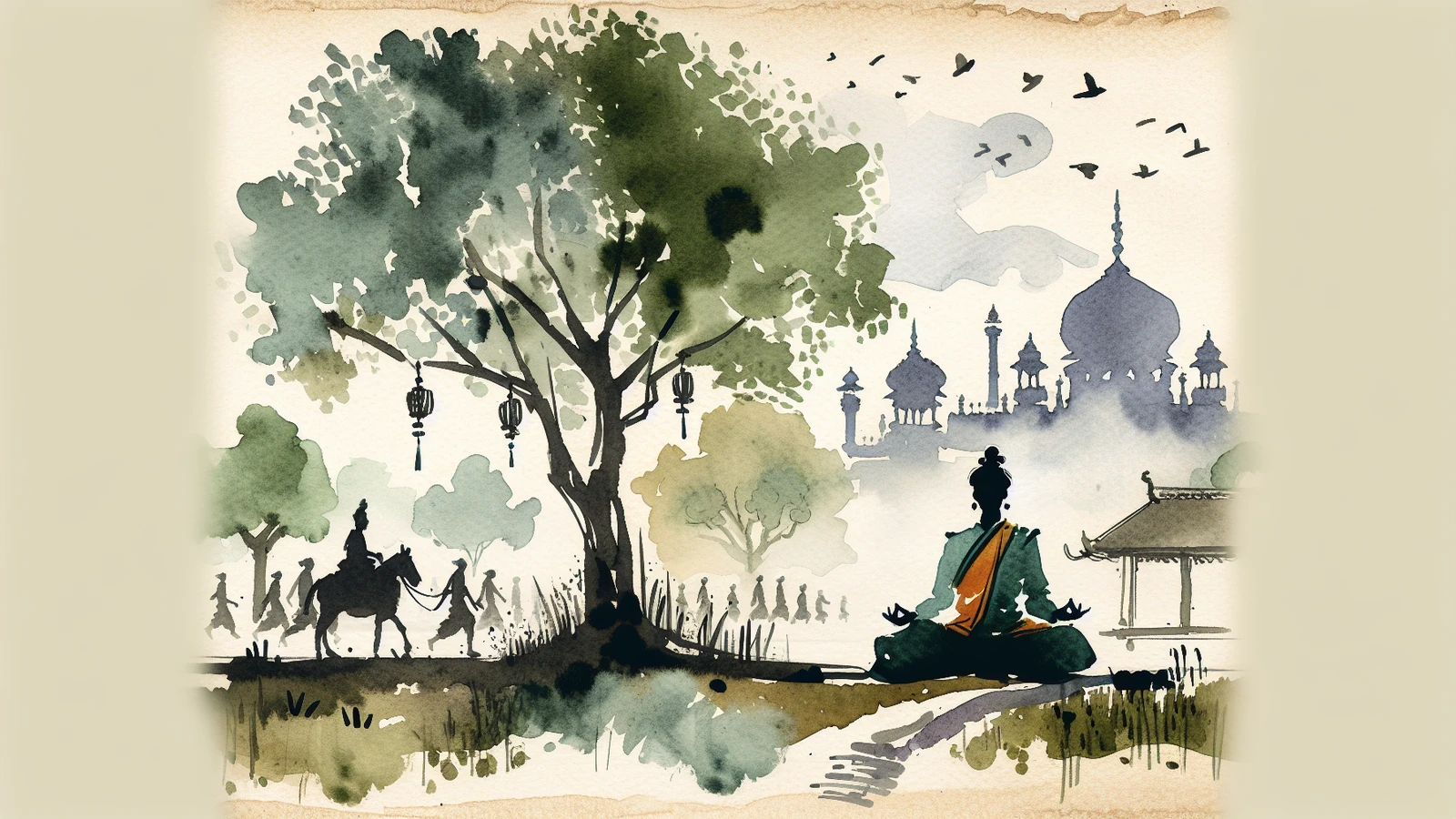
Explore Mahavir Jayanti and the revolutionary prince who renounced everything to conquer himself through absolute non-violence and transformative Jain discip...
The Prince Who Conquered Himself: When Power Chose Powerlessness

A palace in ancient India. Gold gleams from every surface. Servants anticipate every need. A young prince, Vardhamana, stands at a window, watching a funeral procession wind through the streets below. He has everything—power, wealth, family, a kingdom waiting to be inherited. Yet something gnaws at him, a question that won't let go: “What's the point of conquering the world if you can't conquer death?”
This is where our story begins. Not with enlightenment but with privilege. Not with answers but with the kind of questions that keep princes awake at night. Because sometimes the most revolutionary act isn't taking power—it's giving it away.
Today, millions celebrate Mahavir Jayanti, marking the birth of this prince who became a spiritual revolutionary. But to understand why his birthday matters 2,600 years later, we need to understand what made him walk away from everything most humans spend their lives chasing.
The Great Renunciation
At age 30, Vardhamana did something unthinkable. He didn't just leave the palace—anyone can run away. He methodically dismantled his entire identity. First, he gave away his wealth. Then his clothes. Finally, in an act that still makes people wince, he pulled out his own hair by the roots, handful by handful.
Why the hair? Because in ancient India, hair represented beauty, status, identity. By tearing it out, he wasn't just becoming a monk. He was declaring war on his own ego, on every attachment that bound him to the illusion of separateness.
His family begged him to reconsider. His brother offered him half the kingdom. His wife wept. But Vardhamana had glimpsed something that made thrones look like toys: the possibility of absolute freedom. Not political freedom. Not social freedom. Freedom from the very cycle of existence that trapped every living being in endless rounds of birth, death, and rebirth.

Twelve Years in the Wilderness
What followed would break most humans in twelve days, let alone twelve years. Vardhamana wandered naked through India, owning nothing, accepting nothing, protected by nothing. When insects bit him, he didn't brush them away—that would be violence. When thorns pierced his feet, he carefully removed them and placed them where no one else would step on them. When people mocked him, threw stones at him, set dogs on him, he responded with... nothing. No anger. No retaliation. Not even explanation.
This wasn't masochism. It was science—the science of karma. Every reaction creates a new action. Every response forges a new chain. The only way to break free is to stop the entire mechanism. So he practiced non-reaction with the dedication of a physicist in a laboratory, using his own body and mind as the experimental apparatus.
For twelve years, he sat in meditation so deep that vines grew over him, practicing a form of contemplative stillness that echoes across many traditions. He fasted until his bones showed through his skin. He exposed himself to summer heat that could kill and winter cold that could freeze. All to answer one question: What remains when everything else is stripped away?
The Morning Everything Changed
On the tenth day of the bright half of Vaishakha month, under a Sal tree by the river Rijupalika, something shifted. The last veil fell. Vardhamana died, and Mahavir—“Great Hero”—was born. But this wasn't the heroism of battle. It was the heroism of absolute victory over oneself.
What did he see in that moment of enlightenment? According to Jain texts, he saw everything—past, present, and future, the intricate web of karma binding every soul, the exact path to liberation. He became a Jina, a conqueror. But unlike Alexander or Caesar, he conquered by surrendering. His victory came through defeat of everything within him that could be defeated.

The Revolution of Non-Violence
For the next 30 years, Mahavir taught. But his teaching was unlike anything India had seen. Yes, the Buddha was his contemporary, also teaching liberation. Yes, the Hindu sages taught moksha. But Mahavir's path was radical in its absoluteness.
Ahimsa wasn't just “non-violence”—it was a complete revolution in how humans relate to existence:
- Jain monks sweep the ground before them to avoid stepping on insects
- They wear cloth over their mouths to prevent accidentally inhaling tiny beings
- They don't eat root vegetables because harvesting them kills the plant
- They don't eat after sunset because cooking in the dark might harm unseen creatures
To modern ears, this sounds extreme. But consider the logic: If all life is sacred, if every soul—from elephant to ant—is on its own journey toward liberation, then who are we to interrupt that journey? Violence isn't just wrong; it's cosmically stupid. It binds us to the very souls we harm, creating karmic debts that must be repaid.
“All beings love life; they hate pain and death. They want to live as much as you do. How can you kill them or cause them pain?” — Akaranga Sutra

The Five Pillars of Freedom
Mahavir didn't just say “be good.” He gave a precise formula—five vows that, when followed completely, guarantee liberation:
1. Ahimsa (Non-Violence): Not just physical—mental and verbal too. Even thinking harm creates karma.
2. Satya (Truth): But only truth that doesn't harm. If your truth would hurt someone, better to remain silent.
3. Asteya (Non-Stealing): Taking nothing not given—including someone's time, attention, or peace of mind.
4. Brahmacharya (Celibacy/Chastity): For monks, complete celibacy. For householders, absolute fidelity. Why? Because sexual desire is the strongest chain binding souls to the material world.
5. Aparigraha (Non-Possession): Own nothing. Attach to nothing. Because everything you think you own actually owns you.
These aren't rules imposed by a deity. They're laws of spiritual physics, as inevitable as gravity. Like the ancient commandments that have guided humanity, these vows provide a moral framework that transcends cultural boundaries. Break them, and you bind yourself tighter to the wheel of existence. Follow them, and you progressively free yourself.

The Echo Across Traditions
What's remarkable is how Mahavir's insights ripple through every major tradition:
Buddhism emerged in the same era, with Buddha teaching his own middle way. Both traditions share vegetarianism, meditation, and the goal of escaping samsara. They're like two scientists who independently discovered the same law. The Buddhist emphasis on compassion mirrors Jain ahimsa.
Christianity would later teach “turn the other cheek” and “blessed are the meek.” Francis of Assisi's radical poverty and care for all creatures could have come straight from Mahavir's playbook. Christian monasticism echoes Jain asceticism.
Islam's emphasis on charity (zakat) and mercy (rahma) echoes Jain principles. Sufi mystics who renounce worldly goods walk a parallel path. The Islamic concept of taqwa (God-consciousness) aligns with Jain mindfulness.
Hinduism, from which Jainism emerged, shares concepts of karma, dharma, and moksha. But Mahavir took these ideas to their logical extreme—if karma is real, then every action matters infinitely. The Bhagavad Gita explores similar themes of detachment.
Even secular movements unknowingly channel Mahavir. Environmental protection? That's ahimsa toward the Earth. Minimalism? That's aparigraha in modern dress. Veganism? Jains have been doing it for 2,600 years.
The Festival of Light
Today, Mahavir Jayanti isn't celebrated with conquest parades or displays of power. Instead:
- Dawn: Devotees rise before sunrise to bathe Mahavir's image with milk and water, symbolizing purification
- Morning: Processions carry his image through streets, but quietly, peacefully
- Afternoon: Massive charitable activities—free food, medical camps, animal rescue
- Evening: Meditation and study of his teachings
Notice what's missing? No fireworks (they scare animals). No loud music (it disturbs peace). No excess (that contradicts aparigraha). Even in celebration, Jains practice what Mahavir taught.

The Modern Hero's Path
In our age of accumulation—more money, more power, more followers, more everything—Mahavir's message seems almost alien. He's the anti-influencer, teaching that the goal is to need less, want less, be less. Yet perhaps that's exactly why we need him now.
Consider our modern crises:
- Climate change: Caused by excessive consumption. Mahavir taught aparigraha 2,600 years ago.
- Violence: From wars to words on social media. Mahavir showed that all violence begins in the mind.
- Anxiety: We're stressed by what we have and what we lack. Mahavir found peace in having nothing.
- Meaninglessness: We feel empty despite full lives. Mahavir found fullness in emptiness.
Walking the Path Today
You don't have to pull out your hair or wander naked to learn from Mahavir. Here's how modern seekers apply his teachings:
Start with One Day: Try Jain fasting—not just from food, but from harsh words, unnecessary purchases, or digital devices. Notice how much mental space opens up. This practice aligns with contemplative traditions found across many faiths.
Practice Micro-Ahimsa: Before you speak, ask: “Will this cause harm?” Before you buy, ask: “Did suffering create this?” Before you eat, ask: “What died for this meal?”
Experiment with Less: Choose one area—clothes, gadgets, commitments—and reduce by half. Watch how simplicity creates clarity.
Study Anekantavada: Mahavir taught that truth has multiple sides. Next time you're certain you're right, ask: “What am I not seeing?” This mental non-violence prevents dogmatism. The concept parallels principles found in interfaith dialogue and the universal moral values found across traditions.
Visit a Jain Temple: Experience the profound peace of spaces dedicated to absolute non-violence. Notice how even the architecture whispers “calm.”
The Ultimate Victory
Here's the paradox Mahavir embodied: the greatest power is powerlessness. The highest achievement is non-achievement. The deepest fulfillment comes from emptying, not filling.
He conquered no territories, built no monuments, wrote no books. Yet 2,600 years later, millions follow his path. Why? Because he proved something revolutionary: you don't have to accept reality as it's handed to you. Through discipline, compassion, and absolute commitment to truth, you can transcend the entire game.
In a palace long ago, a prince looked out a window and saw death. Instead of turning away, he stared until he saw through death itself to what lies beyond. Then he walked out of that palace and into history, leaving footprints that billions still follow.
The palace is still there in each of us—comfortable, familiar, imprisoning. The door is open. The path Mahavir walked awaits. The only question is: How much are you willing to give up to gain everything?
This Mahavir Jayanti, as millions celebrate the birth of the Great Hero, remember: the hero's journey isn't out there. It's in here. And it begins the moment you decide that conquering yourself is the only victory worth winning.
Related Articles
Explore Jainism in the context of world religions, discover how ahimsa connects with universal ethics across traditions, and understand spiritual transformation processes that appear throughout religious history.
References
- Acharanga Sutra. Translated by Hermann Jacobi. Sacred Books of the East, Vol. 22. Oxford: Oxford University Press, 1884.
- Chapple, Christopher Key. Jainism and Ecology: Nonviolence in the Web of Life. Cambridge: Harvard University Press, 2002.
- Cort, John E. Jains in the World: Religious Values and Ideology in India. Oxford: Oxford University Press, 2001.
- Dundas, Paul. The Jains. London: Routledge, 2002.
- Gandhi, M.K. An Autobiography: The Story of My Experiments with Truth. Boston: Beacon Press, 1993.
- Harvey, Peter. An Introduction to Buddhism. Cambridge: Cambridge University Press, 2013.
- Jaini, Padmanabh S. The Jaina Path of Purification. Delhi: Motilal Banarsidass, 1998.
- Long, Jeffery D. Jainism: An Introduction. London: I.B. Tauris, 2009.
- Shah, Umakant P. Jaina-Rupa-Mandana (Jaina Iconography). New Delhi: Abhinav Publications, 1987.
About the Author
Rev'd Dr. Ayotunde Oyadiran is a Priest of the Anglican Church who brings a unique perspective to the exploration of faith and spirituality. Holding a PhD in Church History and an MSc in Ecology and Environmental Biology, he bridges the worlds of faith, science, and human experience. As the author of over three books, Dr. Oyadiran has explored themes of spirituality, personal growth, and environmental stewardship. He also works as a coach and trainer on peak performance, helping individuals unlock their potential and achieve their goals. His passion is empowering others to live purposeful, high-impact lives that integrate faith, wisdom, and excellence.