Divine Inspiration: Religious Art Across Cultures
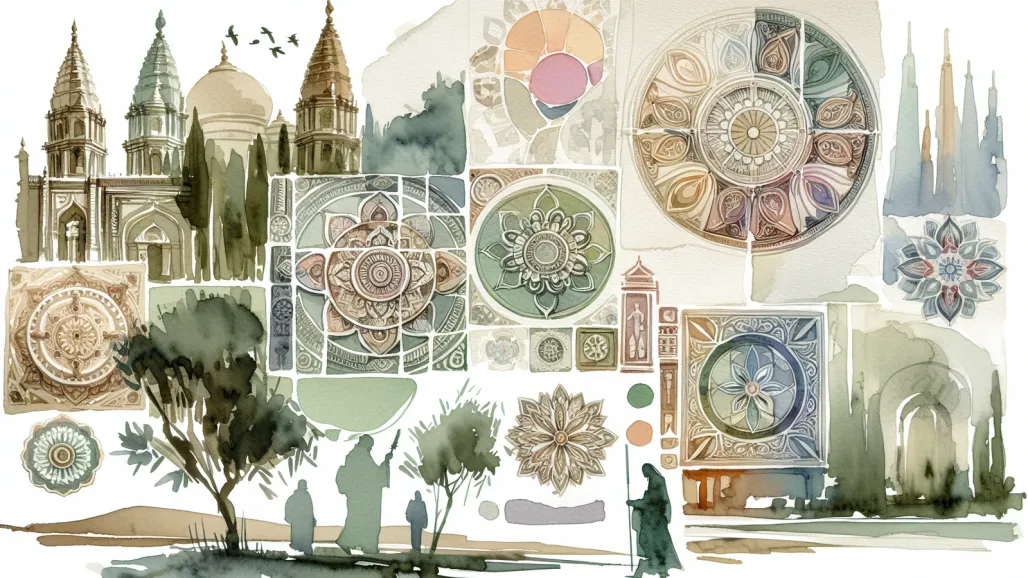
Explore sacred art across Hindu, Buddhist, Christian, Islamic, Jewish, African, and Indigenous spiritual traditions revealing universal divine creativity.
Religious art has been one of humanity's most powerful forms of expression, transcending time, geography, and culture to reflect our deepest spiritual aspirations. From the vibrant frescoes of ancient temples to the stained glass windows of medieval cathedrals, from Islamic calligraphy to Buddhist mandalas, sacred art has served as a bridge between the human and the divine. It embodies stories, doctrines, and experiences of transcendence, inviting viewers into worlds of wonder and reverence.
Throughout history, every major faith tradition has cultivated its own distinctive forms of artistic expression. These creations are not merely decorative; they are visual theologies that reveal how communities understand the sacred. Examining religious art across cultures allows us to see both the remarkable diversity of human creativity and the universal desire to honor what is holy through beauty and craftsmanship.
The Role of Sacred Imagery in Ancient Hindu Temples and Devotional Traditions
Hinduism possesses one of the world's richest traditions of sacred art, expressed through sculpture, painting, dance, and monumental architecture that spans thousands of years. Temples across India are adorned with elaborate stone carvings of deities, mythological scenes, and cosmic symbols that transform these structures into living manifestations of divine presence. From the ancient caves of Ajanta and Ellora to the magnificent temples of Khajuraho and the towering gopurams of South India, these works transcend mere storytelling—they embody the divine presence itself, making each temple a sacred cosmos in miniature.
The concept of darshan, or sacred seeing, is central to Hindu worship, where devotees come not just to pray but to behold and be beheld by the divine through artistic representation. The Bhagavad Gita teaches,
“Whoso shall offer Me in faith and love A leaf, a flower, a fruit, water poured forth, That offering I accept, lovingly made With pious will.” — The Bhagavad Gita 9:15

Hindu temple art manifests this devotional offering, making the very structure of the temple an act of worship carved in stone. Sacred texts like the Rig Veda (10:90:1) describe cosmic realities that artists have sought to portray visually:
“A thousand heads hath Puruṣa, a thousand eyes, a thousand feet. On every side pervading earth he fills a space ten fingers wide.” — Rig Veda 10:90:1

This vast imagery of Purusha, the cosmic being, inspired representations of the interconnectedness of all existence through intricate murals, towering statues, and elaborate iconographic programs that continue to inspire artists and devotees today.

Buddhist Symbolism in Mandalas, Statues, and Monastic Art
Buddhism emphasizes art as both a tool for meditation and a method of teaching the Dharma to practitioners across different levels of understanding. Mandalas, those intricate geometric designs representing the universe in perfect balance, serve as aids for contemplation and spiritual transformation. These sacred diagrams map the journey from the outer world of confusion to the inner realm of enlightenment, with each layer symbolizing stages of spiritual development. The Dhammapada summarizes the ethical foundation behind much Buddhist art:
“Not to commit any sin, to do good, and to purify one's mind, that is the teaching of (all) the Awakened.” — The Dhammapada 183

Monastic murals depicting the life of the Buddha or scenes from the Jataka tales serve as constant reminders to practitioners of the path to enlightenment, while also educating lay visitors about Buddhist teachings.
The tradition of cave paintings at sites like Dunhuang along the Silk Road demonstrates how Buddhist art served as a universal language, transcending cultural and linguistic barriers. Statues of the Buddha, with their serene expressions and symbolic hand gestures (mudras), provide focal points for meditation while embodying the peace that comes from spiritual awakening. The Lotus Sutra (Chapter 2) describes the transformative power of the Dharma, which artists often portray through imagery of blooming lotuses, signifying purity arising from the mud of worldly existence. The painstaking creation of sand mandalas becomes itself a meditative practice, teaching impermanence as these masterpieces are ritually destroyed upon completion, reminding observers that all phenomena are transient.

Christian Cathedrals, Icons, and Sacred Architecture as Portals to Heaven
Christianity has produced some of history's most iconic works of religious art. From Byzantine mosaics and medieval illuminated manuscripts to Renaissance masterpieces and soaring Gothic cathedrals, Christian art has consistently aimed to convey divine truths through transcendent beauty. The Bible celebrates craftsmanship dedicated to God's glory, as seen in Exodus:
“And I have filled him with the spirit of God, in wisdom, and in understanding, and in knowledge, and in all manner of workmanship, To devise cunning works, to work in gold, and in silver, and in brass.” — Exodus 31:3–4

Gothic cathedrals served as “Bibles in stone,” teaching the faithful through stained glass depictions of biblical narratives that transformed sunlight into divine revelation, embodying the same timeless moral principles found in sacred law. Icons in Eastern Christianity are revered as “windows to heaven”—not merely pictures but sacred invitations to encounter the divine presence. This sacred art became a form of theology expressed in color and form, conveying spiritual mysteries that words alone could never adequately express.

The Sublime Beauty of Calligraphy and Pattern in Islamic Art
Islamic art is distinguished by its intricate calligraphy, mesmerizing geometric patterns, and flowing arabesques. Because Islam traditionally discourages figural depictions in religious contexts, sacred art flourished in abstract forms that reflect divine unity and infinite perfection. The Qur'an declares,
“RECITE thou, in the name of thy Lord who created.” — Qur'an Surah Al-Alaq 96:1

This profound reverence for the written word elevated calligraphy to the highest form of sacred art, with beautifully inscribed Qur'anic verses adorning mosques and illuminated manuscripts.
Islamic architecture, exemplified by masterpieces such as the Alhambra in Spain or the Blue Mosque in Turkey, combines sophisticated calligraphic art with mathematically precise symmetrical designs to create spaces that evoke awe and spiritual contemplation. These intricate patterns reflect the underlying divine order of creation, serving as visual reminders of cosmic harmony and divine perfection.

Jewish Visual Traditions and the Sanctification of Beautiful Objects
While Judaism traditionally emphasizes the primacy of the spoken and written word, it has nonetheless developed profound artistic traditions centered around the beautification of religious practice. The elaborate design of Torah scrolls, ceremonial objects like ornate menorahs and decorative mezuzahs, and the rich symbolic program of the Tabernacle described in the Hebrew Bible all reflect a deep reverence for beauty in worship.
Exodus 35:35 acknowledges divine inspiration in craftsmanship:
“Them hath he filled with wisdom of heart, to work all manner of work, of the engraver, and of the cunning workman, and of the embroiderer.” — Exodus 35:35

Illuminated manuscripts of Hebrew texts and elaborate synagogue architecture express the Jewish commitment to glorifying God through artistic excellence, while Kabbalistic diagrams and symbolic illustrations serve as contemplative tools bridging intellectual study with spiritual devotion.

Art as Spiritual Conduit in African and Indigenous Traditions
Many African and Indigenous cultures seamlessly integrate art into every aspect of spiritual life, creating objects that serve simultaneously as aesthetic expressions and sacred vessels. Ceremonial masks, ancestral sculptures, and ritual objects are understood not as mere representations but as powerful conduits through which the sacred becomes present in the material world. The communal creation of these objects reinforces intergenerational bonds, connecting communities to their ancestral wisdom and cosmological understanding.
In Native American traditions, ephemeral sand paintings and towering totem poles serve both as remarkable art forms and as conduits for preserving spiritual narratives. This artistry creates vital connections between communities and their sacred landscapes, ancestors, and the spiritual forces that guide their collective existence.

The Universal Language of Sacred Beauty
Across all traditions, religious art reflects a fundamental human impulse: to honor what transcends comprehension through acts of creative devotion. The Rig Veda (1:164:46) beautifully articulates this truth:
“To what is One, sages give many a title” — Rig Veda 1:164:46

This ancient wisdom reminds us that while artistic expressions differ dramatically across cultures, they spring from a universal yearning to connect with the divine through beauty.
Sacred art continues to teach, inspire, and form communities across the globe, serving as a bridge between generations and cultures. It provides tangible expressions of the intangible, helping people encounter profound mystery in ways that words alone cannot achieve. Contemporary artists continue this tradition, creating works that honor ancient principles while speaking to modern sensibilities. Digital installations in modern churches, Islamic geometric patterns in contemporary architecture, and Buddhist-inspired minimalist sculptures all demonstrate how sacred art evolves while maintaining its essential purpose. Even in our increasingly secularized world, these magnificent creations retain their power to awaken wonder and foster deep spiritual reflection.
The act of pilgrimage often centers around encountering sacred art, from the devotional journey to see Michelangelo's Pietà in St. Peter's Basilica to the circumambulation of Buddhist stupas adorned with relief sculptures. These experiences remind us that art and spirituality are intimately connected, each enhancing the power of the other to transform human consciousness.
Religious art ultimately reveals that while languages, rituals, and doctrines may differ, the fundamental impulse to express divine wonder through creativity remains profoundly universal. As Psalm 27:4 declares,
“One thing have I desired of the LORD, that will I seek after; that I may dwell in the house of the LORD all the days of my life, to behold the beauty of the LORD, and to enquire in his temple.” — Psalm 27:4

These enduring works stand as testaments to humanity's ongoing dialogue with the transcendent, reminding us that creativity itself reflects the divine image within us all.
Related Articles
- Meditation Mastery: Techniques from World Religions - Learn how sacred art aids contemplative practice
- Ten Commandments: Ancient Laws for Modern Relevance - moral guidance through sacred texts
- Sacred Texts Unveiled: A Comprehensive Guide - explore world scriptures
About the Author
Elly Marimbocho is a seasoned writer with a background in Religious Studies and over a decade of experience producing long-form educational content on theology, interfaith spirituality, and world religions. Passionate about the contemplative heart of faith, Elly creates in-depth, reverent, and accessible guides that help readers engage meaningfully with religious wisdom across traditions.