Life Beyond Death: Exploring Humanity's Visions of the Afterlife
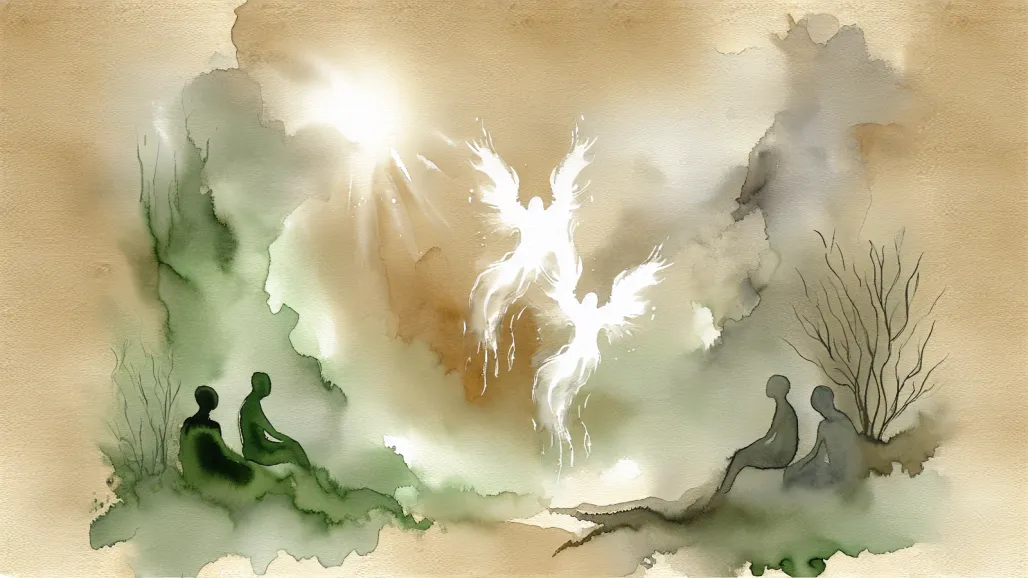
Journey through diverse afterlife beliefs from Islam's Barzakh to Hindu reincarnation. Discover how world faiths envision eternity and the soul's destiny.
Deep in the caves of Lascaux, our ancestors painted something remarkable. Not just bison and horses, but something else—small figures floating above the dying animals. Souls, perhaps. Forty thousand years ago, someone was already asking the question that follows us all: Where do we go when we die?
Watch a child at a funeral, eyes wide with that first terrible understanding. Watch an old woman tending her husband's grave, speaking to him as if he were merely in the next room. We are the only creatures who know we will die, and this knowledge has shaped everything we've become. This awareness often leads to profound spiritual crisis and transformation as we grapple with life's ultimate questions, a journey shared by seekers across all world religions.
The Strange Twilight Where Souls Wander
Picture a soul at the moment of death. In the Islamic tradition, it enters a place called Barzakh—not quite here, not quite there. Like a butterfly between caterpillar and wing. The Quran captures this liminal moment:
“Until, when death comes to one of them, he says: 'My Lord! Send me back, so that I may do good in that which I have left behind!' No! It is but a word that he speaks; and behind them is Barzakh until the Day when they will be resurrected.” — Quran 23:99-100
Time works differently in this in-between place. A thousand years pass like an afternoon nap. A moment stretches into centuries.

The Tibetan monks know this place too. They call it the bardo, and they've mapped it like explorers charting unknown continents. Colors you've never seen. Sounds that are also feelings. Your thoughts becoming landscapes you walk through. It's as if death removes the filter between you and raw reality.
Every culture that's looked closely at death has found this strange twilight zone. It tells us something important: dying isn't like flipping a switch. It's more like walking from one room to another, and there's a hallway in between. This understanding connects with contemplative prayer traditions that teach about the continuity of consciousness beyond physical death.
The Universe's Strangest Classroom
Here's what the Hindu sages discovered, sitting in their mountain caves three thousand years ago: you've done this before. Many times. The soul—they call it atman—is like an actor who's played a thousand roles. King in one life, beggar in the next. Sometimes you're the predator, sometimes the prey.
But why? It's not punishment. It's education.
Think of it like this: How can you truly understand suffering if you've never suffered? How can you know joy if you've never grieved? The universe is teaching empathy the long way around—by having you live every possible life until you understand them all from the inside. This profound understanding shapes the moral compass that guides us toward universal compassion, reflected in principles like the Ten Commandments.

The Buddhists looked at the same mystery and saw something even stranger. There's no unchanging soul moving from life to life—just patterns, like music passing from instrument to instrument. The melody continues, but is it the same song when played on a different flute? They say what passes on is more like a flame jumping from candle to candle. Not the same flame, but not different either.
The Buddha himself taught something remarkable to the Kalamas, a people confused by competing spiritual claims:
“Nevertheless, after advising the Kalamas not to rely upon established tradition, abstract reasoning, and charismatic gurus, the Buddha proposes to them a teaching that is immediately verifiable and capable of laying a firm foundation for a life of moral discipline and mental purification.” — Bhikkhu Bodhi, Commentary on the Kalama Sutta
Whether or not there's an afterlife, he said, a life of compassion brings happiness here and now. If there is rebirth, you're prepared. If there isn't, you've still lived well. Win-win.
Where Memories Burn Like Stars
The Jewish mystics have a different piece of the puzzle. They speak of Gehinnom—not hell, but more like a cosmic washing machine. When you die, they say, you experience the truth of who you were versus who you could have been. It burns, this seeing clearly. But it's not punishment. It's purification.
Imagine wearing the same shirt for seventy years. It becomes part of you—stained with every joy, every sorrow, every small meanness and unexpected kindness. Death strips it away. What's underneath? That's what Gehinnom reveals. And when the cleaning is done—never more than twelve months, the rabbis insist—the soul rises, light and clean, to join its source.
The promise of resurrection echoes through the Hebrew Bible:
“And many of those who sleep in the dust of the earth shall awake, some to everlasting life, and some to shame and everlasting contempt.” — Daniel 12:2
The Catholics saw this same truth and called it Purgatory. Fire that heals rather than harms. Love so pure it burns away everything that isn't love.
When Every Mask Falls Away
Now watch as Islam paints the final awakening. Yawm al-Qiyamah—the Day when all masks fall away. Every soul that ever lived stands naked before truth itself. The proud businessman sees every worker he cheated. The secret philanthropist watches her kindnesses ripple through generations. Nothing hidden, nothing lost.

Before them stretches the Sirat, a bridge narrow as a hair over an abyss of consequences. But here's the secret the mystics whisper: the bridge isn't outside you. It IS you. Your life has built it, thought by thought, choice by choice. The weight of cruelty makes you heavy. The lightness of mercy gives you wings.
And Paradise? Jannah isn't a place you go to. It's what you become when all the false parts of you have burned away. The Quran describes rivers of honey, gardens beyond imagining. But the mystics smile and say: these are just metaphors for a joy too large for human words.
The Dead Who Never Left
Travel to the red heart of Australia, the mountains of Peru, the forests of the Congo. Ask the elders where the dead have gone. They'll look at you strangely. “Gone? They're right here.”
This is perhaps the oldest wisdom of all. The ancestors haven't left—they've just shifted sideways, into the world that exists inside this world. Like tuning to a different radio station. The music was always there; you just needed to adjust your frequency.
An African grandmother sets an extra place at dinner for those who've passed on. A Lakota father feels his grandfather in the wind. They're not being poetic. They're being practical. The dead are simply family members who no longer need bodies.
The Map Written in Light
Step back now. Look at all these visions together—not as competing stories but as glimpses of the same vast truth, each culture seeing what its eyes were prepared to see:
The Muslims mapped the journey's stages. The Jews revealed how we're cleansed. The Christians promised the impossible—that death itself will die. The Hindus showed us the cosmic classroom. The Buddhists pointed to the flowing river of consciousness. The indigenous peoples kept the conversation going.
Together, they tell us this: Something in you is deathless. Call it soul, call it consciousness, call it the part of you that watches you. It doesn't die because it was never born. It doesn't end because it never began.
What the Mystics Died Trying to Tell Us
Here's what all the mystics are trying to tell us, in their different languages: You are not a body that has a soul. You are a soul that has a body. And when that body falls away like winter coat in spring, what remains is what you always were—a spark of the infinite, playing at being finite. This understanding brings profound comfort through healing prayers that connect us to the eternal, and through intercessory prayer practices that bridge the gap between this world and the next.

Death is real. Loss is real. Grief is the price we pay for love, and it's worth every tear. But death is also a doorway, and what passes through is the only thing that was ever truly alive in us anyway.
As I write these words, someone is being born and someone is dying, and they might be the same person. The wheel turns. The journey continues. And somewhere in a place that's not a place, all our ancestors are smiling, waiting to welcome us home to a country we never really left.
The great beyond isn't beyond at all. It's here, now, in this breath, in this heartbeat. We're already there. We just haven't noticed yet.
Sources and Further Reading
- Bhikkhu Bodhi. “A Look at the Kalama Sutta.” Access to Insight, 1988.
- Brown, J. A. C. Muhammad: A Very Short Introduction. Oxford University Press, 2009.
- Catechism of the Catholic Church. Libreria Editrice Vaticana, 1999.
- Cort, J. E. Jains in the World: Religious Values and Ideology in India. Oxford University Press, 2001.
- Dundas, P. The Jains (2nd ed.). Routledge, 2002.
- Eliade, M. Shamanism: Archaic Techniques of Ecstasy. Princeton University Press, 1964.
- English Standard Version Bible. Crossway Bibles, 2001.
- Esposito, J. L. The Oxford Dictionary of Islam. Oxford University Press, 2003.
- Fowler, J. Hinduism: Beliefs and Practices. Sussex Academic Press, 1997.
- Fuller, C. J. The Camphor Flame: Popular Hinduism and Society in India. Princeton University Press, 2004.
- Geertz, C. The Interpretation of Cultures: Selected Essays. Basic Books, 1973.
- Gethin, R. The Foundations of Buddhism. Oxford University Press, 1998.
- Gill, S. D. Native American Religions: An Introduction. Wadsworth Publishing Company, 1987.
- Harvey, P. An Introduction to Buddhism: Teachings, History and Practices (2nd ed.). Cambridge University Press, 2013.
- Jacobs, L. The Jewish Religion: A Companion. Oxford University Press, 1995.
- Jaini, P. S. The Jaina Path of Purification. Motilal Barnasidas Publishers, 1998.
- Jewish Publication Society. Tanach: The Holy Scriptures, 1985.
- Klostermaier, K.K. A Survey of Hinduism (3rd ed.). State University New York Press, 2007.
- Lopez Jr., D.S. The Story of Buddhism: A Concise Guide to its History & Teachings. Harper San Francisco, 2001.
- Mbiti, J. S. African Religions and Philosophy. Heinemann, 1969.
- Quran. (Various translations cited).
- Radhakrishnan, S. The Principal Upanisads. Harpers & Brothers, 1953.
- Schierman, P. Jewish Eschatology and the World to Come. KTAV Publishing House, 2011.
- Thera, N. What the Buddha Taught (Rev. ed.). Motilal Barnasidas Publishers, 1999.
The Author's Journey
Rev'd Dr. Ayotunde Oyadiran is a Priest of the Anglican Church who brings a unique perspective to the exploration of faith and spirituality. Holding a PhD in Church History and an MSc in Ecology and Environmental Biology, he bridges the worlds of faith, science, and human experience. As the author of over three books, Dr. Oyadiran has explored themes of spirituality, personal growth, and environmental stewardship. He also works as a coach and trainer on peak performance, helping individuals unlock their potential and achieve their goals. His passion is empowering others to live purposeful, high-impact lives that integrate faith, wisdom, and excellence.
Journey Further
Explore how spiritual crises transform into profound growth across faith traditions, discover how different religions practice prayer for others, and uncover the meaning behind religious symbols that transcend boundaries.