Prayer Flags: Tibetan Tradition's Colorful Spiritual Messengers
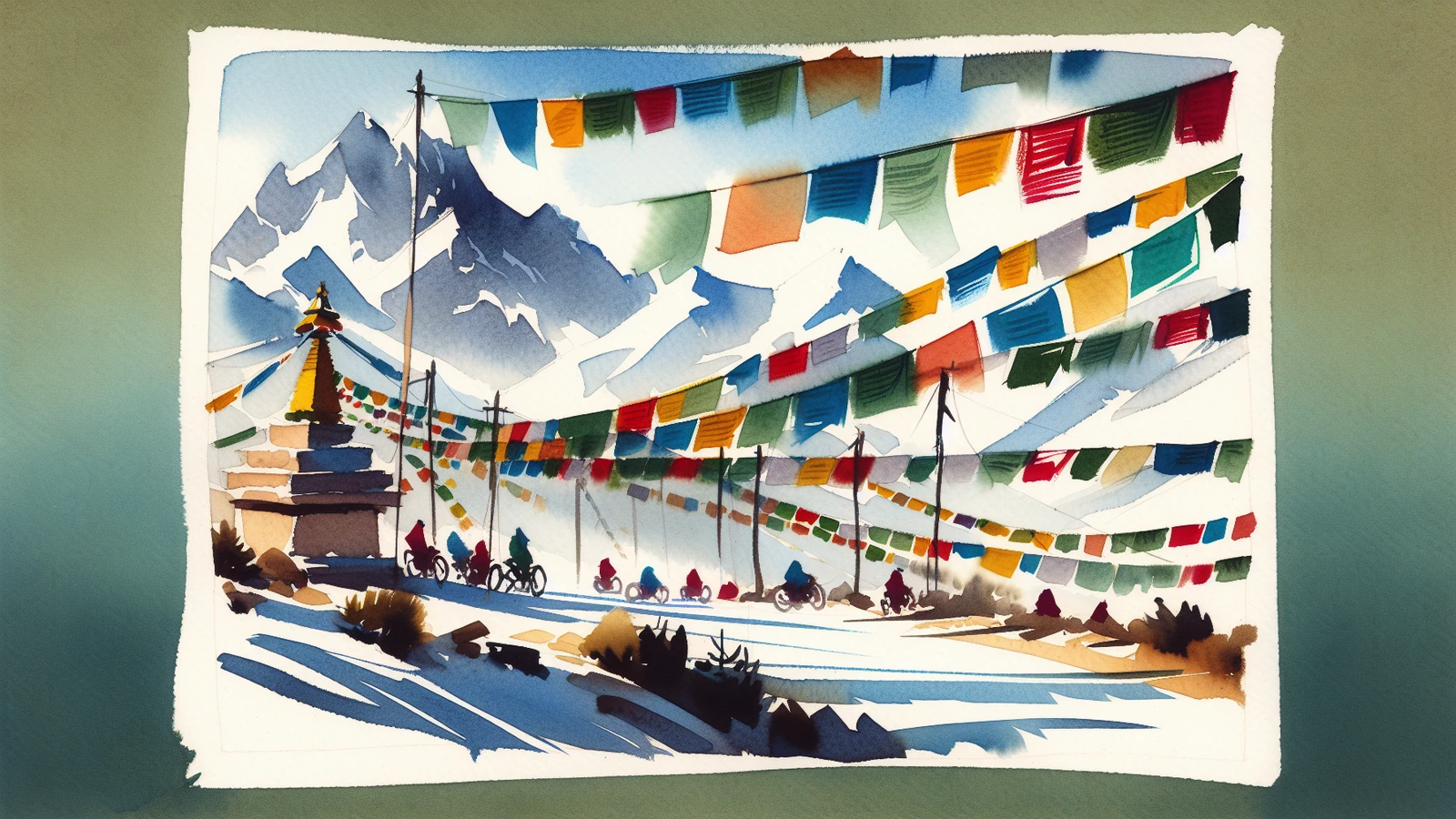
Discover Tibetan prayer flags' spiritual symbolism and ancient Bon roots—how colorful sacred cloths carry Buddhist prayers on winds, spreading compassion and...
High on the windswept passes of the Himalayas, bright squares of cloth flutter endlessly in the mountain breeze. These are Tibetan prayer flags, carrying messages of peace, compassion, strength, and wisdom across the vast expanse of sky and earth. For centuries, they have been a central element of Tibetan Buddhist culture, embodying a profound spiritual belief that prayers and mantras inscribed upon them are spread by the wind to bless all beings throughout the world. Yet their meaning extends far beyond mere decoration—they represent a comprehensive worldview that unites nature, humanity, and the divine in an unbroken circle of harmony and interdependence.
The Ancient Roots and Evolution of Prayer Flags within Himalayan Spirituality
The tradition of prayer flags is deeply rooted in ancient Himalayan cultures that predate Buddhism by thousands of years. Early Bon practitioners, followers of Tibet's indigenous shamanistic religion, hung colored cloths from sacred trees and mountain peaks to honor the powerful deities of nature—wind gods, mountain spirits, and celestial beings who governed the harsh but beautiful landscape of the high plateau. These early practitioners understood that the natural world was alive with spiritual forces that required acknowledgment and propitiation.
With the arrival of Buddhism, especially after its gradual spread from India into Tibet beginning in the 7th century, these sacred cloths underwent a profound transformation, taking on new layers of meaning and purpose. They became vehicles for Buddhist prayers and sacred mantras, serving as a bridge linking human devotion with the elemental forces of wind, water, and sunlight. This synthesis created something entirely new—a practice that honored both the ancient wisdom of the land and the compassionate teachings of the Buddha.
The Tibetan Book of the Dead teaches us that “the winds of karma carry the consciousness from one state to another” (Bardo Thodol 5:17), highlighting the connection between the seen and unseen worlds. This understanding became fundamental to the prayer flag tradition, where physical wind becomes a metaphor for the movement of merit and blessings throughout the cosmos. Similarly, the Rig Veda proclaims,
“To what is One, sages give many a title” — Rig Veda 1.164.46,

a statement that underscores the universality of sacred expression through symbolic acts like prayer flags. These profound ideas merged over centuries, forming a practice where spirituality was literally carried outward on the wind to benefit all sentient beings across vast distances. This concept resonates with meditation mastery techniques from world religions that seek to extend compassion universally, connecting with the mount tai traditions of sacred mountain worship.

The Symbolic Colors and Mantras that Form a Visual Theology of Compassion
Prayer flags are meticulously crafted according to ancient traditions, with nothing left to chance in their colors or inscriptions. Each of the five colors carries deep cosmological symbolism that reflects Buddhist understanding of the elements and their spiritual significance: blue represents the infinite sky and the vastness of space, white symbolizes air and wind in their purifying aspects, red embodies the transformative power of fire, green represents the life-giving properties of water, and yellow signifies the stable, nurturing earth. These colors together embody perfect harmony, interdependence, and the delicate balance of nature's forces that sustain all life.
Sacred texts and mantras are carefully inscribed upon these colorful squares, with Om Mani Padme Hum being among the most common. This six-syllable mantra, associated with Avalokiteshvara, the Bodhisattva of Compassion, is believed to contain the essence of all Buddhist teachings. When repeated or displayed on prayer flags, it evokes infinite compassion and generates blessings that extend to all corners of existence.
The Dhammapada teaches, echoing the sacred symbols that speak across traditions,
Related Articles
- Mount Tai: China's Sacred Peak Spiritual Significance - Sacred mountain traditions
- Sacred Symbols: Universal Language of Spirituality - Symbols across cultures
- Meditation Mastery: Techniques from World Religions - Universal compassion practices
- Dharma Wheel in Motion: Buddhism's Symbol Universal Truth - Buddhist spiritual symbols
“Not to commit any sin, to do good, and to purify one's mind, that is the teaching of (all) the Awakened.” — Dhammapada 183,

encapsulating the moral foundation that underlies the prayer flag tradition. Hanging prayer flags is itself considered an act of virtue, a way of extending blessings through the natural world without discrimination or limitation. The Sutta Nipata reminds practitioners,
“As a mother at the risk of her life watches over her own child, her only child, so also let every one cultivate a boundless (friendly) mind towards all beings.” — Sutta Nipāta 1.8, verse 148,

perfectly capturing the ethos of universal compassion that prayer flags represent and disseminate.

Sacred Rituals and Auspicious Times for Raising Prayer Flags
The hanging of prayer flags follows strict traditional protocols, with flags traditionally raised on astrologically auspicious days carefully determined by Tibetan lunar calendars. These moments are chosen when celestial influences are most favorable for spreading positive energy and blessings. The ritual itself includes the recitation of specific prayers, the making of offerings such as incense and barley flour, and the setting of pure intentions, thereby imbuing the flags with spiritual power and purpose.
This ceremonial act is far more than a symbolic gesture; it reflects the profound Bodhisattva vow to benefit all beings through even the simplest and most humble actions. The Dhammapada declares,
“The gift of the law exceeds all gifts” — Dhammapada 354,

reinforcing the Buddhist view that sharing spiritual merit and wisdom is the greatest form of generosity one can offer to the world.
Countless stories from Tibetan monasteries and mountain communities recount miraculous instances where flags raised with pure intention and proper ceremony have transformed the spiritual atmosphere of entire valleys, filling isolated communities with an almost palpable sense of peace, unity, and divine protection. These accounts reinforce the fundamental Buddhist teaching that inner intentions and mental states manifest outwardly in the physical world, creating ripple effects that can bless and transform entire landscapes and all who dwell within them.

Impermanence Embodied in the Fading and Renewal of Prayer Flags
One of the most philosophically profound aspects of prayer flags lies in their deliberate impermanence. As mountain wind, intense sunlight, rain, and snow gradually fade their vibrant colors and fray their edges, the flags slowly release their accumulated prayers into the world, becoming living embodiments of the Buddhist teaching on transience. They are periodically replaced with fresh flags, often layered directly atop the weathered old ones, creating a powerful symbol of spiritual renewal and the continuity of compassionate intention across generations.
The Dhammapada reminds us,
“'All created things perish,' he who knows and sees this becomes passive in pain; this is the way to purity.” — Dhammapada 277,

capturing the essential insight that prayer flags teach through their very existence. This natural cycle of decay and renewal becomes a living sermon on life's transient nature, visible to all who encounter these sacred banners. As old flags gradually disintegrate and merge with the elements, they remind practitioners that blessings and compassion must be renewed constantly and intentionally, just as life itself is continually arising, flourishing, and passing away in an endless dance of transformation.

Artistic, Cultural, and Interfaith Dimensions of Prayer Flags
In recent decades, prayer flags have transcended their original cultural boundaries to become a powerful global symbol of peace, compassion, environmental awareness, and cultural unity. They now appear at mountaineering base camps on peaks worldwide, interfaith gatherings, peace demonstrations, and environmental protection campaigns, carrying their message of universal blessing far beyond their Himalayan origins.
The Buddha taught in the Dhammapada,
“You yourself must make an effort. The Tathāgatas (Buddhas) are only preachers.” — Dhammapada 276,

emphasizing personal responsibility and the importance of individual action in spiritual development. This teaching reminds practitioners that spirituality must be a lived, active experience rather than passive belief or mere ritual observance, and prayer flags serve as constant reminders of this call to engaged compassion.
The use of physical symbols as carriers of sacred presence appears across many spiritual traditions, demonstrating humanity's universal need to manifest the divine in tangible form. Hinduism employs intricate yantras and sacred geometric diagrams; Christianity lights candles and burns incense during worship; Judaism affixes mezuzot containing sacred verses to doorposts; Islam venerates the Kaaba as the focal point of global prayer. The Tao Te Ching speaks of stillness and cosmic cycles:
“The (state of) vacancy should be brought to the utmost degree, and that of stillness guarded with unwearying vigour. All things alike go through their processes of activity, and (then) we see them return (to their original state).” — Tao Te Ching 16.1.

Prayer flags reflect these same eternal truths by connecting human consciousness with nature's rhythms and the universal flow of spiritual energy.

Global Adaptation and Modern Relevance of Prayer Flags
Today, prayer flags have spread far beyond Tibet's borders, adopted by spiritual seekers worldwide as symbols of goodwill, environmental consciousness, and global unity. They flutter at humanitarian aid stations, peace vigils, ecological restoration sites, and meditation centers across continents. While some may use them purely as decoration without understanding their deeper significance, those who grasp their sacred meaning transform these simple cloth squares from mere ornaments into active prayers and agents of positive change.
Their universal appeal lies in their fundamental message: that even the smallest, most humble acts can spread compassion throughout the world, and that pure intentions carried into the wider community possess transformative power. When mountain wind moves the flags, creating their characteristic fluttering motion, it becomes a perfect metaphor for the invisible interconnectedness of all existence, the ripple effects of compassionate action, and the continuous flow of blessings between all beings.
Living the Teachings of Prayer Flags through Daily Action
Prayer flags ultimately serve as invitations for individuals to embody and live out the blessings they represent in daily life. Simple acts of kindness toward strangers, mindful and compassionate speech, environmental stewardship and protection, and generous sharing of resources become practical, concrete ways to live out the prayer flags' essential message of universal compassion and interconnectedness.
The Dhammapada proclaims,
“Through zeal knowledge is gotten, through lack of zeal knowledge is lost” — Dhammapada 282,

reminding us that true spirituality, like the endlessly fluttering prayer flags themselves, requires continual renewal, conscious intention, and active engagement with the world around us.
Through their simple yet profound presence on wind-swept heights and in peaceful gardens alike, prayer flags teach timeless lessons of impermanence, compassion, and universal responsibility. They call all of humanity to recognize the sacred dimension present within everyday actions and to understand that blessings multiply exponentially when shared freely with open hearts. In their colorful dance with the wind, they remind us that we are all connected in a vast web of interdependence, and that our smallest acts of kindness ripple outward to touch lives we may never know.
Related Articles
- Zen and the Art of Universal Mindfulness - Discover the profound practice of mindfulness in Zen Buddhism
- Sacred Symbols: The Universal Language of Spirituality - Explore how symbols communicate spiritual truths across cultures
- Dharma Wheel in Motion: Buddhism's Symbol of Universal Truth - Understanding Buddhism's most sacred symbol
About the Author: A Decade of Sacred Storytelling
Elly Marimbocho is a seasoned writer with a background in Religious Studies and over a decade of experience producing long-form educational content on theology, interfaith spirituality, and world religions. Passionate about the contemplative heart of faith, Elly creates in-depth, reverent, and accessible guides that help readers engage meaningfully with religious wisdom across traditions.