Bhagavad Gita: Timeless Wisdom for Life's Battles
Unlock timeless wisdom from the Bhagavad Gita for modern challenges. Transform your life with Krishna's teachings on dharma, karma yoga, and enlightenment.
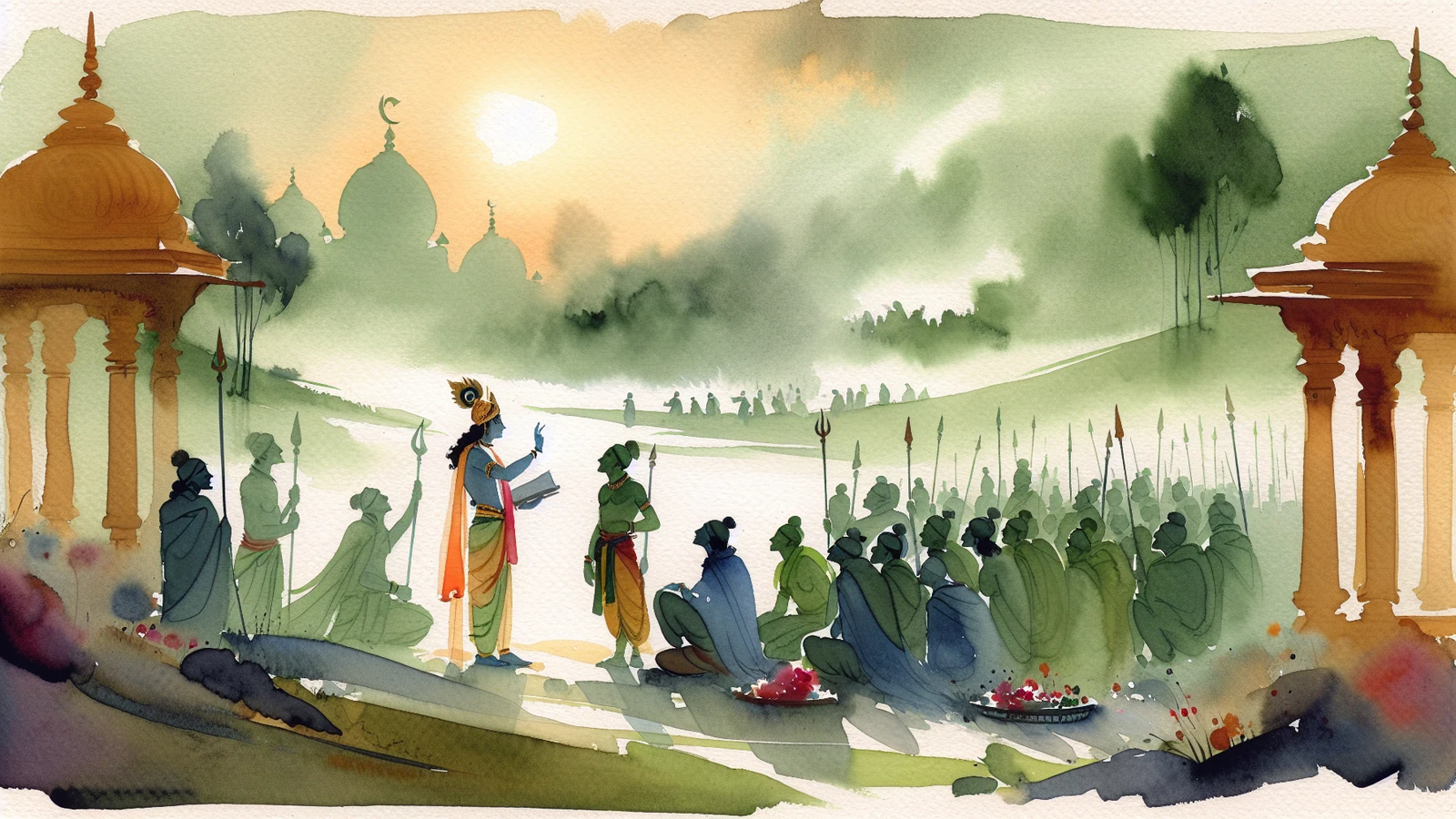
In the stillness before dawn, on the sacred field of Kurukshetra, a warrior's heart trembled. Arjuna, the mighty archer of the Pandava lineage, stood paralyzed—not by fear of defeat, but by the moral storm raging within. Torn between kinship and duty, compassion and courage, he dropped his bow and questioned the very essence of life, honor, and righteousness. In that moment, the charioteer beside him revealed his true form: Krishna, the Divine incarnate. What followed was not merely advice—it was revelation. The Bhagavad Gita, or “Song of the Lord,” remains one of the most profound dialogues in world spirituality, illuminating the human struggle for clarity amidst chaos.
The Sacred Conversation That Changed History
The Bhagavad Gita is found within Book VI of the Mahabharata, an epic poem that spans nearly two million words and represents one of the longest works of literature ever composed. This sacred dialogue comprises eighteen chapters and 700 verses, capturing a divine exchange between Krishna and Arjuna on the brink of war. But the battlefield is not just Kurukshetra—it is the battlefield of the human heart, where duty, identity, fear, and transcendence clash in eternal tension.
The historical context adds layers of meaning to this spiritual discourse. The Kurukshetra War was not merely a political conflict but a cosmic battle between dharma and adharma, righteousness and unrighteousness. This eternal struggle between light and darkness finds expression across all traditions, from the moral clarity of the Ten Commandments to the cosmic balance of Eastern philosophy. The Pandavas, representing virtue, faced the Kauravas, embodying greed and injustice. Yet Arjuna's moral crisis transcends this ancient setting, speaking to every generation that grapples with ethical complexity.
The text begins with Arjuna's despair:
“My members fail, my tongue dries in my mouth, A shudder thrills my body, and my hair Bristles with horror;” — Bhagavad Gita 1:28 He questions the righteousness of killing relatives, mentors, and friends for the sake of a kingdom. This is not cowardice but profound moral sensitivity—the recognition that victory achieved through violence against loved ones may be hollow indeed. Krishna responds not with easy comfort, but with cosmic vision. What unfolds is a sacred manual on dharma (duty), karma (action), jnana (knowledge), and bhakti (devotion).

When Duty Clashes with Compassion
Arjuna's dilemma represents a universal human experience: the moment when competing moral imperatives create paralyzing conflict. Should he fulfill his duty as a warrior and prince, or honor his love for family and teachers? This tension between personal affection and social responsibility resonates across cultures and centuries. Modern readers might recognize similar struggles in their own lives—the executive who must make difficult decisions affecting employees, the parent balancing competing needs of different children, or the citizen wrestling with complex political choices.
Krishna's response acknowledges the legitimacy of Arjuna's concerns while expanding his perspective beyond immediate emotional reactions. This pedagogical approach—honoring the student's genuine struggle while gradually revealing deeper truths—demonstrates the Gita's sophisticated understanding of human psychology and spiritual development.
Acting Without Attachment: The Revolutionary Path
At the heart of the Gita lies the concept of dharma—one's sacred duty. But dharma is not mere rule-following; it is the alignment of action with cosmic order and individual nature. Krishna urges Arjuna to rise above attachment to outcomes and act with unwavering focus on righteousness:
“Find full reward Of doing right in right! Let right deeds be Thy motive, not the fruit which comes from them.” — Bhagavad Gita 2:47

This verse, foundational to Hindu ethics, separates action from ego.
This principle of nishkama karma (desireless action) revolutionizes our understanding of motivation and success. In a world obsessed with results, the Gita suggests that true fulfillment comes not from achieving desired outcomes but from acting with integrity regardless of consequences. This paradox—that we achieve the highest results by not being attached to results—reflects the Gita's profound psychological insight.
Arjuna's crisis reflects a universal struggle: How do we act justly in an unjust world? The Gita's answer is not passivity or blind obedience, but conscious, aligned action. True dharma arises from self-knowledge and service, not ambition. Krishna does not diminish the horror of war but expands Arjuna's awareness of the eternal Self, untouched by death or defeat.
The teaching on svadharma (one's own duty) versus paradharma (another's duty) further illuminates this ethical framework. This wisdom about finding one's authentic path resonates with the spiritual renewal celebrated during Eid al-Fitr, where believers realign with their highest purpose. Krishna explains that it is better to perform one's own dharma imperfectly than to perform another's dharma perfectly. This wisdom validates individual authenticity while maintaining social harmony—a delicate balance that speaks to contemporary discussions about personal fulfillment versus collective responsibility.
Discovering Your Indestructible Soul
Central to Krishna's teaching is the Atman, the eternal soul:
“I say to thee weapons reach not the Life; Flame burns it not, waters cannot o’erwhelm, Nor dry winds wither it.” — Bhagavad Gita 2:23

This immortal Self transcends bodily death, inviting the seeker into a deeper awareness of spiritual identity. The soul, Krishna explains, changes bodies as a person changes clothes—death is merely a transition, not an ending.
This vision liberates the individual from fear and bondage. When Arjuna begins to see beyond the transient nature of the body, his paralysis dissolves. He becomes the instrument of divine will, not a conqueror driven by gain. This shift from ego-identification to soul-identification represents the core transformation that the Gita seeks to facilitate.

The teaching on the eternal Self also addresses the problem of grief and loss. Krishna explains that we mourn not for the soul, which is imperishable, but for the temporary arrangements of matter. This perspective does not diminish the natural human experience of loss but places it within a larger framework of meaning and continuity.
Three Transformative Paths to Divine Unity

The Bhagavad Gita outlines multiple yogas, or spiritual disciplines, each offering a path to union with the Divine. These are not competing systems but complementary approaches suited to different temperaments and life circumstances:
Karma Yoga: The path of selfless action transforms work into worship by dedicating all activities to the Divine. This path suits those who are naturally active and engaged with the world. The karma yogi finds God not through withdrawal from activity but through sanctification of activity.
Jnana Yoga: The path of wisdom and discernment appeals to those of a philosophical bent who seek liberation through understanding the nature of reality. This path involves rigorous self-inquiry and the cultivation of discrimination between the eternal and the temporary.
Bhakti Yoga: The path of devotion and surrender attracts those whose hearts naturally turn toward love and relationship with the Divine. This path emphasizes emotional purification and the cultivation of divine love as the means to realization.
Each is not exclusive, but harmonized within the whole. This integrative approach resonates with the balanced philosophy of Yin and Yang found in Eastern traditions. Krishna teaches that the ultimate goal is not renunciation of the world, but enlightened participation within it:
“He who sees How action may be rest, rest action — he Is wisest ‘mid his kind;” — Bhagavad Gita 4:18

This paradox reveals the Gita's spiritual depth. Enlightenment is not escape—it is engagement with clarity, detachment, and love. The yogi lives in the world, but is not consumed by it. This integration of spiritual practice with worldly engagement makes the Gita particularly relevant to contemporary spiritual seekers who cannot or will not abandon their worldly responsibilities.
Why Every Spiritual Path Leads to the Same Summit
Though deeply rooted in Hindu cosmology, the Bhagavad Gita transcends religious boundaries. Its message speaks to seekers of all paths. In the ninth chapter, Krishna declares:
“Even those who worship other gods with devotion and faith, they too worship Me, though not in the prescribed way” (Bhagavad Gita 9:23).
This inclusiveness reflects the Gita's interfaith relevance. Whether one follows a theistic path or philosophical discipline, the Gita honors the inner journey toward truth, love, and liberation. This universal approach mirrors how Guru Nanak's revolutionary teachings also emphasized the unity underlying all spiritual paths. It affirms that devotion, rightly directed, purifies the heart and draws the soul closer to the divine essence.
The text's universal appeal has been recognized by spiritual leaders and thinkers across traditions. Mahatma Gandhi called it his “spiritual dictionary,” while philosophers like Aldous Huxley and Ralph Waldo Emerson found profound wisdom in its pages. This cross-cultural appreciation testifies to the Gita's ability to speak to fundamental human concerns that transcend particular religious frameworks.

Transforming Your Daily Struggles into Spiritual Victory
Life's battlefield may not be Kurukshetra, but its struggles are just as real: ethical dilemmas, emotional conflict, fear of failure, and longing for purpose. In times of deep suffering, many turn to healing prayers from various traditions for strength and guidance. The Gita does not promise a life without conflict—it offers a way to meet conflict with wisdom. In our modern context, these battles might include navigating corporate ethics, balancing family and career demands, facing illness or loss, or simply maintaining integrity in a complex world.
Krishna does not remove Arjuna from the battlefield. Instead, he opens his eyes to a reality beyond fear, inviting him to act with spiritual vision. This is the timeless message of the Gita: act without attachment, love without demand, serve without ego, and live without fear. The text offers practical guidance for maintaining equanimity in the face of life's inevitable ups and downs.
As Arjuna listens, a shift occurs. He picks up his bow not as a warrior for conquest, but as a servant of dharma. He says,
“My delusion is destroyed. I have regained memory through your grace. I am firm. I am free from doubt. I will do your bidding” (Bhagavad Gita 18:73).
This transformation from confusion to clarity, from paralysis to purposeful action, represents the Gita's promise to every sincere seeker.
The Living Dialogue That Continues in Every Heart
More than two millennia after its composition, the Bhagavad Gita remains a living scripture. It speaks not only to Hindus, but to anyone facing moral complexity, inner struggle, or spiritual longing. Its battlefield is the human soul, and its victory is the awakening of wisdom.
In times of uncertainty, the Gita offers an anchor. In moments of despair, it offers vision. In the noise of conflict, it offers a song. And that song reminds us that in every life's battle, the divine charioteer rides with us still, ready to guide us toward clarity, courage, and ultimately, toward the realization of our highest potential. The conversation between Krishna and Arjuna continues in every heart that seeks truth, making the Gita not just an ancient text, but a living dialogue between the human and the divine.
Writer's Corner
Elly Marimbocho is a seasoned writer with a background in Religious Studies and over a decade of experience producing long-form educational content on theology, interfaith spirituality, and world religions. Passionate about the contemplative heart of faith, Elly creates in-depth, reverent, and accessible guides that help readers engage meaningfully with religious wisdom across traditions. Explore more insights: Healing Prayers: The Intersection of Faith and Wellness and Chinese New Year: A Celebration of Renewal in Eastern Faiths.
Continue Your Journey
- The Ocean Library Project: Revolutionizing Religious Literacy Through Technology - Discover Ocean Library's groundbreaking interfaith digital platform. Access 500+...
- World Religion 101: A Beginner's Guide to Global Faiths - Discover the core beliefs of nine major world religions and their surprising con...
- Kundalini Rising: The Serpent Power in Eastern and Western Traditions - Discover the ancient serpent power within you. Explore Kundalini's journey from ...
Related Articles
- Ocean Library: An Adventure Through Sacred Texts with Immersive Audio Technology - Bible verses
- Beyond Lanterns and Lotus: Vesak's Three-Fold Path to Awakening - spiritual awakening
- Lantern Festival: Illuminating the Path to Spiritual Enlightenment - spiritual awakening
- Meditation Mastery: Techniques from World Religions - Meditation
- Under the Bodhi Tree: The Night That Changed Everything - Buddhism