Rosary Revelations: Prayer Beads in World Religions
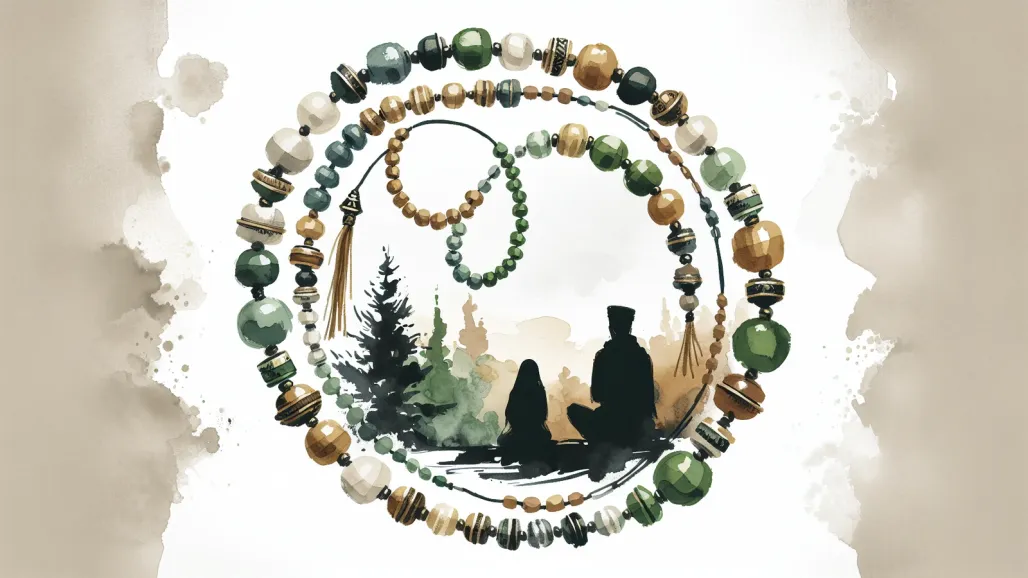
Discover how prayer beads unite spiritual seekers across faiths—from Catholic rosaries to Hindu malas, Islamic tasbih to Buddhist malas in sacred practices.
The old woman's fingers moved with practiced grace, each bead sliding through weathered hands that had performed this ritual for seventy years. Her practice embodied contemplative prayer that transcends denominational boundaries. Click. “Hail Mary, full of grace...” Click. Another bead, another prayer, another breath drawn deeper into stillness. In the hospital bed beside her, machines beeped their electronic mantras, but her consciousness had retreated to a more ancient rhythm—the tactile meditation that had carried her through war, loss, birth, and now, perhaps, death.
Across the world in a Tibetan monastery, a young monk's fingers worked their own strand of 108 beads, lips moving in silent recitation: “Om mani padme hum.” In a mosque in Istanbul, a businessman paused between meetings to pull out his tesbih, thumbing through 99 beads while whispering the names of Allah. This practice connects with intercessory prayer traditions that unite hearts across spiritual boundaries. In a Hindu temple in Varanasi, a grandmother's rudraksha mala clicked steadily as she chanted “Ram, Ram, Ram,” each repetition sinking deeper into her bones.
Different faiths. Different languages. Different theologies. Yet their hands moved in the same eternal gesture—bead by bead, breath by breath, drawing the infinite down into the intimate space between finger and thumb. These meditation mastery techniques from world religions demonstrate how physical objects can support spiritual practice across all traditions. This universality reflects the same moral compass that guides humanity across religious boundaries.
Related Articles
- Healing Prayers: The Intersection of Faith and Wellness - Prayer as transformative practice
- Moral Compass: Universal Values in a Diverse World - Shared spiritual principles
- Intercessory Prayer: Spiritual Advocacy Across Faiths - Prayer traditions across religions
“The rosary is the book of the blind, where souls see and there enact the greatest drama of love the world has ever known.” — Archbishop Fulton Sheen
This universal practice raises profound questions. Why do humans across every culture instinctively reach for beads when seeking the sacred? What is it about this marriage of touch and prayer, repetition and transcendence, that speaks to something fundamental in our spiritual DNA? And in our fractured age, might these simple strings of beads offer not just personal solace but a bridge between divided communities?
To understand prayer beads is to glimpse the hidden unity beneath humanity's diverse spiritual expressions—a shared technology of transformation that predates our divisions and points toward our common yearning for connection with the Mystery.
Ancient Origins: Where Prayer Beads Began
The story begins not in temples or churches but in the fundamental challenge of human consciousness: how to anchor the wandering mind in the sacred. Ancient practitioners discovered that the body could be enlisted as ally in this struggle. Just as walking meditation uses steps to mark presence, prayer beads transformed touch into a technology of transcendence.
Archaeological evidence suggests the first prayer beads emerged in India over 3,500 years ago, crafted from seeds, bones, and stones. The Rigveda, Hinduism's oldest text, hints at their use in maintaining count during lengthy fire rituals. But counting was never just about numbers—it was about creating a physical pathway for consciousness to follow, like a climbing rope for the soul.
As trade routes carried goods and ideas across continents, prayer beads traveled with them, shape-shifting to meet each culture's spiritual needs. Buddhist monks adapted the Hindu mala, establishing the sacred number 108. Desert fathers in Egypt and Syria knotted ropes to track their prayers, creating the prototype for the Christian rosary. Muslim merchants, encountering these practices, developed the misbaha with its 99 beads for the names of Allah.
This wasn't mere cultural borrowing but recognition of a universal principle: the marriage of repetition, touch, and sacred word creates a uniquely powerful spiritual technology. Whether fingering sandalwood in a Himalayan cave or clicking plastic beads on a modern subway, humans discovered that this simple practice could transport consciousness from the mundane to the mystical.
The Christian Rosary: Meditation Through Mary

The Catholic rosary emerged from a democratic impulse: what if those who couldn't read the 150 Psalms could still participate in their transformative power? Medieval monks developed a solution—150 Hail Marys, one for each Psalm, counted on beads to free the mind from tracking numbers. But the rosary transcended its practical origins to become something far more profound: a handheld cathedral where mysteries of faith unfold through touch.
The modern rosary's architecture reflects sophisticated spiritual psychology. Five decades of ten small beads, punctuated by larger beads for the Our Father, create a rhythm that mirrors natural breathing patterns. The twenty mysteries—Joyful, Sorrowful, Glorious, and Luminous—transform repetitive prayer into contemplative journey through Christ's life. Each bead becomes a window into sacred story: the Annunciation's radical yes, Gethsemane's anguished surrender, Easter's explosive joy.
But the rosary's true power lies deeper than structure. As fingers move from bead to bead, the analytical mind gradually releases its grip. Words dissolve into presence. Time becomes elastic. Many practitioners report entering altered states—colors intensifying, boundaries softening, a profound sense of being held by something infinitely loving. This echoes the transformative power of healing prayers across traditions. Neuroscience now confirms what centuries of practice revealed: repetitive prayer combined with tactile stimulation induces measurable changes in brain activity, decreasing anxiety and increasing feelings of connection.
During Ireland's Great Famine, families clutched rosaries as they starved. In Nazi concentration camps, prisoners fashioned beads from bread and string. Today, rosaries accompany soldiers into battle, mothers through labor, the dying across the threshold. This isn't mere superstition but recognition that in life's extremities, we need practices that anchor us to meaning when words fail.
Hindu Japa Mala: 108 Steps to Divine Connection

In Hinduism, prayer beads are known as the japa mala. The term japa refers to the repeated chanting of a mantra, and mala translates to “garland.” Hindu malas traditionally consist of 108 beads, which correspond to sacred numbers in Hindu cosmology. The use of the mala is an integral part of japa yoga, a meditative practice where the practitioner repeats a mantra for spiritual growth and alignment with the divine (Feuerstein, 2001).
The japa mala serves as a tool to keep track of the mantra repetitions, which can be focused on deities such as Vishnu, Shiva, or Lakshmi. The act of chanting and counting the beads helps the practitioner stay mindful and focused, eliminating distractions and encouraging a deepened sense of devotion. It's believed that through this process, the practitioner can channel divine energy, cleanse the mind, and develop a deeper connection to the divine essence.
“When the mind is silent and peaceful it becomes very powerful. It can become a receptor of bliss and wisdom enabling life to become a spontaneous flow and expression of joy and love.” — Swami Dhyan Giten
For Hindus, the mala is more than just a physical object; it is a bridge to higher states of consciousness, helping the individual journey inward toward spiritual liberation (moksha) (Shah, 2003).
Buddhist Mala: Counting Breaths to Enlightenment

In Buddhism, mala beads are similarly used for mantra repetition during meditation, much like in Hinduism. The Buddhist mala traditionally consists of 108 beads, though variations can exist. Each bead is used to count the recitation of a mantra or the name of the Buddha. The repetition of mantras, such as Om Mani Padme Hum or the names of the Buddha, serves as a tool for focusing the mind, cultivating mindfulness, and seeking enlightenment. This practice aligns with the broader meditation mastery found across spiritual traditions.
The use of mala beads in Buddhism is closely associated with the path of compassion and wisdom, with each repetition bringing the practitioner closer to the realization of ultimate truth. Buddhists believe that chanting mantras with the mala beads helps one overcome suffering and attachment, leading to spiritual awakening.
In Tibetan Buddhism, the mala is often viewed as a sacred object, with each bead carrying the potential to bring peace, healing, and wisdom to the practitioner. As such, the mala is treated with great respect, and practitioners may use the beads in combination with visualization and breathing techniques to deepen their meditative experience (Feuerstein, 2001).
Islamic Tasbih: Remembering the 99 Names

In Islam, prayer beads are known as tasbih and are used to recite the names of God, known as the dhikr. The tasbih typically contains 33, 66, or 99 beads, which correspond to the names of Allah. After performing their daily prayers, Muslims use the tasbih to count the recitations of dhikr, which praises God’s qualities and seeks His forgiveness (Khan, 2002).
The use of tasbih is integral to Islamic spirituality, offering a way for practitioners to remain mindful of God throughout their daily lives. It serves as a reminder of Allah’s presence and helps purify the soul. The physical act of moving the beads while reciting dhikr focuses the mind, allowing the practitioner to experience a deep sense of connection to the Divine. It’s often used in moments of reflection, gratitude, or supplication.
The tasbih beads are more than just a way to show spiritual devotion. They are also a reminder of how important it is to always remember God, which is a core idea in Islamic practice.
“Remember Me, and I will remember you.” — Quran 2:152

The Bahá'í Faith: The Most Powerful Name
In the Bahá'í faith, prayer beads are used to say holy words over and over, especially the “Greatest Name” of God (Alláh-u-Abhá, which means “God the Most Glorious”) 95 times. This is a type of dhikr, which means “remembrance.” It is similar to tasbih in Islam and mantra repeat in the East. “A lot of Bahá'ís use prayer beads to keep track of how many times they say the Greatest Name.” She wrote this in her book From Copper to Gold: The Life of Dorothy Baker (Gilstrap, 2018), page 402.
Sacred Numbers: The Mathematics of Divine Connection
The number of beads in each tradition carries deep spiritual significance. The Hindu and Buddhist use of 108 beads relates to cosmic mathematics—108 is considered sacred in Eastern traditions, representing the wholeness of existence. The Catholic rosary's 59 beads create a rhythm of tens, echoing the completeness of the decimal system. Islam's 99 beads correspond to the beautiful names of Allah, while some traditions use 33 beads, representing a third of this divine totality.
These numbers aren't arbitrary—they create specific rhythms and durations for prayer, allowing practitioners to enter meditative states through mathematical precision combined with devotion.
Universal Thread: What Prayer Beads Share Across Faiths
While the specifics of prayer bead practices vary between religions, they share a common purpose: to foster spiritual connection and transformation. At their core, prayer beads are tools that help individuals focus their minds, center their thoughts, and develop a deeper connection with the divine. Whether used to recite prayers, chant mantras, or repeat affirmations, prayer beads guide practitioners toward a state of heightened mindfulness and spiritual awareness.
The tactile experience of moving the beads through the fingers, along with the repetitive nature of the practice, encourages a form of mental and spiritual discipline. This repetition helps individuals bypass the distractions of daily life, allowing them to enter into a state of focused attention and devotion. As such, prayer beads serve as both a tool for meditation and a symbol of the individual's commitment to their spiritual journey.
Prayer Beads Today: Ancient Practice for Modern Seekers
In today’s fast-paced world, many people are rediscovering the power of prayer beads as a tool for spiritual growth. Yoga studios, interfaith communities, and mindfulness retreats are introducing individuals to the practice of using prayer beads, often incorporating them into meditation, relaxation, or stress-relief routines. Even those outside of religious practices are embracing the beads for their calming, centering effects.
Moreover, the practice of using prayer beads is no longer confined to the traditional settings of religious institutions or ashrams. People across cultures are finding solace in the beads, integrating them into their personal spiritual practices, regardless of their religious affiliation. This has sparked a renewed interest in understanding the symbolism behind prayer beads and their role in connecting humanity with the divine.
Your First Steps: Using Prayer Beads with Respect

If you’re interested in incorporating prayer beads into your own practice, here are a few tips for engaging with them respectfully:
Learn About the Tradition: Take time to understand the history and significance of prayer beads within the context of different spiritual traditions. Each tradition brings a unique perspective on the purpose of the beads and how they should be used.
Choose the Right Set of Beads: Depending on your spiritual or personal preference, you may choose to use a rosary, mala, tasbih, or another type of prayer bead. Select one that resonates with your own spiritual journey.
Start with Intention: Before using the beads, set a clear intention. Whether it’s for peace, healing, or guidance, establishing your purpose can deepen your connection to the practice.
Practice with Mindfulness: As you move through the beads, focus on the prayers or mantras you are reciting. Try to eliminate distractions and fully immerse yourself in the experience.
Respect Cultural and Religious Significance: Prayer beads are sacred objects in many traditions. Treat them with respect and avoid using them in ways that reduce their spiritual significance.
Beads of Unity: Connecting Hearts Across Traditions
From the Christian rosary to the Hindu japa mala, prayer beads have been used across the world to deepen spiritual practices and connect with the divine. Though each tradition has its unique approach, the underlying purpose of prayer beads remains the same: to help individuals focus their minds, elevate their spirits, and foster a deeper connection to the divine. As we embrace these ancient practices in the modern world, prayer beads continue to remind us of the timeless human quest for spiritual enlightenment.
References
Feuerstein, G. (2001). The Yoga Tradition: Its History, Literature, Philosophy and Practice. Hohm Press.
Gilstrap, D. F. (n.d.). From Copper to Gold: The Life of Dorothy Baker. Retrieved from https://bahai-library.com/gilstrap_copper_gold_baker
Shah, H. (2003). The Heart of Hinduism: The Eastern Path to Freedom. Penguin Books.
Khan, M. (2002). Islam: Beliefs and Practices. Oxford University Press.
Underhill, E. (1911). Mysticism: A Study in Nature and Development of Spiritual Consciousness. Methuen & Co.
Mallinson, J. (2017). Roots of Yoga. Penguin Books.
Connected Articles
- Sacred Symbols: The Universal Language of Spirituality - Discover how sacred symbols transcend religious boundaries to form humanity's shared spiritual vocabulary
- World Religion 101: A Beginner's Guide to Global Faiths - Discover the core beliefs of nine major world religions and their surprising connections
- Intercessory Prayer: The Art of Spiritual Advocacy Across Faiths - Discover how intercessory prayer connects hearts across faiths across traditions
Author
Mercy Iburuoma explores the rich tapestry of world religions with curiosity and reverence. Through her interfaith writings, she bridges spiritual traditions to foster understanding and connection. Her insights span topics from Kundalini wisdom to navigating the dark night of the soul in spiritual journeys.

![Book of Common Prayer [King's Chapel]](https://oceanlibrary.com/server/files/858520a530e6809db907d9501d416129/ea3902a880e3e4641146a7faa1ac8a0e.webp)