Under the Bodhi Tree: The Night That Changed Everything
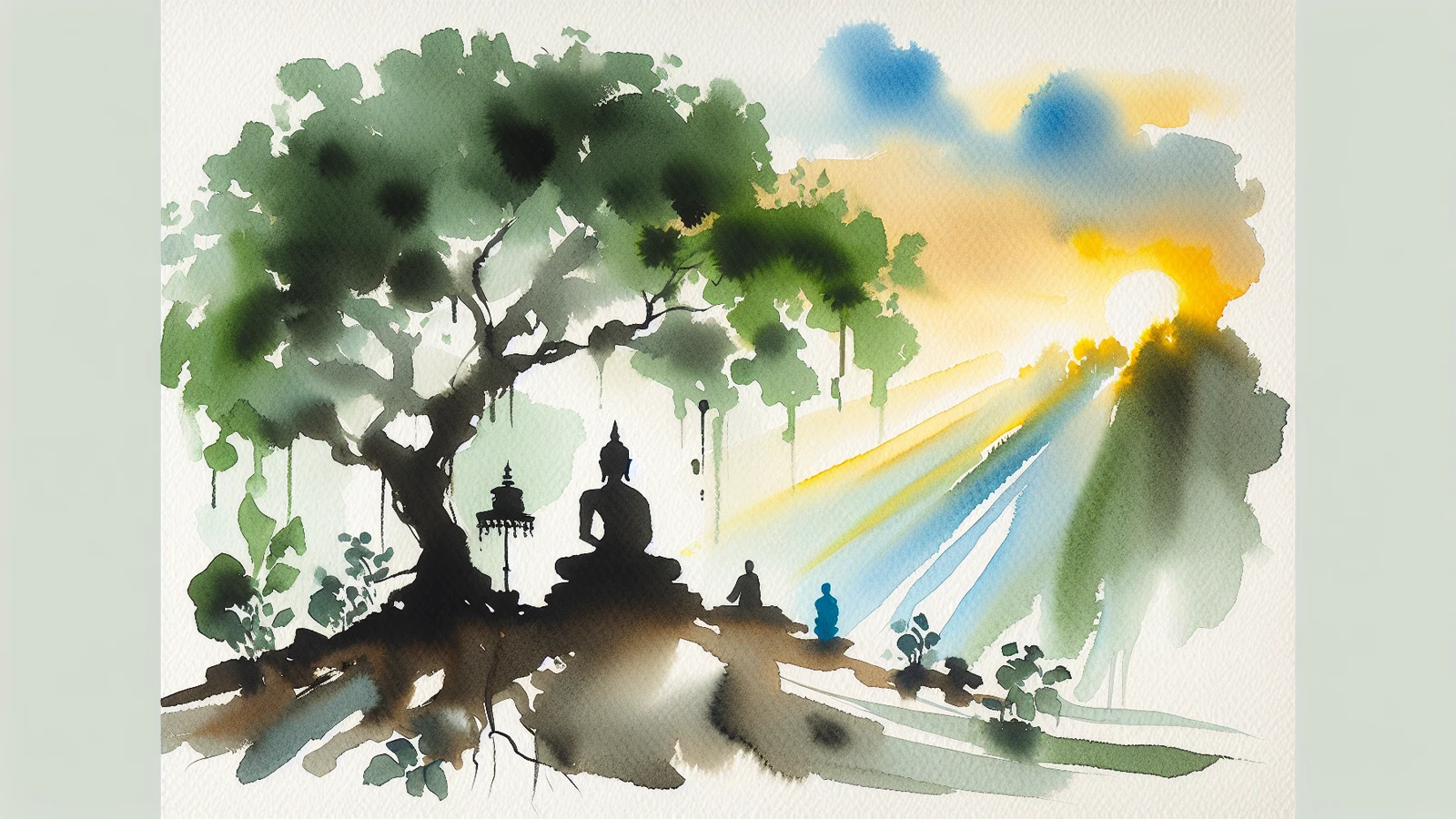
Discover Buddha's enlightenment under the Bodhi Tree—how Prince Siddhartha's desperate quest for truth became humanity's roadmap to spiritual liberation.
Under the Bodhi Tree: The Night That Changed Everything

There's a tree in India that remembers everything.
It remembers a desperate man, skeletal from years of starvation, dragging himself to its shade. It remembers him accepting a bowl of milk-rice from a village girl, the first real food he'd eaten in years. It remembers him sitting down with absolute determination, placing his hand on the earth, and declaring: “I will not move from this spot until I find the truth or I die trying.”
The tree remembers the battle that followed—not with swords or armies, but with the demons of the mind. It remembers the moment when those demons fled, when the man's face transformed, when something shifted in the very fabric of reality. It remembers the first words he spoke afterward: “I have found it.”
That tree still stands in Bodh Gaya, India. Its descendant, actually—the original died and was replanted from a cutting. But trees have long memories, passed from root to root, leaf to leaf. And millions come each year to sit in its shade, hoping to catch even an echo of what happened there 2,600 years ago, when Prince Siddhartha Gautama became the Buddha and discovered a truth so profound it would reshape half the world, celebrated annually during Vesak festivals.
The Prison of Paradise
To understand what happened under that tree, we need to understand the prison Siddhartha escaped from. It wasn't a dungeon—it was paradise itself.
Picture the most perfect life imaginable. You're a prince in ancient India. Your father, the king, has surrounded you with every pleasure: three palaces for three seasons, the most beautiful wife, dancers, musicians, the finest foods. More than that, he's hidden all suffering from you. No sick people in your sight. No elderly. Certainly no dead bodies. Your world is an eternal spring of youth and pleasure.
Most would call this heaven. Siddhartha would later call it hell.
Because here's what his father didn't understand: you can't protect someone from truth forever. And when Siddhartha finally ventured outside the palace walls, reality hit him like a physical blow. An old man, bent and struggling. A sick person, wracked with pain. A corpse being carried to cremation. And then—like a key turning in a lock—a wandering ascetic with a face of absolute peace.
“My body became extremely emaciated, just like a skeleton covered with skin.” — Majjhima Nikaya
In those Four Sights, Siddhartha's entire worldview shattered. The paradise was a lie. Everyone—king or beggar, beautiful or ugly—was heading toward old age, sickness, and death. No amount of pleasure could change that. But that ascetic's peaceful face suggested something else: maybe there was a way out.
That night, Siddhartha looked at his sleeping wife and newborn son. He could have stayed, ruled kingdoms, lived in comfort. Instead, he walked out into the darkness, trading silk robes for rags, a palace for the forest, certainty for the most dangerous question a human can ask: “Is there a way to end suffering?”

The Years of Hunger
What followed would break most people. Siddhartha didn't just leave comfort—he ran toward its opposite. He found the most extreme ascetics in India and out-asceticked them all. While they ate a handful of rice, he ate a single grain. While they meditated in the heat, he sat in the blazing sun. While they practiced breath control, he held his breath until he passed out.
For six years, he tortured his body, believing that by conquering flesh he could liberate spirit. His hip bones protruded like handles. His eyes sank so deep they looked like water at the bottom of wells. When he touched his stomach, he could feel his spine.
His five ascetic companions watched in awe. Surely this man would achieve enlightenment through sheer will. But Siddhartha was dying, not awakening. And in a moment of startling clarity—perhaps brought on by nearness to death—he remembered something.
As a child, sitting under a rose-apple tree while his father plowed the fields, he had spontaneously entered a state of perfect peace and joy. Not through forcing or straining, but through simple, natural presence—a state that would later inform meditation practices across traditions. What if he'd been going about this all wrong? What if the path wasn't through extremes but through the middle—what would become known as the Noble Eightfold Path?
When he accepted that bowl of milk-rice from Sujata, his ascetic companions abandoned him in disgust. He'd given up, gone soft. They couldn't see what he saw: that both his palace life and his ascetic life were prisons. One was a prison of indulgence, the other of denial. The door was somewhere in between.
The Night the Universe Blinked
Strengthened by food and armed with his new understanding, Siddhartha found his tree. The spot felt right—a natural throne at the base of a pipal tree (ficus religiosa), beside a river, in a grove near the village of Gaya. He gathered grass, made a cushion, sat down facing east, and made his vow.
What happened next depends on how you read it. Skeptics see a man having a profound psychological breakthrough. Believers see a cosmic event. The texts describe it as a battle with Mara, the demon of temptation, delusion, and death. But whether you read Mara as an external entity or the personification of Siddhartha's own mind, the battle was real—a cosmic struggle between light and darkness that resonates with universal spiritual themes.
First came desire. Mara sent his daughters—the most beautiful beings imaginable—to seduce Siddhartha back into the world of pleasure. He remained unmoved.
Then came fear. Mara's demon armies attacked with weapons, hurling spears and shooting arrows. In the stories, the weapons turned to flowers before they could touch him. Read psychologically: the fears that usually control us lost their power.
Finally came doubt, the subtlest enemy. “Who are you to seek enlightenment? By what right do you sit on this seat?” Here, Siddhartha made the gesture that would echo through Buddhist art for millennia. He touched the earth with his right hand. The earth itself bore witness to his countless lifetimes of preparation. He had earned this moment.
Mara fled. And in the stillness that followed, Siddhartha's mind opened like a flower.

The Three Watches of the Night
Buddhist texts divide that night into three watches, three deepening levels of insight:
First Watch: He saw all his past lives, thousands upon thousands, in various forms across countless eons. He saw the thread connecting them all—the continuity of consciousness that transcends any single lifetime.
Second Watch: He saw how all beings die and are reborn according to their karma—their intentional actions. He saw the vast machinery of cause and effect that drives existence, how every action ripples outward, shaping future experiences.
Third Watch: He saw the way out. The famous Four Noble Truths crystallized:
- Life contains suffering (dukkha)
- Suffering has a cause (craving/attachment)
- Suffering can cease (nirvana)
- There's a path to that cessation (the Eightfold Path)
As dawn broke, Siddhartha opened his eyes. But the being who opened them was no longer Siddhartha. He was Buddha—“Awakened One.” The first words tradition attributes to him: “I have conquered all; I know all; I am detached from all; I have renounced all; I am liberated through the destruction of craving. Having myself realized the truth, whom shall I call my teacher?”
The Tree That Became a Compass
Today, Bodh Gaya throbs with life. The descendant of the original Bodhi Tree stands at the center of a complex that's part archaeological site, part active temple, part spiritual United Nations. On any given day, you'll see:
- Tibetan pilgrims performing full-body prostrations, inching their way around the temple
- Thai monks in saffron robes sitting in perfect stillness
- Japanese practitioners walking meditation circuits with mechanical precision
- Western seekers with their journals and confusion and desperate hope
- Hindu pilgrims (yes, Hindu—many consider Buddha an avatar of Vishnu)
- Tourists with selfie sticks, trying to capture enlightenment in a frame
The main temple—the Mahabodhi Temple—rises like a rocket ship aimed at transcendence. Built and rebuilt over centuries, it marks THE spot, ground zero of Buddhism. Inside, a golden Buddha sits in the earth-touching gesture, forever defeating Mara, forever awakening.
But the real magic isn't in the temple. It's under the tree.
Sit there in the pre-dawn hours, before the crowds arrive. The tree's heart-shaped leaves whisper in languages older than Sanskrit. The stone diamond throne (vajrasana) where Buddha sat radiates a peculiar stillness. And sometimes—just sometimes—you can feel it: the possibility that a human being can completely transform. That suffering isn't mandatory. That there's a way out of the prison of our own minds.

The Path That Leads Everywhere
What Buddha discovered under the tree wasn't a religion—it was a technology of liberation. The Eightfold Path he taught isn't about beliefs but about practices:
Wisdom: Right understanding and intention Ethics: Right speech, action, and livelihood Mental Cultivation: Right effort, mindfulness, and concentration
Notice what's missing? No mention of God. No requirement for faith. No chosen people or eternal damnation. Just a practical program for ending suffering through your own effort. It's why Buddhism could spread from India to Greece, China to California, adapting to each culture while maintaining its core insight: suffering comes from our own minds, and we can train our minds to be free.
Today, “mindfulness”—a direct translation of the Buddhist term “sati”—has gone mainstream. Hospitals teach it for pain management. Corporations use it for productivity. Therapists prescribe it for anxiety. The tree's gift has spread far beyond any temple walls, offering practical wisdom for modern seekers.
The Echo That Never Stops
Here's the thing about that night under the tree—it's still happening. Not metaphorically. Actually.
Every time someone stops mid-argument and realizes they're defending an ego that doesn't even exist. Every time an addict puts down the bottle and sees clearly for the first time in years. Every time someone sits in traffic, late for work, and suddenly laughs at the absurdity of their own rage. That's the same awakening, just dressed in modern clothes.
A CEO in Tokyo closes a billion-dollar deal and feels... empty. She remembers the Buddha's first noble truth: even getting what you want is suffering. A teenager in Detroit, bullied to the edge, discovers meditation and finds something unbreakable inside. That's touching the same earth Buddha touched. A nurse in London, burned out from pandemic work, takes a mindfulness course and learns to watch her thoughts without drowning in them. Same tree, different century.
The Buddha's discovery wasn't just for monks in robes. It was a universal diagnosis with a universal cure. We suffer because we cling. We're free when we let go. Simple as that. Impossible as that. And somewhere between simple and impossible lies the middle way that a desperate prince found 2,600 years ago.
You know that moment when you're lying awake at 3 AM, mind racing, replaying conversations, planning arguments, defending against attacks that haven't happened yet? That's Mara. And you know that other moment—maybe it comes while washing dishes, maybe while walking—when suddenly everything stops and there's just... this? That's the dawn breaking. That's enlightenment in a teacup.

The Dawn That Never Ends
As I write this, it's dawn somewhere. And somewhere, someone is sitting under their own Bodhi Tree—maybe literal, maybe metaphorical. They're facing their own Mara, touching their own earth, finding their own middle way. The awakening that happened 2,600 years ago wasn't a one-time event. It's happening right now, always happening, wherever someone decides that suffering is not mandatory, that transformation is possible, that the prison of our own making can be escaped.
The tree in Bodh Gaya remembers the first time. But it's waiting for the next time, and the next. It's waiting for you.
Because here's Buddha's final message, the last thing he said before dying: “Work out your salvation with diligence.” Not “wait for salvation” or “pray for salvation” but “work out your salvation.” The tree is there. The seat is empty. The dawn is always about to break.
The only question is: When will you sit down?
Related Articles
- When God Whispers in Sleep: The Sacred Art of Dream Reading - spiritual awakening
- The Architecture of the Soul: How Five Ancient Practices Shape Two Billion Lives - meaning of life
- The Divine Shield: When Humanity Calls for Protection - spiritual journey
References
- Bodhi, Bhikkhu, trans. The Middle Length Discourses of the Buddha: A Translation of the Majjhima Nikaya. Boston: Wisdom Publications, 1995.
- Gethin, Rupert. The Foundations of Buddhism. Oxford: Oxford University Press, 1998.
- Harvey, Peter. An Introduction to Buddhism: Teachings, History and Practices. Cambridge: Cambridge University Press, 2013.
- Nanamoli, Bhikkhu. The Life of the Buddha According to the Pali Canon. Seattle: BPS Pariyatti Editions, 2001.
- Strong, John. The Buddha: A Short Biography. Oxford: Oneworld Publications, 2001.
About the Author
Rev'd Dr. Ayotunde Oyadiran walks between worlds. Anglican priest meets ecology scientist. Church historian meets peak performance coach. Author of three books that refuse to fit in tidy categories. He's the rare soul who can discuss 4th-century theological controversies over breakfast and cutting-edge neuroscience over lunch, finding God in both. With a PhD in Church History and an MSc in Ecology and Environmental Biology, he doesn't just study the intersection of faith and science—he lives there, building bridges for others to cross. His mission? Helping people discover that excellence and enlightenment aren't opposites but dance partners, that ancient wisdom and modern knowledge can shake hands, that you can be deeply spiritual and rigorously practical. Find him wherever transformation is happening—usually with dirt under his fingernails from both archaeological digs and community gardens.