Yin and Yang: The Dance of Duality in Spiritual Traditions
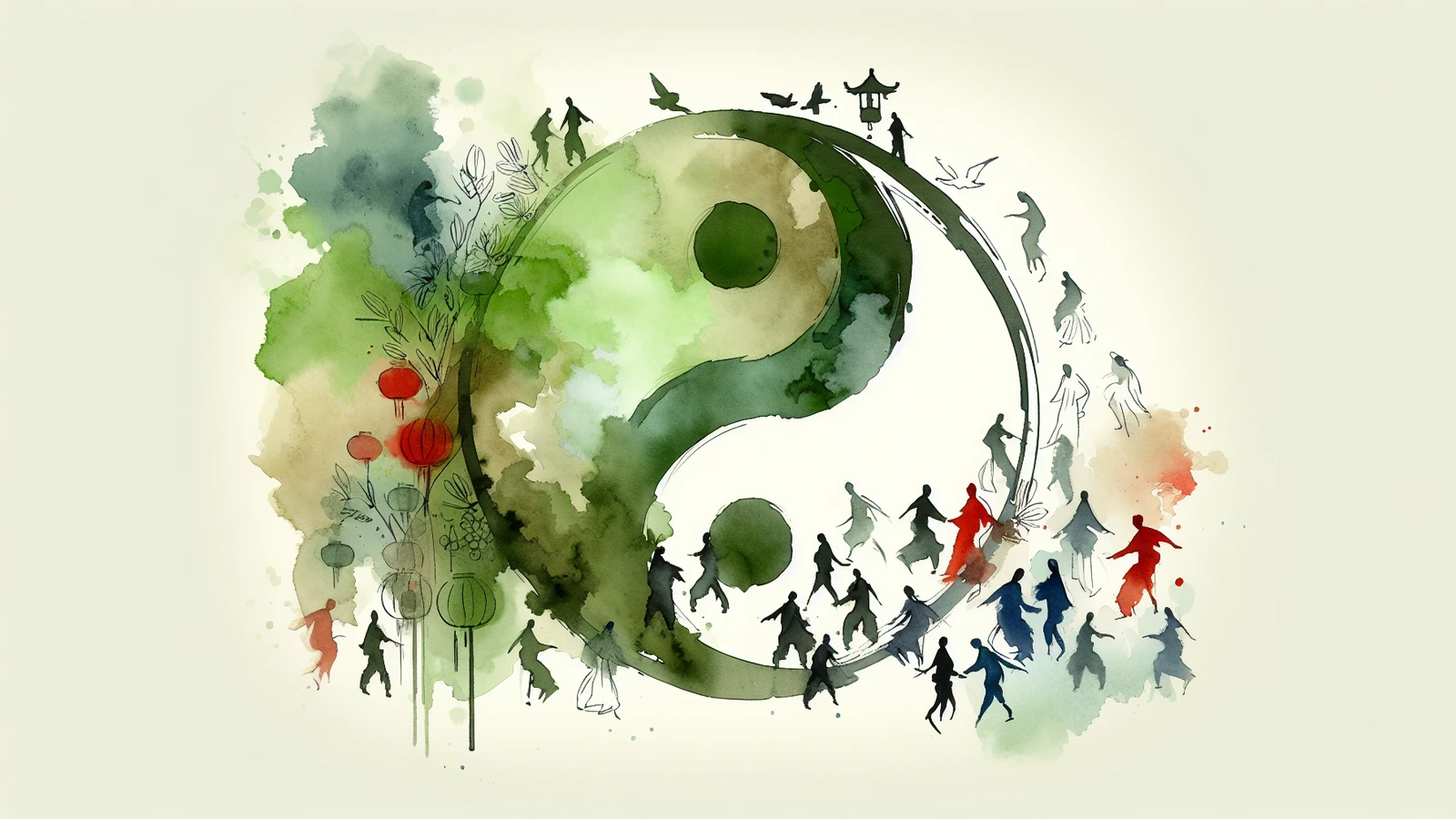
Master the ancient wisdom of Yin and Yang for perfect life balance. Apply Taoist principles to relationships, health, and personal harmony in modern life daily.
When we observe the swirling black and white of the yin-yang symbol, we are witnessing more than just a striking piece of design. We are peering into an ancient worldview that perceives life not as conflict between opposites, but as their dance. Light and dark, male and female, movement and stillness—these are not enemies, but partners. The concept of yin and yang, deeply rooted in Chinese philosophy, invites us to see the world in terms of complementarity rather than contradiction.
This exploration delves into the rich legacy of yin and yang, not only in Taoist and Confucian contexts, but also through its reflections in Hindu, Buddhist, Christian, and Islamic thought. Much like lantern festivals that illuminate spiritual paths, yin and yang lights the way to understanding universal balance. By understanding how different traditions have embraced the harmony of opposites, we uncover a universal language of balance and interdependence that speaks profoundly to our modern lives, offering wisdom that transcends cultural boundaries and speaks to the human condition itself, connecting with sacred symbols that speak across cultures.
Related Articles
- Chinese New Year: Celebration and Renewal in Eastern Faiths - Cosmic cycles and transformation
- Sacred Symbols: Universal Language of Spirituality - Symbols across spiritual traditions
- Lantern Festival: Illuminating Path Spiritual Enlightenment - Light and balance in celebration
The Cosmic Dance: How Ancient Taoism Reveals Life's Hidden Rhythm
Yin and yang are central to Taoism, where they express the dynamic polarity that animates the universe. According to the Tao Te Ching, the foundational text of Taoist thought:
“The Tao produced One; One produced Two; Two produced Three; Three produced All things. All things leave behind them the Obscurity (out of which they have come), and go forward to embrace the Brightness (into which they have emerged), while they are harmonised by the Breath of Vacancy.” — Tao Te Ching, Chapter 42

Here, yin (the dark, receptive, passive) and yang (the light, active, assertive) arise from the Tao and give birth to all phenomena. Rather than being static forces locked in eternal combat, these energies are always in flux, flowing into each other in an eternal rhythm that mirrors the very pulse of existence. The curved line of the yin-yang symbol reflects this motion, showing that nothing remains purely one thing. Within the seed of darkness lies light, and within light, the inevitable return to dark.
This cosmic rhythm governs everything: day and night, the seasons, birth and death, the ebb and flow of water, the rise and fall of dynasties. It echoes through celebrations like Chinese New Year, where the turning of cosmic cycles brings renewal and transformation. Even human physiology reflects this pattern—our heartbeat, breathing, and sleep cycles all embody the alternating dance of expansion and contraction. The Zhuangzi, another classic Taoist text, affirms:
“When yin and yang harmonize, all things flourish. When one dominates, imbalance leads to decline.” — Zhuangzi, Chapter 6
In this vision, spiritual wisdom lies not in conquering or eliminating one force in favor of another, but in aligning oneself with the Tao's flow by accepting, rather than resisting, the shifting nature of reality. The sage learns to be like water—yielding when necessary, flowing around obstacles, yet capable of wearing down the hardest stone through gentle persistence.

Beyond Philosophy: Why Confucian Balance Creates Thriving Societies
While Confucianism is more focused on social order than metaphysical speculation, yin and yang still play a vital role in shaping its ethical framework. The I Ching (Book of Changes), a cornerstone of Chinese thought used in both Taoist and Confucian traditions, is entirely built on the interactions of yin and yang lines to form hexagrams that describe different states of change and transformation.
Confucian sages interpreted yin and yang as a framework for ethics and governance that extends far beyond abstract philosophy into practical wisdom. Yang was associated with action, leadership, and responsibility; yin with nurturing, receptivity, and inner cultivation. A just ruler was one who maintained balance between firmness and compassion, between decisive decree and careful listening. The ability to know when to act and when to wait, when to speak and when to remain silent, became markers of wisdom.
The Confucian Doctrine of the Mean teaches:
“The knowing go beyond it, and the stupid do not come up to it.” — Doctrine of the Mean, Section 13

This ideal of moderation, rooted in the balancing act of yin and yang, extends into family relationships, educational practices, and ritual life. Parents must balance discipline with affection, teachers must combine rigor with encouragement, and students must integrate learning with reflection. The harmony of opposites becomes a practical guide for navigating the complexities of human relationships and social responsibility.
Divine Union: How Eastern Wisdom Transcends the Illusion of Separation

In Hinduism, the interplay of opposites finds its most profound expression in the divine dance of Shiva and Shakti. Shiva, the masculine force of stillness and consciousness, and Shakti, the feminine force of dynamism and creation, are never separate despite their apparent duality. As the Saundarya Lahari declares:
“You are the ocean of compassion and He is the moon who stirs your tides. Without You, He cannot move.” — Saundarya Lahari, Verse 1
This reflects a profound insight shared with yin and yang: that energy and awareness, feminine and masculine, are not hierarchies but co-creative partners in the cosmic dance. The iconography of Ardhanarishvara—the half-male, half-female form of Shiva—visually represents this unity of opposites, showing that the divine transcends and includes all dualities.
Buddhism, particularly in its Mahayana schools, embraces a similar logic in the concept of form and emptiness. The Heart Sutra famously proclaims:
“Form is emptiness, and emptiness is form.” — Heart Sutra
Here again, the apparent duality is transcended in a deeper unity that dissolves the boundaries between subject and object, self and other. Just as yin and yang mutually arise and cannot exist independently, form and emptiness are interdependent aspects of reality. Spiritual awakening comes not by rejecting one for the other, but by seeing their inseparability—understanding that the phenomenal world and ultimate reality are not two different things but two ways of experiencing the same truth.
The Buddhist concept of the Middle Way also reflects this balance, teaching practitioners to avoid the extremes of self-indulgence and self-mortification, finding liberation through the harmony of opposites rather than through their suppression. This teaching resonates deeply with the Noble Eightfold Path, which guides seekers toward enlightenment through balanced practice.
Sacred Paradox: Finding God in the Unity of Opposites
In Christianity, the dual themes of light and darkness are rich with symbolic meaning, yet they are not framed as cosmic enemies locked in eternal battle, but as part of a redemptive arc that encompasses the fullness of human experience. In the Gospel of John:
“And the light shineth in darkness; and the darkness comprehended it not.” — John 1:5

While the light of Christ brings clarity and revelation, the darkness is not evil in itself—it is the space in which transformation can occur, the fertile ground of mystery and growth. Saints like John of the Cross spoke of the dark night of the soul as essential to spiritual development, a necessary passage through uncertainty and surrender that leads to deeper union with the divine.
The Christian understanding of the Incarnation itself embodies this principle—the divine taking on human nature, the eternal entering time, the infinite embracing the finite. These apparent contradictions are resolved not through elimination but through integration, creating a new synthesis that honors both aspects of reality.
In Islam, the interplay of divine attributes also reflects yin-yang-like dynamics through the beautiful names of Allah. Allah is described through both Jalal (majesty, justice, power) and Jamal (beauty, mercy, compassion). The Asma'ul Husna—the 99 names of Allah—combine these traits, guiding believers to honor both awe and love, both reverence and intimacy in their relationship with the Divine. The Qur'an states:
“My mercy embraceth all things.” — Qur'an 7:156

This suggests that mercy is not a negation of justice, but its fulfillment. Like yin and yang, Jalal and Jamal reveal different aspects of one unifying reality. The believer learns to navigate between hope and fear, between reliance on divine grace and personal responsibility, finding in this tension not contradiction but a deeper harmony.
Your Life in Balance: Ancient Wisdom for Today's Polarized World
In today's polarized world, the yin-yang worldview offers a desperately needed reminder: opposites do not need to cancel each other out. They can complement, balance, and renew one another in ways that create greater wholeness and understanding.
The pressures of modern life often split us into false binaries—work versus rest, reason versus emotion, tradition versus innovation, individual versus community. Social media and political discourse frequently force us to choose sides, to be either for or against, creating an environment where nuance and complexity are lost. But spiritual traditions across the globe remind us that true wisdom lies in integration, in finding the third way that honors the partial truth in each position.
Like the Taoist sage who yields to the river's current while maintaining direction, or the Hindu devotee who embraces both Shiva and Shakti as aspects of one reality, or the Christian who finds light through darkness, we are called not to choose sides in false dichotomies, but to embrace the whole. This integration doesn't mean compromising our values or accepting everything as equally valid, but rather developing the wisdom to discern when and how to apply different approaches.
Living the Practice: Transform Theory into Daily Harmony
To honor yin and yang in practice is to honor rhythm in life, recognizing that balance is not a static state but a dynamic process of constant adjustment and recalibration. It might mean allowing space for stillness after periods of intense effort, or cultivating gentleness amidst necessary ambition. It might mean seeing another's viewpoint not as a threat to our own understanding, but as a complement that can deepen our perspective.
In relationships, this wisdom teaches us to honor both autonomy and connection, both speaking our truth and listening deeply to others. In work, it guides us to balance productivity with reflection, innovation with tradition, leadership with service. In spiritual practice, it reminds us that growth often comes through the integration of apparent opposites—effort and surrender, discipline and spontaneity, solitude and community. The practice of meditation mastery from various traditions exemplifies this balance, combining focused attention with relaxed awareness.
Interfaith understanding grows when we recognize how many paths describe the same cosmic choreography, each tradition offering its own vocabulary for the universal human experience of navigating duality. The black and white swirl of the yin-yang symbol is not about choosing a side—it is about learning the steps of the eternal dance, finding our place in the rhythm that connects all things.

In embracing this ancient wisdom, we discover that the goal is not to eliminate tension but to transform it into creative energy, not to resolve all contradictions but to find the harmony that emerges from their interplay. This is the gift of yin and yang: a vision of reality that celebrates both unity and diversity, both the one and the many, both the journey and the destination.
Integrating Yin-Yang Wisdom into Your Spiritual Journey
The ancient symbol of yin and yang offers more than philosophical insight—it provides a practical framework for navigating life's complexities with grace and wisdom. Whether you're drawn to Taoist simplicity, Confucian ethics, Hindu devotion, Buddhist mindfulness, or Abrahamic faith traditions, the principle of complementary opposites illuminates a path toward wholeness and harmony.
Discover More
- Chinese New Year: A Celebration of Renewal in Eastern Faiths - Explore Chinese New Year's profound spiritual significance through Taoism, Confucianism and Buddhism
- Lantern Festival: Illuminating the Path to Spiritual Enlightenment - Experience the magic of the Lantern Festival through colorful traditions, symbol...
- Kundalini Rising: The Serpent Power in Eastern and Western Traditions - Discover the ancient serpent power within you. Explore Kundalini's journey from spiritual traditions to modern practice
Your Guide
Elly Marimbocho is a seasoned writer with a background in Religious Studies and over a decade of experience producing long-form educational content on theology, interfaith spirituality, and world religions. Passionate about the contemplative heart of faith, Elly creates in-depth, reverent, and accessible guides that help readers engage meaningfully with religious wisdom across traditions. Her work explores diverse topics from revolutionary spiritual leaders to the healing power of interfaith prayer practices.