The Geometry of Survival: How Six Points Became a Nation's Soul
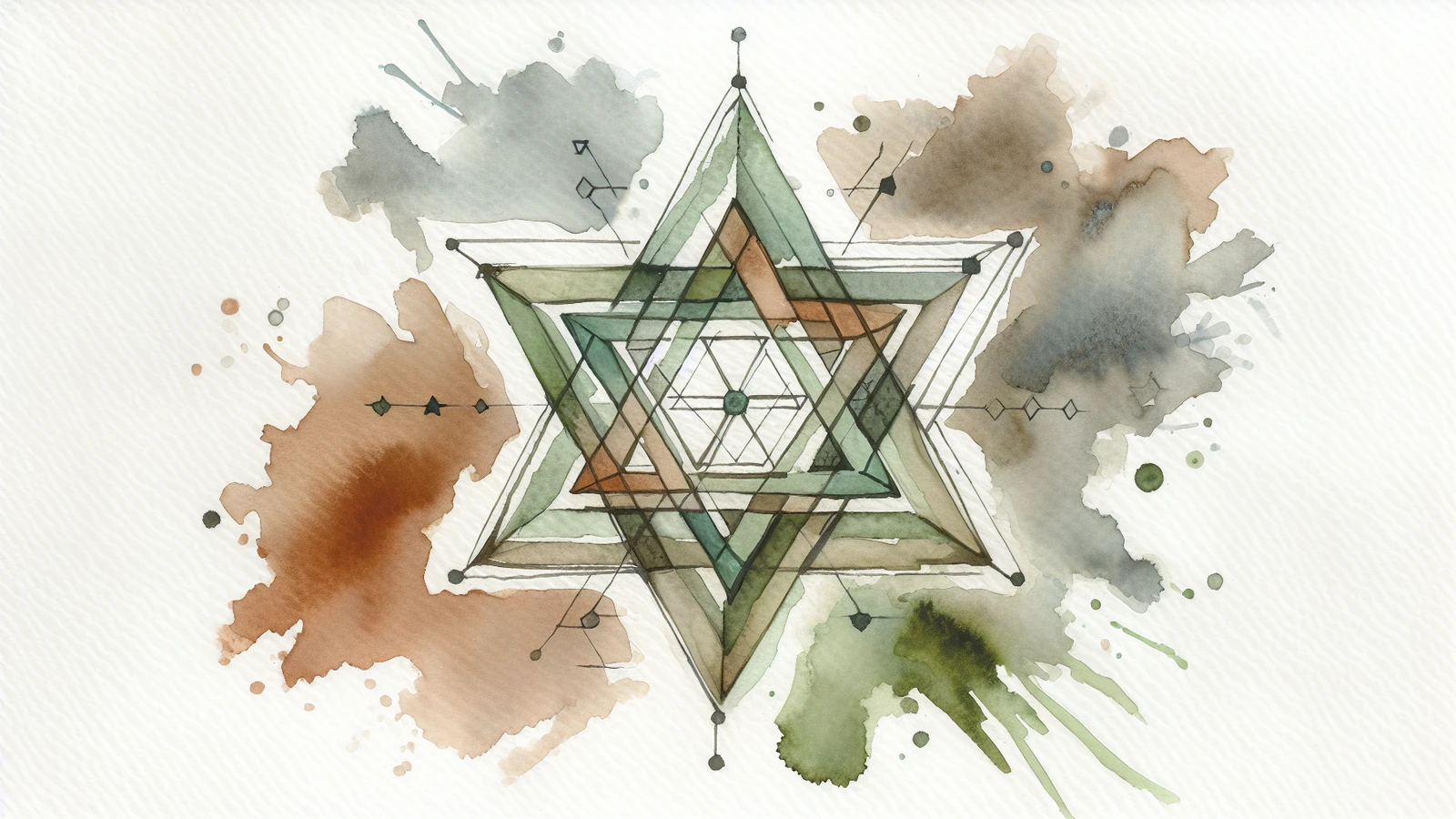
Discover how the Star of David evolved from universal symbol to Jewish identity marker. Learn its mystical Kabbalistic meanings and profound historical trans...
Here's a riddle that will break your assumptions about symbols: What if the most recognizable emblem of Judaism isn't actually Jewish? What if the Star of David—that six-pointed geometric certainty adorning Israeli flags and synagogue walls—started its life as a Hindu temple decoration, a Christian church ornament, an Islamic art motif, and a medieval magician's charm?
What if I told you that for most of Jewish history, this symbol was essentially... optional?
Stand in any major city today and flash a six-pointed star. Instant recognition: Jewish. Israeli. Ancient. Sacred. Yet this mathematical certainty of interlocking triangles carries one of history's most improbable stories—how a wandering geometric pattern became the visual DNA of an entire people.
This is the story of how meaning can be manufactured, how symbols can be stolen and reclaimed, and how six simple points learned to carry the weight of three millennia. It's a journey that parallels other sacred symbols across traditions and reveals how visual identity shapes religious experience.
The Latecomer: A Symbol Without Ancient Roots

Here's what will surprise you: The Star of David doesn't appear in the Torah. It's absent from the Talmud. For the first several thousand years of Jewish history, it was essentially a bit player—a decorative afterthought while symbols like the menorah and the lion dominated the stage.
The hexagram—two interlocking triangles—is older than Judaism itself. You can find it carved into Hindu temples from the 6th century BCE, adorning medieval Christian churches, gracing Islamic architecture, and decorating the magical grimoires of European alchemists. This universality mirrors how Jewish traditions often absorbed and transformed elements from surrounding cultures, reflecting the same adaptive wisdom seen in how the letters that refused to die preserved Torah through centuries of persecution.
Related Articles
- Sacred Symbols: Universal Language of Spirituality - Symbols across traditions
- Letters That Refused to Die: Torah Sacred Writing - Jewish textual preservation
- The Promises That Outlived Empires: Hebrew Bible Prophecy - Jewish survival through history For centuries, it was spiritual Esperanto—a universal symbol that belonged to everyone and no one.
“The geometric shape itself, the hexagram, is ancient and can be found in a variety of contexts, from Hindu temples to medieval Christian churches and Islamic art.”
So how did this cosmopolitan wanderer become exclusively Jewish? The answer lies in one of history's most unlikely adoption stories.
The Prague Moment: When Jews Claimed Their Star
The transformation began in 14th-century Prague, in one of those historical accidents that change everything. The Jewish community was granted the unprecedented right to fly their own flag—a moment of recognition in a world that usually preferred them invisible.
They chose a six-pointed star.
Not because of ancient tradition. Not because of divine command. Simply because they needed a symbol, and this one was available, beautiful, and somehow felt... right.
From Prague, the symbol spread like visual DNA through Jewish communities across Europe. By the 17th century, it was marking Jewish quarters, adorning synagogue facades, appearing on communal seals. A decorative motif was becoming an identity marker.
But here's what makes this story extraordinary: The symbol wasn't imposed from above by religious authorities. It was chosen from below, by communities asserting their right to exist, to be seen, to claim visual space in a hostile world.
The Star of David became Jewish because Jewish communities made it Jewish.
The Mystical Mathematics: Kabbalistic Sacred Geometry

Once adopted, Jewish mystics did what they do best—they found infinite meaning in finite space. The Kabbalists looked at those two interlocking triangles and saw the entire cosmos.
The upward triangle: humanity reaching toward the divine. Prayers ascending. Good deeds rising. The eternal human yearning for transcendence.
The downward triangle: divine grace descending. Blessings flowing earthward. God's presence entering the material world.
“This creates a powerful visual representation of the reciprocal relationship between the divine and the human, an idea central to Jewish spirituality.”
But they went deeper. The six outer points became the six Sefirot—divine attributes that channel God's creative power. The center point represented Malkhut, divine sovereignty manifest in the physical world.
Suddenly, this adopted symbol had become a complete theological system. A map of creation. A visual prayer. Sacred geometry made manifest.
The Philosopher's Star: Rosenzweig's Cosmic Vision
In the 20th century, the German-Jewish philosopher Franz Rosenzweig gave the symbol its most sophisticated interpretation. In his masterwork The Star of Redemption, he saw the two triangles as representing the fundamental structure of existence:
One triangle: God, humanity, and the universe—the three core elements of reality.
The other triangle: Creation (God relating to universe), Revelation (God relating to humanity), and Redemption (humanity relating to universe)—the three fundamental relationships.
The interlocking pattern revealed how everything connects to everything else, with the Jewish soul at the center, the eternal point where all relationships converge.
Rosenzweig had transformed a medieval flag design into a complete philosophical system. The Star of David became a visual theology, a geometric contemplation of existence itself.
The Shield That Failed: From Legend to National Symbol
The symbol's name—Magen David, “Shield of David”—promised protection that reality couldn't deliver. Legend claimed it adorned King David's battle shield, that its six points represented the six tribes united behind him. Beautiful story. Historical evidence: minimal.
But symbols don't need historical accuracy to carry emotional truth. The name connected the geometric present to the royal past, linking every Jewish community to the golden age of Israelite sovereignty—the same connection to ancient memory that resonates in traditions like Rosh Hashanah.
When Theodor Herzl chose the Star of David for the Zionist flag in 1897, he was making a visual argument: The Jewish people weren't just a religious community—they were a nation with ancient sovereignty and modern aspirations.
The Star of David became the banner of return, the geometric promise of a homeland restored.
The Yellow Reversal: Nazi Weaponization and Jewish Resilience

Then came the ultimate test of a symbol's power. The Nazis took the Star of David—this emblem of divine connection and national pride—and weaponized it. Yellow stars sewn onto clothing. Public marking. Mass humiliation. The transformation of an identity symbol into a death warrant.
But here's what the Nazis failed to understand about symbols: They can be stolen, but they can't be permanently redefined by their thieves.
“The same symbol used to humiliate and destroy became a source of shared strength and a visual testament to the Jewish people's resilience in the face of unimaginable evil.”
Every yellow star became an act of involuntary martyrdom. Every forced wearing became an unintended declaration of identity. The Nazis thought they were marking Jews for destruction. Instead, they were creating millions of visible testimonies to survival.
The yellow star, meant to be a badge of shame, became a badge of honor—visible proof that this people, this symbol, this geometric certainty of six points could not be erased. This transformation echoes the spiritual resilience found in Yom Kippur's message of redemption through suffering.
The Resurrection Flag: Israel's Symbolic Reclamation

May 14, 1948. The State of Israel declares independence. The flag bears a blue Star of David on white background—the same symbol the Nazis had used to mark Jews for death now flying as the emblem of a sovereign nation.
This is symbolic resurrection at its most powerful. The star that had been weaponized was now reclaimed, elevated, transformed from a mark of persecution into a banner of independence.
Every Israeli flag becomes a visual argument: This people survived. This symbol endured. This six-pointed geometric pattern carries within its angles the entire arc of Jewish history—ancient wandering, medieval adoption, mystical interpretation, modern persecution, ultimate redemption.
The Living Symbol: Modern Expressions of Ancient Identity
Today, the Star of David lives in countless forms:
Jewelry worn close to the heart—personal declarations of identity that travel the world, carrying the symbol into boardrooms and classrooms, concerts and coffee shops.
Synagogue facades and ritual objects—marking sacred space, adorning prayer books, decorating kiddush cups, transforming the functional into the holy.
Community centers and gravestones—signaling belonging, marking memory, creating visual bonds that transcend geography and generation.
But perhaps most powerfully, it lives as a mathematical certainty in an uncertain world—proof that meaning can be manufactured, that symbols can survive their misuse, that six points properly arranged can carry the entire weight of a people's story.
The Universal Question: How Symbols Acquire Meaning
The Star of David poses a challenge that extends far beyond Jewish identity: How do symbols acquire meaning? Can ancient patterns carry modern truths? What transforms decoration into devotion?
In our age of viral images and instant symbols, the Star of David offers something rare: a symbol that earned its meaning slowly, through adoption rather than imposition, through community choice rather than religious commandment. This organic evolution mirrors how Jewish traditions preserved their identity through centuries of diaspora.
It suggests that the most powerful symbols aren't necessarily the oldest or the most obviously sacred—they're the ones that communities embrace, invest with meaning, and refuse to abandon even when those symbols are stolen and misused.
The Star of David didn't start Jewish, but it became Jewish through the persistent choice of Jewish communities to make it theirs. In a world where identity seems increasingly fluid, it offers the radical possibility that meaning can be created through commitment, that symbols can be adopted and transformed through collective will.
Six points. Two triangles. Infinite meaning.
In the mathematics of survival, sometimes the simplest equations carry the most complex truths. Like the enduring power of the Ten Commandments, simple forms can carry infinite meaning across millennia.
The Star of David isn't just a Jewish symbol—it's proof that any group of people, given enough time and conviction, can take a wandering geometric pattern and turn it into the visual expression of their soul.
The real secret message hidden in those six points? That meaning itself can be made, remade, and made again—one community, one choice, one star at a time.
References
- Aish.com. (n.d.). Star of David (Magen David): Origins & Meaning of the Jewish Star. Retrieved from https://aish.com/star-of-david-3/
- Britannica. (n.d.). Star of David | Meaning, Image, & Facts. Retrieved from https://www.britannica.com/topic/Star-of-David
- Chabad.org. (n.d.). The Star of David - Kabbalistic Insights Into the Jewish Star. Retrieved from https://www.chabad.org/library/article_cdo/aid/788679/jewish/The-Star-of-David.htm
- EBSCO Research Starters. (n.d.). Star of David. Retrieved from https://www.ebsco.com/research-starters/communication-and-mass-media/star-david
- Klein, R. (2006). A Practical Guide to Jewish Life. Jewish Lights Publishing.
- My Jewish Learning. (n.d.). What is the Star of David?. Retrieved from https://www.myjewishlearning.com/article/star-of-david-hot-topic/
- Rosenzweig, F. (1985). The Star of Redemption. University of Notre Dame Press.
- Scholem, G. (1949). Kabbalah. Meridian Books.
- Telushkin, J. (1991). Jewish Literacy: The Most Important Things to Know About the Jewish Religion, Its People, and Its History. William Morrow.
- Wikipedia. (n.d.). Star of David. Retrieved from https://en.wikipedia.org/wiki/Star_of_David
Related Articles
- Sacred Symbols: The Universal Language of Spirituality - Explore how different faiths use visual symbols to express divine truths
- The Letters That Refused to Die: A Journey Into Sacred Writing - Discover how Jewish tradition preserved sacred texts through millennia
- The Threads That Bind Heaven: A Journey Into Sacred Covering - Learn about other Jewish ritual objects and their spiritual significance
About the Author
Rev'd Dr. Ayotunde Oyadiran is a Priest of the Anglican Church who brings a unique perspective to the exploration of faith and spirituality. Holding a PhD in Church History and an MSc in Ecology and Environmental Biology, he bridges the worlds of faith, science, and human experience. As the author of over three books, Dr. Oyadiran has explored themes of spirituality, personal growth, and environmental stewardship. He also works as a coach and trainer on peak performance, helping individuals unlock their potential and achieve their goals. His passion is empowering others to live purposeful, high-impact lives that integrate faith, wisdom, and excellence.