Mount Tai: China's Sacred Peak and Its Spiritual Significance
Explore Mount Tai, China's holiest mountain where emperors performed sacred rituals for divine mandate and Confucianism, Taoism, and Buddhism converge in har...
Mount Tai: China's Sacred Peak and Its Spiritual Significance

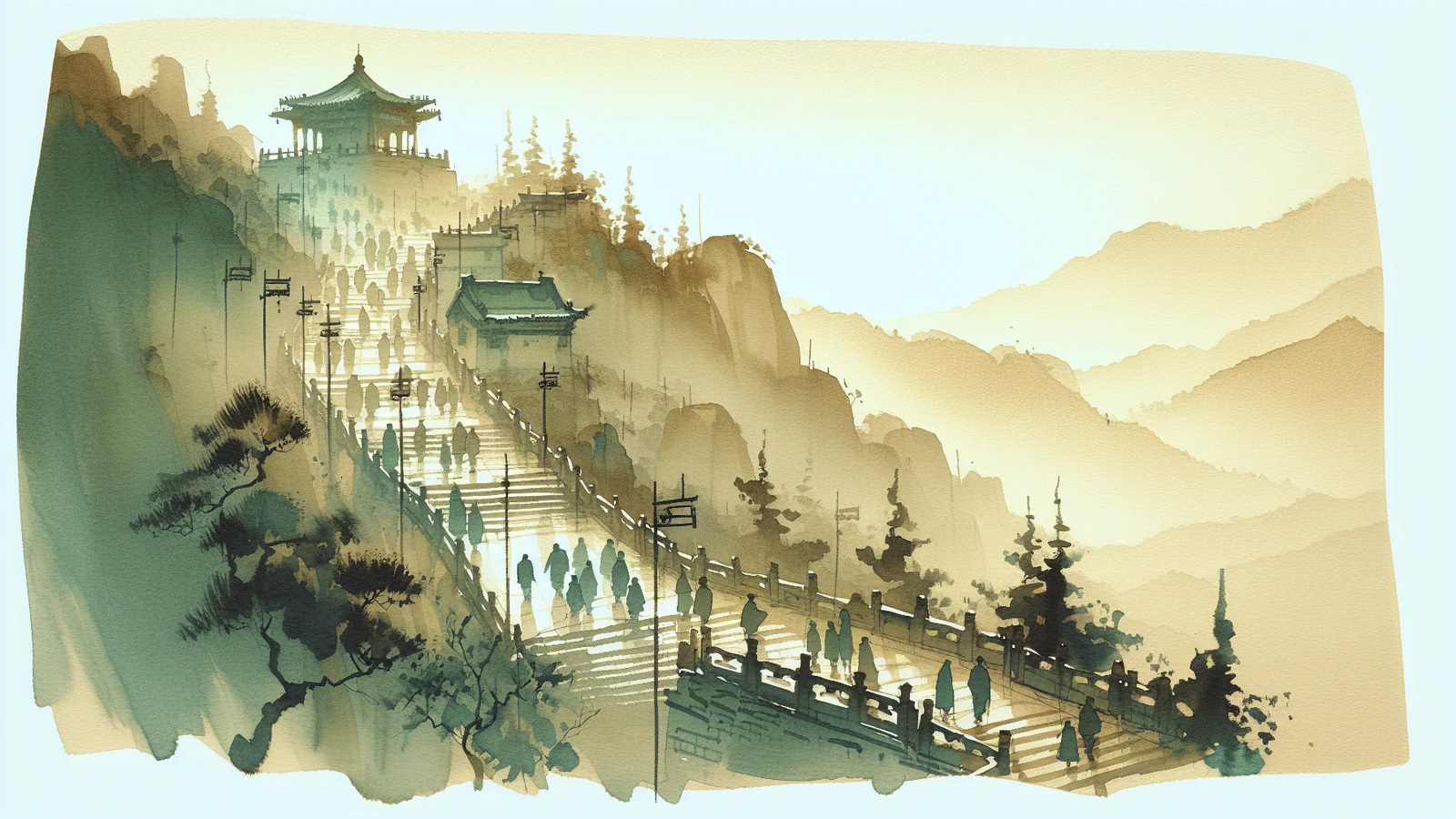
Mount Tai, rising majestically in China's Shandong province, has for thousands of years been regarded as one of the holiest sites in East Asia. More than a mountain, it is a sacred bridge between heaven and earth, a place where emperors affirmed their mandate to rule, sages sought spiritual insight, and pilgrims ascended in devotion. Its presence in Chinese history, philosophy, and religion is profound, shaping Confucian, Taoist, and Buddhist traditions alike. As Confucius once said of his most diligent disciple,
“Alas for Hwui! I saw him ever making progress. I never saw him stopping short.” — The Analects 9.28

These words of perseverance and steady advancement echo the enduring journey of pilgrims climbing Mount Tai, a path that symbolizes moral growth and spiritual elevation.
Standing at 1,545 meters above sea level, Mount Tai commands respect not merely through its physical prominence but through its extraordinary cultural weight. Like other sacred symbols that serve as universal language of spirituality, the mountain transcends its physical form to embody profound spiritual meaning. The mountain's slopes have witnessed the footsteps of countless pilgrims across millennia, each stone step worn smooth by generations seeking divine favor, moral clarity, or spiritual transformation. Its ancient pine trees, weathered stone inscriptions, and temple complexes create a landscape where the natural and sacred seamlessly converge.
Mount Tai as the Axis of Heaven and Earth in Ancient Chinese Cosmology and Imperial Ritual
In early Chinese cosmology, the five sacred mountains, or Wuyue, symbolized the pillars of the world, with Mount Tai representing the east and the rising sun. Because it greeted each new day first, it came to embody renewal, vitality, and divine favor. As early as the Shang and Zhou dynasties, rulers regarded Mount Tai as the cosmic altar where human authority met celestial will.
The mountain's eastern position held particular significance in Chinese philosophical thought. East represented the beginning, the source of life-giving energy, and the direction from which enlightenment emerges. This cosmic orientation made Mount Tai the natural choice for imperial ceremonies that sought to align earthly governance with heavenly principles. The very geography of the mountain seemed to declare its divine purpose, with its gradual ascent symbolizing the spiritual journey from earthly concerns to celestial wisdom.
Emperors performed the grand Feng and Shan sacrifices at the mountain's peak to affirm their legitimacy as the “Son of Heaven.” Historical records show that seventy-two emperors undertook these rites, believing that divine approval was essential for maintaining cosmic balance.

These elaborate ceremonies required months of preparation and involved complex rituals designed to demonstrate the emperor's worthiness. The Feng sacrifice, performed at the summit, involved offerings to Heaven, while the Shan sacrifice, conducted at the mountain's base, honored Earth. This dual ceremony symbolized the emperor's role as mediator between celestial and terrestrial realms, responsible for maintaining harmony between all levels of existence.
These ceremonies symbolized the bond between governance and virtue. Confucius taught,
“A director should be himself correct. If you, sir, as a leader show correctness, who will dare not to be correct?” — The Analects 12.38
Emperors ascended Mount Tai not only to sacrifice but also to present themselves as moral rulers aligned with heaven's order. The physical act of climbing represented the moral elevation required of just leadership, while the summit ceremonies proclaimed their commitment to virtuous governance before both divine and human witnesses.
A Mountain Revered Across Confucian, Taoist, and Buddhist Traditions
Confucianism venerates Mount Tai for its moral symbolism and historical association with sages and rulers. Its height and prominence made it a metaphor for virtue and steadfastness. Confucius's own pilgrimage reinforced its status as a site of humility and moral reflection. The mountain embodied the Confucian ideal of cultivation through challenge, where moral character was forged through perseverance and dedication.
Confucian scholars established academies on the mountain's slopes, where students contemplated the relationship between personal virtue and social responsibility. The mountain's demanding ascent became a metaphor for the lifelong journey of self-improvement that Confucian teaching emphasized. Each temple and pavilion along the climbing route served as a station for reflection on moral principles and their practical application.
For Taoists, Mount Tai is one of the holiest mountains, believed to house celestial immortals. Taoist texts affirm that aligning oneself with the Dao requires simplicity and harmony:
“The great Tao (or way) is very level and easy; but people love the by-ways.” — Tao Te Ching 53.2

Taoist temples on the mountain hosted elaborate rites for longevity, harmony, and spiritual refinement.

The Taoist presence on Mount Tai dates back over two millennia, with hermit sages establishing retreats in remote caves and valleys. These mystics sought to harmonize with the mountain's natural rhythms, observing the changing seasons, the movement of clouds, and the behavior of wildlife as sources of spiritual insight. Taoist alchemists believed that the mountain's unique energy made it an ideal location for cultivating elixirs of immortality and practicing internal energy cultivation techniques.
Buddhism also flourished on Mount Tai, especially during the Tang dynasty, when monasteries and temples became prominent. Dai Temple, one of the largest Taoist-Buddhist complexes, reflects centuries of syncretism in Chinese spirituality. Monks ascended the mountain for meditation, believing that its elevation symbolically brought them closer to enlightenment.
Buddhist influence introduced new architectural styles and artistic traditions to the mountain. Pagodas and meditation halls were constructed at strategic points along the climbing routes, providing spaces for contemplation and rest. Buddhist sculptures and paintings adorned temple walls, depicting scenes from the Buddha's life alongside traditional Chinese motifs, creating a unique fusion of artistic traditions that reflected the mountain's role as a meeting ground for diverse spiritual practices.
The Role of Poetry, Literature, and Art in Immortalizing Mount Tai's Spiritual Grandeur
Beyond imperial and religious rituals, Mount Tai inspired generations of poets, scholars, and artists. The celebrated poet Du Fu praised its grandeur: “How is one to describe Mount Tai? Its green mass glows through the sky.” Such depictions transformed the mountain into a cultural icon of perseverance, majesty, and spiritual aspiration.
The literary tradition surrounding Mount Tai spans over two thousand years, with each dynasty contributing new layers of meaning to its cultural significance. Poets found in the mountain's changing moods—from misty dawn ascents to dramatic sunset views—metaphors for human emotion and spiritual states. The mountain's seasonal transformations, from spring blossoms to winter snows, provided endless inspiration for artistic expression.
Pilgrimages became common among commoners and elites alike. Ascending its 7,000 stone steps was seen as a moral journey, each step representing progress toward virtue. Travelers left inscriptions carved into the cliffs, blending devotion and art.
“Even though a speech be a thousand (of words), but made up of senseless words, one word of sense is better” — Dhammapada 100

resonates with the pilgrim's desire for meaningful spiritual ascent.

These stone inscriptions, numbering in the thousands, create an open-air museum of Chinese calligraphy and thought. Emperors, scholars, poets, and common pilgrims all left their marks, creating a dialogue across centuries carved in stone. The inscriptions range from grand imperial proclamations to humble personal prayers, collectively forming a testament to the mountain's enduring appeal across all levels of society.
Mandate of Heaven and the Sacred Politics of Mount Tai
Mount Tai's association with the Mandate of Heaven made it central to Chinese political theology. Emperors who ruled justly affirmed their heavenly right through sacrifices on its summit, while unjust rulers risked losing divine favor. The rituals symbolized the moral contract between heaven and the ruler, echoing Confucian ethics.
The concept of the Mandate of Heaven, intimately connected with Mount Tai's ceremonies, provided a theological foundation for political legitimacy while simultaneously establishing limits on imperial power. Rulers understood that their authority depended not merely on military might or hereditary claims, but on their moral worthiness as judged by heaven itself. This created a system of accountability that transcended human institutions.
“To govern upon principles of virtue, and to reduce them to order by the Rules of Propriety, would not only create in them the sense of shame, but would moreover reach them in all their errors.” — The Analects 2.5
Such teachings framed the emperor's ascent of Mount Tai as more than ritual; it was a public act affirming virtue-based leadership.
Interplay of Belief Systems: A Shared Sacred Landscape
Mount Tai is a rare site where Confucian, Taoist, and Buddhist elements coexist harmoniously. Taoist altars, Buddhist temples, and Confucian inscriptions intertwine, reflecting China's unique religious pluralism. Taoist sages sought immortality, Buddhists pursued enlightenment, and Confucian scholars contemplated moral duty—all upon the same mountain.
This confluence mirrors a broader truth that sacred spaces can transcend doctrinal boundaries.
“He who knows (the Tao) does not (care to) speak (about it); he who is (ever ready to) speak about it does not know it.” — Tao Te Ching 56.1
encapsulates the ineffable mystery that Mount Tai has always represented, a place where silence can speak louder than proclamation.
The mountain's ability to accommodate diverse spiritual traditions while maintaining its distinct identity demonstrates the inclusive nature of Chinese religious culture. This harmonious integration of different spiritual paths reflects themes found in celebrating Chinese New Year as a celebration of renewal, where multiple traditions unite. Rather than creating conflict, these different approaches to the sacred enriched each other, with Confucian emphasis on moral cultivation complementing Taoist pursuit of natural harmony and Buddhist focus on compassionate wisdom. This syncretic approach, similar to how Chinese New Year brings together multiple traditions, creates harmony between different spiritual traditions at many sacred sites worldwide.

Modern Relevance and Continuing Pilgrimages to Mount Tai
Today, Mount Tai remains a UNESCO World Heritage Site and an active center of spiritual and cultural life. Pilgrims continue to climb its steep paths, and rituals, festivals, and temple offerings persist. Its legacy stands as a reminder of the enduring connection between land, culture, and the divine.
Modern pilgrims represent a fascinating blend of traditional believers and contemporary seekers. Some climb for explicitly religious purposes, following ancient customs and offering prayers at traditional shrines. Others ascend seeking personal challenge, cultural connection, or simply the peace that mountain solitude provides. Yet even secular climbers often find themselves moved by the mountain's spiritual atmosphere, suggesting that its sacred power transcends specific religious frameworks.
Tourists ascend for scenic beauty, but many also seek moral and spiritual renewal, echoing ancient traditions. In modern interfaith dialogues, Mount Tai is often cited as an example of sacred geography's ability to unite diverse practices while preserving cultural heritage. The mountain demonstrates that sacred spaces can bridge generations and beliefs, offering a shared sense of reverence. Like Zen and the art of universal mindfulness, Mount Tai demonstrates how ancient wisdom remains relevant for modern spiritual seekers. Similar to Ise Grand Shrine in Japan, Mount Tai shows how sacred sites can maintain relevance across millennia.
Mount Tai as a Symbol of Enduring Virtue and Cosmic Harmony
Mount Tai's prominence in Chinese history is inseparable from its role as a spiritual and cultural axis. It embodies the ancient belief that leadership must align with virtue and divine order.
“Let a ruler base his government upon virtuous principles, and he will be like the pole-star, which remains steadfast in its place, while all the host of stars turn towards it.” — The Analects 2.2
The mountain's rituals and symbolism reinforced the profound link between moral governance and cosmic stability.
Even in a rapidly modernizing world, Mount Tai continues to inspire reflection on humanity's relationship with nature, morality, and the transcendent. It remains a living testament to the idea that true authority, like the mountain itself, is rooted in enduring values and a higher order. The mountain stands as proof that some truths transcend historical periods, speaking to fundamental human needs for meaning, connection, and spiritual grounding that remain constant across millennia.
Related Articles
- Chinese New Year: A Celebration of Renewal in Eastern Faiths - Explore how Confucianism, Taoism, and Buddhism shape this vibrant celebration
- Yin and Yang: The Dance of Duality in Spiritual Traditions - Understand the philosophical foundations underlying Mount Tai's significance
- Sacred Symbols: The Universal Language of Spirituality - Discover how sacred mountains serve as universal symbols across cultures
About the Author
Elly Marimbocho is a seasoned writer with a background in Religious Studies and over a decade of experience producing long-form educational content on theology, interfaith spirituality, and world religions. Passionate about the contemplative heart of faith, Elly creates in-depth, reverent, and accessible guides that help readers engage meaningfully with religious wisdom across traditions.