When Sleep Becomes Prophecy: The Ancient Art of Reading Tomorrow's Shadow
Explore Jewish dream interpretation from Jacob's ladder to modern psychology. Discover how ancient rabbinical wisdom decodes sleep's spiritual language in dr...
Close your eyes. Surrender to the darkness. Let consciousness slip away like water through your fingers. In that liminal space between waking and sleep, between the known and the unknowable, something extraordinary happens.
You begin to dream.
But what is a dream? Random neural static? Psychological debris from the day's experiences? Or something far more mysterious—a crack in the fabric of time itself, a whispered message from realms beyond the reach of ordinary consciousness?
For three millennia, Jewish tradition has insisted on the latter. Dreams aren't just neurological noise—they're divine telecommunications, spiritual GPS systems, prophecy's younger sibling trying to get your attention. This understanding resonates across faiths, from Islamic dream interpretation to Christian visions and prophetic dreams found across traditions.
“A dream is a sixtieth part of prophecy.” — Talmud, Berakhot 57b
One-sixtieth. Not much, perhaps. But in a world where direct prophecy has fallen silent, even a fraction of divine communication becomes precious beyond measure.
This is the story of how an ancient people learned to read the language of sleep, to decode the grammar of the unconscious, and to find tomorrow's truth hidden in tonight's visions.
Jacob's Divine Encounter: The Ladder That Changed Everything

The story begins with a fugitive sleeping on stones.
“Dreams are the seedlings of reality.” — Jewish proverb
Jacob is running for his life, fleeing his brother's murderous rage. Exhausted, he stops as the sun sets, gathers stones for a pillow, and surrenders to sleep. What happens next transforms not just his life, but the entire understanding of what dreams can be.
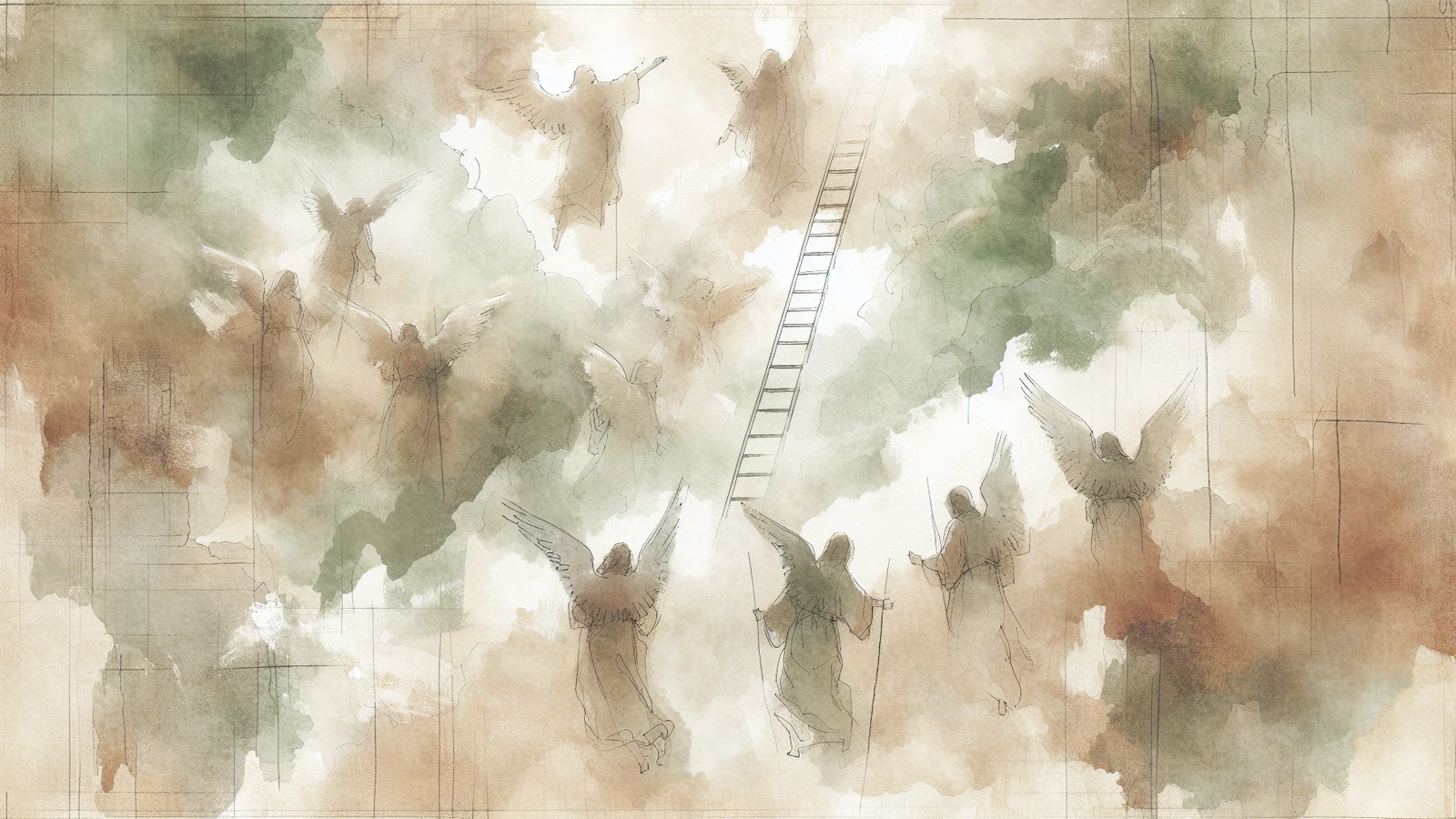
He sees a ladder stretching from earth to heaven, with angels ascending and descending in an endless procession. At the top stands the divine presence itself, offering promises that will echo through history:
“The land on which you lie I will give to you and to your offspring... I am with you and will keep you wherever you go.” — Genesis 28:13-15
When Jacob awakens, he's trembling. Not from fear, but from awe. He's discovered something that changes everything:
“Surely the Lord is in this place, and I did not know it... This is none other than the house of God, and this is the gate of heaven.” — Genesis 28:16-17
The place where he sleeps becomes Bethel—“House of God.” But the real revelation isn't geographical; it's ontological. Dreams, Jacob has discovered, can be doorways. Sleep can become sanctuary. The unconscious mind can host divine encounters.
This isn't just personal mystical experience—it's the birth of a new understanding of how heaven communicates with earth.
Joseph's Gift and Curse: The Dreamer Who Saved Nations
If Jacob's dream established the principle, Joseph's dreams demonstrated the power. But Joseph's story is also a masterclass in how divine gifts can become dangerous weapons when wielded without wisdom.
Picture a seventeen-year-old boy, beloved by his father, already resented by his brothers. Then come the dreams:
Sheaves of wheat bowing down to his sheaf. The sun, moon, and eleven stars prostrating before him.
Joseph tells these dreams with all the tact of a teenager announcing he's destined for greatness. The result? His brothers' jealousy erupts into violence. They sell him into slavery, telling their father he's dead.
Dreams of future glory become the catalyst for present suffering.
But here's where the story becomes extraordinary. Years later, in an Egyptian prison, Joseph encounters two fellow prisoners troubled by dreams they can't understand. Joseph interprets their dreams with startling accuracy—one man will be restored to favor, the other executed.
“Do not interpretations belong to God? Please tell them to me.” — Genesis 40:8
Joseph has learned something crucial: Dream interpretation isn't about human cleverness—it's about divine revelation channeled through human consciousness.
The climax comes when Pharaoh himself is tormented by dreams no one can interpret. Seven fat cows devoured by seven thin ones. Seven plump ears of grain consumed by seven withered ones.
Joseph's interpretation saves not just Egypt, but the entire known world. Seven years of abundance followed by seven years of famine. A nation prepares, stockpiles grain, and survives. Joseph's dreams of future greatness are finally fulfilled—not through arrogance, but through service. This story, preserved with meticulous care in the sacred Hebrew scriptures, demonstrates how divine communication operates through human consciousness.
The message is clear: Dreams can carry world-changing information. But their power depends entirely on how they're received, interpreted, and acted upon.
Wisdom from the Sages: The Rabbinic Revolution

After the biblical era, as direct prophecy faded from human experience, the rabbis faced a crucial question: If God no longer speaks through burning bushes and heavenly voices, where do we find divine communication?
Their answer was nuanced, practical, and psychologically sophisticated. Dreams, they taught, come from three sources:
- Divine origin: True messages from God (rare but real)
- Angelic messengers: Spiritual guidance from intermediate beings
- Demonic deception: Misleading visions designed to confuse
- Human psychology: Processing of daily experiences, anxieties, desires
“A man is shown in a dream only the thoughts of his heart.” — Berakhot 55b
Most dreams, the rabbis concluded, are psychological—the mind's way of processing experience. But some carry genuine spiritual significance. The challenge is discernment.
But here's where Jewish dream interpretation becomes revolutionary: The rabbis taught that interpretation itself shapes reality.
“A person's dreams follow the interpretation of his mouth.” — Berakhot 56a
Tell someone a positive interpretation of their troubling dream, and you help create a positive outcome. This gave birth to hatavat chalom—“improving a dream”—a ritual where bad dreams are symbolically reinterpreted to avert negative consequences.
Imagine the psychological power of this practice. You wake from a nightmare, gather three friends, and together you reframe the disturbing images as positive omens. Fear transforms into hope. Anxiety becomes anticipation.
The rabbis had discovered something profound: We're not passive recipients of fate—we're active participants in creating our reality through the power of interpretation and speech. This transformative approach to meaning-making connects to broader Jewish practices of spiritual renewal, much like the profound introspection found in Yom Kippur's day of atonement.
“All dreams follow the mouth of the interpreter.” — Rabbi Eleazar, Talmud
Decoding Divine Messages: The Symbolic Universe
Jewish dream interpretation operates through a rich symbolic vocabulary developed over centuries:
Water = Torah and spiritual wisdom (dreams of clean springs indicate spiritual growth)
Trees = Righteous individuals (flourishing trees represent a fruitful life)
Animals = Various spiritual forces (lions = divine strength, snakes = evil inclination)
Numbers = Hidden meanings through gematria (seven = completion, four = cosmic wholeness)
This isn't arbitrary symbolism—it's a coherent spiritual language rooted in biblical imagery and rabbinic wisdom. Similar symbolic systems exist in other sacred traditions, each culture developing its own dream lexicon based on sacred symbols that transcend cultural boundaries. To dream in this tradition is to participate in a cosmic conversation using symbols that have carried meaning for millennia.
Maimonides' Balance: The Rationalist Rebellion
Not everyone bought into the mystical approach. Maimonides, the great philosopher-physician, brought rigorous skepticism to dream interpretation:
Most dreams, he argued, are simply psychological processing. True divine dreams are extraordinarily rare, experienced only by the most spiritually refined individuals.
“The imaginative faculty during sleep... may sometimes hit upon truth by chance, but this is not necessarily a prophetic dream.”
Maimonides' rationalism provides crucial balance. It prevents the reduction of every random dream to divine significance while still allowing for genuine spiritual experiences.
His approach reflects a fundamental tension in Jewish thought: How do we remain open to the miraculous while maintaining intellectual integrity?
Ancient Wisdom Meets Neuroscience: Dreams in the Digital Age

In our era of neuroscience and sleep studies, Jewish dream interpretation faces new challenges and opportunities. We know that REM sleep serves crucial psychological functions—memory consolidation, emotional processing, creative problem-solving.
But contemporary Jewish thinkers find ways to integrate scientific understanding with spiritual wisdom. Chasidic thought, for example, views dreams as divine providence working through natural psychological processes.
A dream about losing something might simultaneously be:
- Psychological processing of real-world anxiety
- Spiritual metaphor for a lost aspect of the soul
- Divine guidance pointing toward areas needing attention
The modern approach doesn't require choosing between scientific and spiritual explanations—it integrates them into a more complete understanding. This parallels how modern spirituality bridges ancient wisdom and contemporary knowledge.
Cultivating Dream Wisdom: The Practice of Sacred Sleep
For those drawn to this tradition, Jewish dream wisdom offers practical approaches:
Before Sleep: Set intention for meaningful dreams through prayer or meditation, drawing on contemplative practices that meditation traditions worldwide have refined over centuries
Upon Waking: Record dreams immediately, before rational mind dismisses them
Interpretation: Look for personal rather than universal meanings
Community: Share troubling dreams with trusted friends for reframing
Action: Let dream insights guide real-world choices and spiritual growth
The goal isn't to become a professional dream interpreter—it's to develop sensitivity to the subtle ways divine guidance might operate through natural psychological processes.
Between Matter and Spirit: The Eternal Question
Jewish dream interpretation poses a question that every culture must answer: Is consciousness purely material, or does it touch something beyond the physical world?
In our age of materialistic reductionism, the Jewish tradition offers a different possibility. What if consciousness is the interface between physical and spiritual realms? What if dreams are the natural state where this interface operates most freely?
You don't need to believe in literal divine communication to find value in treating dreams as meaningful. The simple act of paying attention to your dreams, looking for patterns and insights, can lead to greater self-understanding and wisdom.
The Jewish approach suggests that the line between psychological and spiritual is itself an artificial boundary. Perhaps the divine works through natural processes rather than despite them. Perhaps God speaks through neurons and neurotransmitters just as readily as through burning bushes.
Tonight's Portal to Mystery: The Invitation of Sleep

Every night, as you close your eyes and surrender to sleep, you're entering a realm that has fascinated humanity since consciousness first emerged. You're participating in an ancient mystery that connects you to Jacob's ladder, Joseph's prison cell, and countless dreamers across the centuries.
The Jewish tradition of dream interpretation offers a framework for engaging with this mystery—not as superstition, but as spiritual technology for accessing wisdom, processing experience, and connecting with something larger than ordinary waking consciousness.
Whether you view dreams as divine communication, psychological processing, or some combination of both, the Jewish approach offers valuable insights:
- Pay attention to your dreams—they carry information worth exploring
- Interpretation shapes reality—how you understand your dreams affects their impact
- Community matters—sharing dreams with trusted others can provide new perspectives
- Integration is key—let dream insights influence your waking life
In our hyperconnected, always-on culture, perhaps we need the ancient wisdom of sleep more than ever. In dreams, we return to a slower rhythm, a deeper knowing, a connection to truths that daylight consciousness often obscures.
Tonight, when you close your eyes, remember: You're not just going to sleep.
You're opening a doorway to mystery, stepping into a realm where tomorrow's truth might whisper its secrets through today's dreams.
Listen carefully. The angels might still be climbing Jacob's ladder.
And one of them might have a message just for you.
References
- Aish.com. (n.d.). Dream Interpretation in the Torah. Retrieved from https://www.aish.com/sp/ph/Dream_Interpretation_in_the_Torah.html
- Chabad.org. (n.d.). Dreams in Chasidic Thought. Retrieved from https://www.chabad.org/library/article_cdo/aid/100416/jewish/Dreams-in-Chasidic-Thought.htm
- Klein, R. (2006). A Practical Guide to Jewish Life. Jewish Lights Publishing.
- Maimonides, M. (1963). The Guide for the Perplexed. (S. Pines, Trans.). University of Chicago Press.
- My Jewish Learning. (n.d.). Dreams in Jewish Tradition. Retrieved from https://www.myjewishlearning.com/article/dreams-in-jewish-tradition/
- Telushkin, J. (1991). Jewish Literacy: The Most Important Things to Know About the Jewish Religion, Its People, and Its History. William Morrow.
- The Talmud, Tractate Berakhot. (n.d.). Berakhot 55-57. (English translation). Retrieved from https://www.sefaria.org/Berakhot
Related Articles
- Divine Communication Through Dreams - Explore how different traditions interpret divine communication through dreams
- Hebrew Prophetic Tradition - Discover the prophetic tradition that preceded dream interpretation
- Sacred Symbolism - Understanding symbolic languages across spiritual traditions
About the Author
Rev'd Dr. Ayotunde Oyadiran is a Priest of the Anglican Church who brings a unique perspective to the exploration of faith and spirituality. Holding a PhD in Church History and an MSc in Ecology and Environmental Biology, he bridges the worlds of faith, science, and human experience. As the author of over three books, Dr. Oyadiran has explored themes of spirituality, personal growth, and environmental stewardship. He also works as a coach and trainer on peak performance, helping individuals unlock their potential and achieve their goals. His passion is empowering others to live purposeful, high-impact lives that integrate faith, wisdom, and excellence.