Eid al-Fitr: Celebrating the End of Fasting Across Cultures
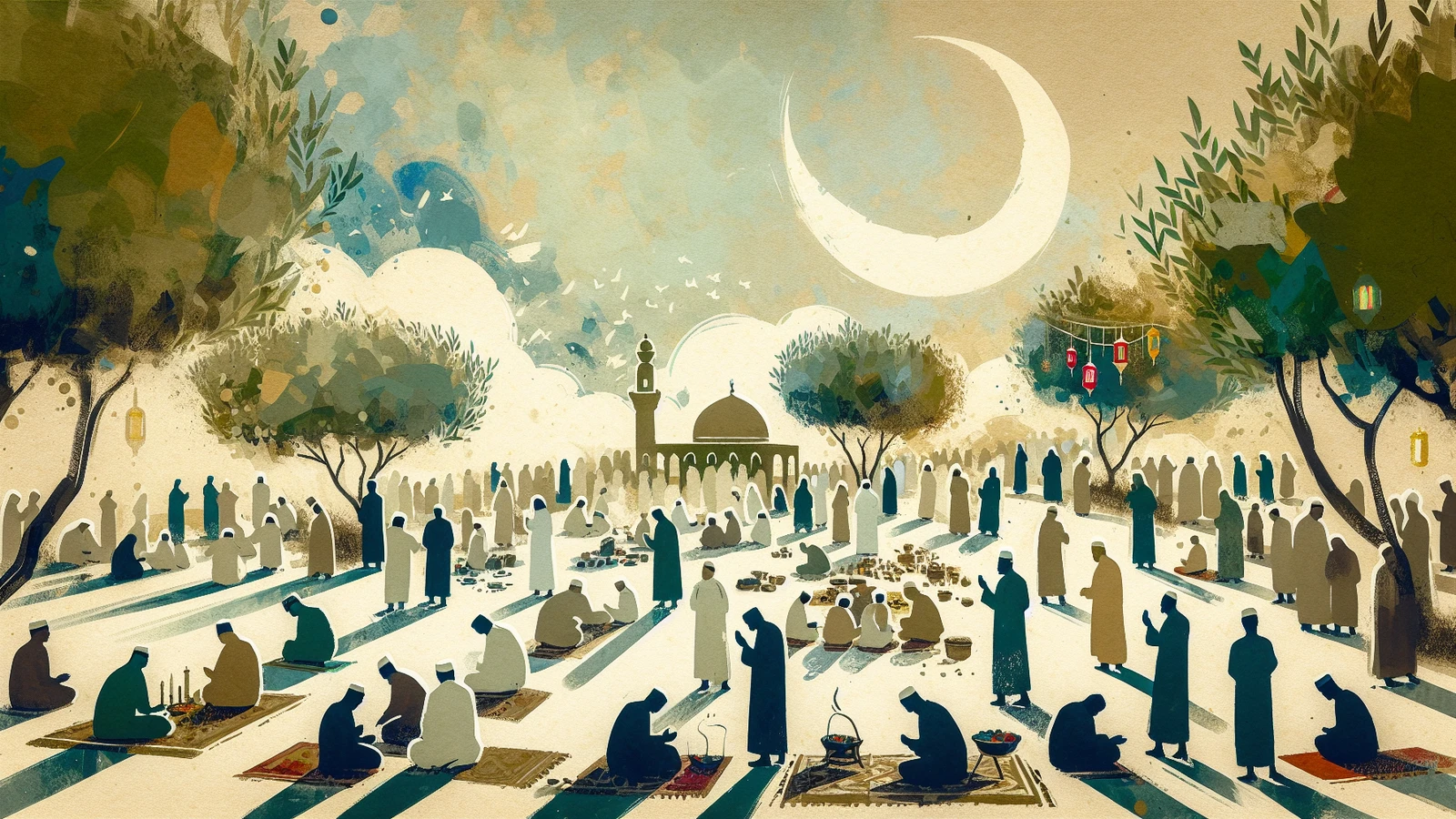
Celebrate Eid al-Fitr with authentic traditions, meaningful prayers, and joyful customs. Learn the spiritual significance of breaking the Ramadan fast.
When the human spirit discovers it can say no to the body's most basic demands, a profound awakening occurs. For thirty days, Muslims worldwide engage in this radical act of refusal—declining food when hungry, water when thirsty, comfort when desired. This profound spiritual discipline echoes across faith traditions, from Yom Kippur's transformative fast to Buddhist mindfulness practices. Then, in a single moment marked by the moon's reappearance, the no transforms into the most jubilant yes imaginable.
Eid al-Fitr is born from this transformation. This festival reveals that restraint and celebration are not opposites but partners in a sacred dance, each giving meaning to the other. Where else in human experience does voluntary hunger lead to such explosive joy? Where else does personal discipline create such collective euphoria?
This is not simply a religious holiday but a profound masterclass in the psychology and spirituality of human fulfillment. The empty stomach becomes the full heart. The disciplined soul discovers that its greatest treasure lies not in what it can withhold from itself, but in what it can give to others. Within this paradox is the genius of Eid al-Fitr: the deepest satisfaction arises not from taking, but from having first learned to abstain.
How Eid al-Fitr Transformed from Tribal Festivals to Global Unity
The origins of Eid al-Fitr trace back to the second year of the Islamic calendar, when the Prophet Muhammad established this celebration in Medina. Prior to Islam, the Arabian Peninsula observed a variety of tribal festivals that often celebrated seasonal cycles or tribal victories. The Prophet's institution of Eid al-Fitr redefined the festival as a distinctly Islamic observance, uniting the growing Muslim community around shared spiritual values and collective gratitude.
The timing of Eid al-Fitr follows the lunar calendar, specifically the sighting of the new crescent moon that marks the start of Shawwal, the month following Ramadan. This lunar dependency creates a natural rhythm connecting Muslim communities to celestial cycles that have guided human civilizations for millennia. Such cosmic timing resonates with ancient celebrations like Chinese New Year, which similarly follows celestial rhythms. The moon-sighting tradition also fosters communal participation, with communities gathering to witness this astronomical event together.
This establishment was revolutionary, emphasizing spiritual achievement over material display. Unlike pre-Islamic festivals, which often glorified earthly power or harvest abundance, Eid al-Fitr honors the soul’s conquest over worldly desires. The Qur’an affirms this spiritual triumph:
“And for those who fear God, He (ever) prepares A way out,” — Qur'an 65:2

This profound philosophical foundation continues to distinguish Islamic celebrations from mere cultural or materialistic observances.
Why Muslims Give Before They Feast: The Revolutionary Wisdom of Zakat
Fasting during Ramadan is divinely ordained in the Qur’an:
“O ye who believe! Fasting is prescribed to you As it was prescribed To those before you, That ye may (learn) Self-restraint” — Qur'an 2:183

This month-long devotion culminates in Eid al-Fitr, a festival grounded in both divine injunction and Prophetic example.
The Prophet Muhammad established Eid al-Fitr as a day of communal gathering and thanksgiving. Prior to the Eid prayer, Muslims are instructed to give zakat al-fitr — a specific form of charity purifying the fast and ensuring the poor's participation in the celebration. This emphasis on charitable giving resonates with Guru Nanak's revolutionary teachings on service and community care. As narrated in Sahih Bukhari, “The Prophet enjoined the payment of one sa' of dates or one sa' of barley as Zakat al-Fitr on every Muslim, young and old, free and slave, male and female.” This charitable obligation, equivalent to approximately 2.5 kilograms of staple food or its monetary value, serves multiple spiritual and social purposes: it purifies the fasting individual from any lapses during Ramadan, secures inclusivity for the marginalized, and embodies the Islamic principle that personal piety must be inseparable from social responsibility. The Qur'an reiterates:
“If any one does A righteous deed, It enures to the benefit Of his own soul;” — Qur'an 45:15

Thus, Eid begins not with feasting but with giving — a powerful affirmation that spiritual joy is incomplete without communal care. This ritual transforms Eid into a collective celebration of shared humanity and mutual care.
From Empty Stomachs to Full Hearts: The 30-Day Journey to Joy

The transition from Ramadan's rigorous fasting to Eid's joyous festivity exemplifies Islam's delicate balance between spiritual discipline and human joy. During Ramadan, Muslims abstain from food, drink, and intimate relations from dawn until sunset, while intensifying prayer, Qur'anic recitation, and charitable acts.
This month-long spiritual training cultivates self-discipline, empathy for the less fortunate, and heightened awareness of God’s presence in everyday life. The physical hunger experienced becomes a metaphor for the soul’s yearning for divine connection, while the shared evening meals with family and community deepen social bonds. As the Qur’an teaches:
“Who gives me food and drink” — Qur’an 26:79*

The final ten nights of Ramadan hold special sanctity, especially Laylat al-Qadr (the Night of Power), when Muslims believe the first Qur’anic revelation was received. Many devote these nights to intensive prayer and reflection, seeking divine mercy and guidance. The Qur’an describes this night’s immense spiritual significance:
“The Night of Power Is better than A thousand Months” — Qur’an 97:3*

This spiritual crescendo imbues the arrival of Eid al-Fitr with profound meaning and heartfelt gratitude.
Dawn Gatherings That Unite Millions: The Power of Eid Prayer
The centerpiece of Eid al-Fitr is the congregational prayer held in mosques, open fields, or community centers. Men, women, and children gather at dawn, adorned in their finest garments, to praise God through takbir (glorification), prayer, and supplication.
The Eid prayer consists of two rak’ahs (units of prayer) and is accompanied by a khutbah (sermon). It differs from regular prayers by including additional takbir — the phrase “Allahu Akbar” (God is Greatest) — creating a communal, rhythmic declaration of faith reverberating through the gathering.
The Qur’an commands:
“So establish regular Prayer, Give regular Charity, And hold fast to God!” — Qur’an 22:78*

This gathering fortifies bonds of faith and kinship, transcending social and ethnic boundaries. The powerful image of thousands standing shoulder to shoulder in prayer vividly embodies Islamic egalitarianism. The collective power of these healing prayers creates a profound sense of spiritual unity transcending individual concerns.
Following the prayer, families exchange the greeting “Eid Mubarak” — meaning “Blessed Eid” — and embrace with renewed love and goodwill. Children often receive gifts or Eidi (small monetary gifts), and elders are honored with respect. This intergenerational exchange reinforces family unity and ensures that the joy of Eid permeates all ages.

From Turkish Baklava to Indonesian Ketupat: How Every Culture Makes Eid Special
While the spiritual core of Eid al-Fitr is universal, its cultural expressions reflect the rich diversity of the global Muslim community, demonstrating Islam’s remarkable adaptability alongside its unwavering spiritual message.
In Turkey, families share baklava and wear heirloom garments. The bayram tradition includes visiting elders, kissing their hands in respect, and receiving blessings. Homes are adorned with crescents and stars, while rose-flavored sweets are prepared weeks in advance.
In Senegal, the festival known as Korité features vibrant dance, colorful attire, and feasting on lamb and rice. Community solidarity is paramount, with entire neighborhoods preparing together. Women wear ornate boubous, and men don their finest agbadas. Celebrations can last for days, including open-air festivals.
In Indonesia—the world’s largest Muslim-majority country—the mudik homecoming tradition brings millions to ancestral villages. Streets fill with joyful processions, homes are decorated with lights and crescents, and ketupat (rice cakes wrapped in woven palm leaves) become the meal centerpiece. The artistry of ketupat weaving is passed through generations.
In Arab countries, maamoul cookies filled with dates or nuts and sweets like qatayef and knafeh grace tables. Their preparation is a family affair, preserving recipes through time.
In Western countries, Muslim communities often host open houses, inviting people of other faiths to join celebrations. These interfaith gatherings foster understanding and friendship across religious boundaries, embodying the spirit of interfaith understanding and dialogue.
Why Restraint Creates Joy: The Profound Psychology of Eid al-Fitr
Beyond festivity, Eid al-Fitr embodies profound spiritual truths. It affirms the human capacity for self-restraint, empathy, and transformation. By abstaining during Ramadan, Muslims cultivate taqwa — God-consciousness — which endures beyond the fasting month.
Taqwa transcends rule-following, representing an elevated awareness of moral and spiritual duties. It manifests in generosity, character refinement, and compassion. The Qur’an teaches:
“And if Any one puts his trust In God, sufficient is (God) For him. For God will Surely accomplish His purpose:” — Qur’an 65:3*

Eid honors not only the fast’s completion but the spiritual growth it fosters.
The Qur’an reminds believers:
“Verily The most honoured of you In the sight of God Is (he who is) the most Righteous of you.” — Qur’an 49:13*

Eid is thus a celebration of moral achievement, highlighting that worship draws believers closer to worldly care and service.
Serving as a communal reset, the festival renews commitments to faith, family, and social responsibility. The joy of Eid coexists with the recognition that Ramadan’s spiritual disciplines should continue shaping everyday life. As the Qur’an affirms:
“If any do deeds Of righteousness, Be they male or female — And have faith, They will enter Heaven,” — Qur’an 4:124*

How Modern Muslims Navigate Moon-Sighting in the Digital Age
In a globalized world, Eid al-Fitr faces both challenges and opportunities. Muslim minorities in non-Muslim societies often navigate maintaining tradition while adapting to different cultural contexts. The lunar calendar’s reliance on moon-sighting sometimes complicates work and school scheduling in solar calendar societies.
These challenges have inspired innovation. Online platforms connect Muslims globally for virtual Eid celebrations, bridging distances. The COVID-19 pandemic particularly tested this adaptability, as communities embraced virtual prayers, socially distanced greetings, and other creative measures, demonstrating the resilience of Islamic communal bonds.

What Eid al-Fitr Teaches About Human Connection Across Boundaries
In an age often marked by division, Eid al-Fitr offers a rare moment of spiritual and communal alignment. Millions bow in prayer, give charity, and share joyous meals worldwide. The diversity of expression enriches rather than diminishes the unity of purpose: to thank God, honor community, and renew the inner light guiding human hearts toward peace.
For those outside Islam, Eid al-Fitr opens a window into a tradition rich with spiritual meaning and humanity. It invites reflection on the universal values of discipline, generosity, and community. The Qur’an articulates this universality:
“O mankind! We created You from a single (pair) Of a male and a female, And made you into Nations and tribes, that Ye may know each other” — Qur’an 49:13*

When the crescent moon appears and the call to celebration echoes across minarets and homes, Eid transcends a mere cultural event. It becomes a sacred testimony to resilience, remembrance, and the hope for a better world. Muslims worldwide, in celebrating Eid al-Fitr, affirm their commitment to spiritual excellence and social harmony, offering a timeless model that nourishes both soul and society.
Other Perspectives
Explore other profound fasting traditions that transform spiritual practice, discover how lunar celebrations create spiritual renewal across cultures, and learn how prayer practices bring comfort and unity across diverse faith traditions.
The Scribe
Elly Marimbocho is a seasoned writer with a background in Religious Studies and over a decade of experience producing long-form educational content on theology, interfaith spirituality, and world religions. Passionate about the contemplative heart of faith, Elly creates in-depth, reverent, and accessible guides that help readers engage meaningfully with religious wisdom across traditions.
Related Articles
- Guru Nanak: The Revolutionary Saint Who Founded Sikhism - Guru Granth Sahib
- Lantern Festival: Illuminating the Path to Spiritual Enlightenment - spiritual awakening
- Intercessory Prayer: The Art of Spiritual Advocacy Across Faiths - blessing prayer
- Ocean Library: An Adventure Through Sacred Texts with Immersive Audio Technology - Bible verses