Nine Faces of the Mother: How a Billion People Find God in the Feminine
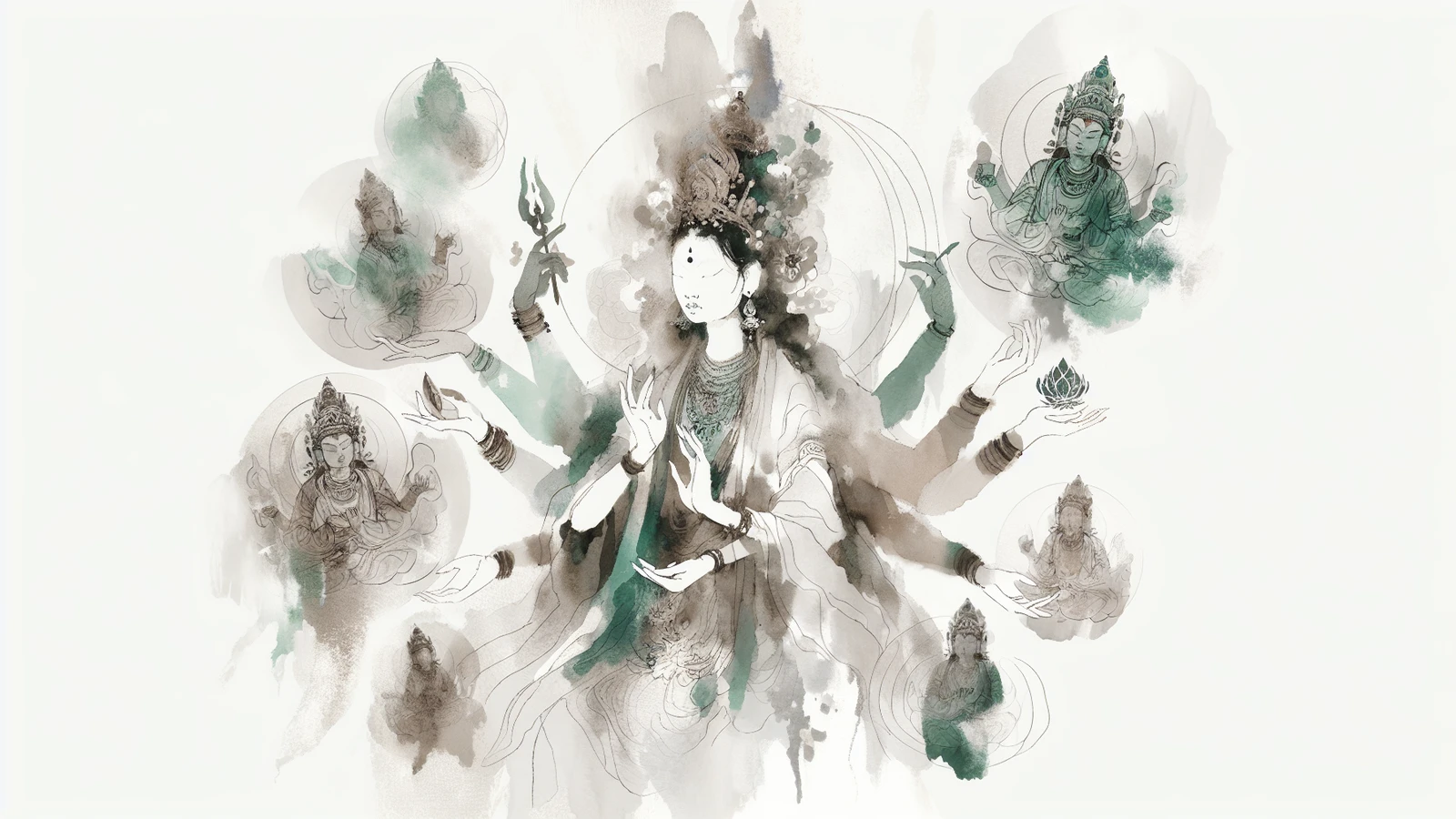
Discover how Navaratri's nine sacred nights reveal divine feminine power through Durga's cosmic dance, ancient mantras, and sacred feasts across Hindu tradit...
Picture a mother's face when her child is threatened—fierce as lightning, tender as prayer, unstoppable as love itself.
Now imagine that same expression magnified across the cosmos, wielded by hands that shape galaxies and hearts that hold every tear ever shed. In kitchens across India, grandmothers light clay lamps while whispering her names. In Hindu households worldwide, this divine maternal energy pulses through daily life. In temple courtyards, children learn her dances before they can properly walk. In the secret chambers of the heart, a billion people turn to her when the world grows too dark, too cruel, too overwhelming.
This is Durga—the Mother who refuses to let evil have the last word.
What Makes the Divine Mother Unstoppable

While other traditions honor sacred women—Mary's intercession in Christianity, Fatima's wisdom in Islam, Tara's compassion in Buddhism—none claim the full thunderous authority of godhood itself. But Durga? She stands as Creator and Destroyer, Nurturer and Warrior, the Mother who births universes and the fierce protector who guards them. She is what happens when divine love meets divine power in feminine form.
And for nine nights each year, the world stops to remember why mothers—earthly and cosmic—are forces no darkness can defeat.
The Mother Who Commands the Universe
“O mother of Skanda, O thou that possessest the six (highest) attributes, O Durga, O thou that dwellest in accessible regions, thou art described as Swaha, and Swadha, as Kala, as Kashta, and as Saraswati, as Savitra — the mother of the Vedas, and as the science of Vedanta… Thou always defeatest the Danavas.” — Mahābhārata, Vyāsa, The Mahabharata 6, 23.4
Listen to how ancient voices describe Durga, and you'll hear something that makes kitchen conversations with neighborhood moms suddenly seem cosmic. She receives Swaha and Swadha—the sacred offerings that only true deities can accept. She masters time itself (Kala), dwelling in places no mortal can reach. She is the science behind every sacred text, the mother of wisdom itself.
This isn't a gentle grandmother figure relegated to blessing recipes and tending gardens. This is the Mother who authors reality, the feminine face of power so complete that she defeats demons while nurturing creation. She represents what every mother knows in her bones—that true love sometimes requires fierce protection, that nurturing and fighting are not opposites but two sides of the same sacred coin, embodying the universal call to holiness found in ordinary mothers everywhere.
“Thou art the unconsciousness, the sleep, the illusion, the modesty, the beauty of (all creatures). Thou art the twilight, thou art the day, thou art Savitri, and thou art the mother. Thou art contentment, thou art growth, thou art.” — Vyāsa, The Mahabharata 6, 23.4
She is everything—the quiet moments and the dramatic ones, the gentle twilight that soothes children to sleep and the blazing day that powers life itself. Like any mother worth her salt, she contains multitudes, reflecting the sacred symbols that speak across cultural boundaries.
Related Articles
- The Democracy of Holiness: Why Catholics Believe Your Grandmother Might Be a Saint - Divine presence in ordinary mothers
- Sacred Symbols: Universal Language of Spirituality - Cross-cultural divine imagery
- Ten Heads We Carry: Dussehra Victory Good Over Evil - Divine feminine triumph over darkness
Nine Sacred Faces, Nine Sacred Lessons

The Devi Mahatmya reveals Durga's nine manifestations during her legendary battle with the demon Mahishasura. But these aren't just ancient stories—they're a recipe for spiritual courage that mothers have been passing down for centuries, teaching their children how to face life's battles with grace and strength.
1. Shailaputri: The Spark That Starts Everything
Picture the moment when a mother first holds her newborn—that instant when fierce protective love ignites. Shailaputri rides a bull, carries a trident and lotus, marking the beginning of Durga's campaign against evil. She teaches us that every great victory begins with a single spark of courage, as simple as a mother deciding nothing will harm her child.
2. Brahmacharini: Wisdom That Feeds the Soul
With rosary and water pot in hand, this face of Durga embodies the mother who stays up all night researching her child's illness, who learns new languages to help with homework, who acquires whatever knowledge is needed to protect and nurture. Wisdom isn't just about books—it's about the relentless learning that love demands.
3. Chandraghanta: Armed and Ready
Ten arms, weapons gleaming, astride a tiger—this is the mother-bear defending her cubs. But notice the beauty in her ferocity. True maternal strength isn't about rage; it's about the calculated power that knows exactly how much force is needed and never uses more than necessary.
4. Kushmanda: The Cosmic Kitchen
Eight arms holding weapons and rosary, riding a lion—this is Durga as the cosmic source of all energy. Like the mother whose kitchen somehow feeds everyone who walks through the door, Kushmanda creates abundance from seeming emptiness. She reminds us that the most profound creation often happens in the most ordinary spaces.
5. Skandamata: Joy in Protection
Four arms cradling baby Skanda while riding a lion—here's the divine truth every parent knows. Even in the midst of cosmic battles, the child comes first. Skandamata brings joy to devotees because she models what perfect protection looks like: fierce toward threats, infinitely tender toward the beloved.
6. Katyayani: Courage That Cuts Through
Sword and lotus in hand, lion beneath her—this is the mother who cuts through every excuse, every obstacle, every voice that says her child can't succeed. Her courage isn't reckless; it's surgical, precise, unstoppable as sunrise.
7. Kalaratri: The Dark Night of Reckoning
Dark-complexioned and fearsome, this is Durga's face when patience ends. Every mother knows this moment—when gentleness has been exhausted and only fierce justice remains. Kalaratri teaches that sometimes love requires terrible honesty, that breaking destructive patterns often looks like destruction itself.
8. Mahagauri: Serenity After Storm
Fair and calm, riding a bull like Shailaputri but transformed by battle—this is the mother after the crisis passes. Pure and serene, holding trident and drum, she embodies the peace that comes not from avoiding conflict but from emerging victorious with integrity intact.
9. Siddhidatri: The Blessing-Giver
Four arms on lotus or lion, granting supernatural powers—this final face shows complete triumph. Like the grandmother whose very presence brings good fortune, Siddhidatri represents the moment when all battles end in blessing, when victory creates space for gifts to flow freely.
Nine Nights of Sacred Celebration

Navaratri (nava meaning nine, ratri meaning nights) isn't just a festival—it's an annual family reunion with the Divine Mother, complete with all the elements that make family gatherings unforgettable: dancing until your feet hurt, food that tastes like love, and stories that bind generations together.
In Gujarat and West Bengal, the celebration reaches peak intensity, spreading through Tamil Nadu, Maharashtra, Karnataka, Himachal Pradesh, Kerala, and Rajasthan like the aroma of festival sweets wafting through neighborhood streets.
Dancing as Prayer
The Garba (garbha meaning womb) dance centers around a clay pot holding a flickering candle—representing the divine womb, the source of all life. Women circle this sacred flame like planets around the sun, their movements weaving stories older than memory. Watch children join their mothers and grandmothers in these circles, and you'll see how wisdom transfers through rhythm and joy.
Dandiya Raas (dandiya meaning sticks, raas meaning dance) brings playful drama as dancers with decorated wooden sticks (dandiyas) reenact Durga's battle with Mahishasura. Two by two, they clash and circle, their choreographed combat celebrating the ultimate victory of good over evil. When little ones join with their tiny sticks, trying to match their elders' movements, the battlefield becomes a playground where even ancient cosmic wars turn into family fun.
“Mantra is the sound-body of the Divine, a bridge to transcend the mind and awaken the spirit.”
Each of the nine nights carries its own mantra and aarti—sacred songs that connect directly with each face of Durga. These aren't just religious formalities; they're family traditions passed down through kitchen conversations and bedtime stories, prayers learned at grandmother's knee while helping prepare festival meals.
Sacred Feasting and Fasting

Navaratri transforms ordinary kitchens into temples, where every meal becomes an offering. The traditional guidelines create space for both discipline and celebration—like any good family gathering, there are rules that somehow make the feast more meaningful.
What Nourishes the Soul
During these nine sacred days, families avoid grains, meat, eggs, onions, and garlic. But this isn't about deprivation—it's about refinement, like preparing a special meal that brings out subtle flavors usually overwhelmed by stronger ingredients.
Instead, Navaratri tables overflow with:
- Fresh fruits and vegetables that taste like sunshine stored up for sharing
- Millets that prove simple grains can satisfy like comfort food
- Pumpkin and bottle gourd transformed into dishes that make children forget they're eating vegetables
- Rich proteins and probiotics that nourish body and spirit together
Smart grandmothers know the secret: festival food restrictions don't limit creativity—they unlock it. Watch any Navaratri cook work with these ingredients, and you'll see culinary magic that proves the best limitations are the ones that push you toward unexpected discoveries.
Universal Kitchen, Universal Mother
Here's what makes Durga's story extraordinary: it translates perfectly into every culture's understanding of maternal love. You don't need to speak Sanskrit or know ancient texts to recognize the fierce protectiveness of a mother defending her children.
Sharing Tables, Sharing Stories
Navaratri welcomes everyone to the feast. Non-believers can join the dances, share the meals, learn the stories. Like any good mother, Durga makes room at her table for whoever needs feeding.
During Ramadan, Muslim families break fasts with suhoor and iftar meals that carry the same spirit of sacred sharing. The iftar table that welcomes neighbors regardless of faith echoes the Navaratri kitchen that feeds everyone who enters hungry.
Patterns That Echo Across Traditions
Christianity's Easter story mirrors Durga's journey from darkness to light. Kalaratri's darkness—like the earthquake and eclipse during Christ's crucifixion—gives way to Mahagauri's radiant peace, resembling resurrection's triumph over death. Both traditions understand that the deepest love sometimes requires passing through darkness to reach dawn.
Siddhidatri's final blessing-giving reflects Christ's ascension—the moment when victory transforms into gifts freely given, when the battle ends and the real work of blessing begins.
“Blessed be the God and Father of our Lord Jesus Christ, who hath blessed us with all spiritual blessings in heavenly places in Christ:” — Bible, Ephesians 1:3
Judaism's Sabbath carries the same understanding—that after creation's work comes the blessing of rest, the divine gift of peace. Like Siddhidatri granting supernatural powers, the Sabbath offers gifts that can't be earned, only received with gratitude.
“If thou turn away thy foot because of the sabbath, from pursuing thy business on My holy day; and call the sabbath a delight, and the holy of the LORD honourable; and shalt honour it… Then shalt thou delight thyself in the LORD” — The Tanakh, Yisheyah (Book of Isaiah) 58:13
The Mother's Final Wisdom
Finding God in feminine form isn't just about adding diversity to divine imagery—it's about recognizing the cosmic truth that every human mother reflects: love powerful enough to create life is fierce enough to defend it. For those exploring the divine feminine across traditions, prayer beads across world religions often connect devotees to feminine aspects of the divine.
Durga's nine faces offer a complete recipe for spiritual courage:
- Beginning with small sparks of determination
- Wisdom that keeps learning whatever love requires
- Bravery that acts despite fear
- Vitality that creates abundance from emptiness
- Care that protects while nurturing
- Righteousness that cuts through confusion
- Fearlessness that faces darkness without flinching
- Purity that emerges from conflict with integrity intact
- Peace that blesses from a place of complete victory
These aren't just ancient principles—they're daily practices that any parent, any person who's ever loved someone vulnerable, can understand and apply.
In kitchens around the world, mothers continue embodying these nine faces every day. They begin each morning with determination, seek wisdom for challenges ahead, show courage in protecting their families, create abundance from limited resources, offer care that never calculates cost, stand for what's right regardless of convenience, face fears without letting children see their trembling, maintain integrity through every trial, and finally—when the day's battles end—offer blessing instead of bitterness.
This is why a billion people find God in the feminine. Not because Durga replaces other divine images, but because she completes them. She shows us that the Divine is as close as the nearest mother's love and as powerful as the force that refuses to let evil have the final word.
The Mother's face has been watching over the world all along. We're just finally learning to see her clearly.
Sacred Pathways to Divine Understanding
- Exploring World Religions - Learn how different traditions honor the divine feminine through goddess figures, feminine saints, and maternal aspects of the divine
- Understanding Kundalini - Discover the feminine energy that awakens spiritual transformation in Eastern and Western mystical traditions
- Universal Values - Understanding how maternal wisdom shapes ethics across cultures through compassionate guidance and protective love
About the Sacred Storyteller
Mercy Iburuoma weaves together the threads of humanity's spiritual traditions with the warmth of a mother sharing family recipes. Her interfaith perspective illuminates how divine feminine wisdom appears across cultures, from Hindu temples to family kitchens worldwide. She specializes in finding the sacred in everyday moments and revealing how ancient festivals like Navaratri speak to modern hearts seeking the Mother's embrace. Continue exploring divine feminine wisdom through the maternal aspects of prayer and remembrance found in traditions like the Jewish New Year celebrations with their calls to memory, and intercessory prayer's spiritual advocacy across faiths where many traditions invoke divine mothers and feminine saints as intercessors.